Core French
Grade 10 Academic, following the Ontario curriculum.
- 5 units
- 26 lessons
- 293 practice questions
- 232 flashcards
- 2 simulators
Units
Précision: Sharpening the Basics
Take the Grade 9 basics — the present tense, questions, adjectives and comparisons — and make them precise, with spelling-change verbs, savoir versus connaître, inversion, meaning-changing adjectives, adverbs and every kind of comparison.
Le passé: Telling Stories in the Past
Tell stories in the past with precision: past-participle agreement, a step-by-step method for choosing the imparfait or the passé composé, the plus-que-parfait for the past before the past, every kind of pronominal verb, and the structure of a biography or autobiography.
Future, Conditional and Subjunctive
Move beyond facts to plans, possibilities and needs: the futur simple and the conditionnel built on one shared stem, the conditionnel for politeness, advice and reported speech, real and hypothetical si clauses, the subjonctif after il faut que, and the phrases that make an opinion persuasive.
Les pronoms: Saying More with Less
Replace nouns the way fluent speakers do: object pronouns in every tense, y and en in depth, two pronouns at once, pronouns with commands, stressed and possessive pronouns, and the relative pronouns qui, que, dont and où.
La francophonie mondiale and Media Texts
Take your French around the world: the full rule set for prepositions with places, the francophonie on five continents and across Canada, register and Canada–France differences, real media texts and signs, and the complex sentences and editing habits behind polished writing.
Simulators
Simulators for every course →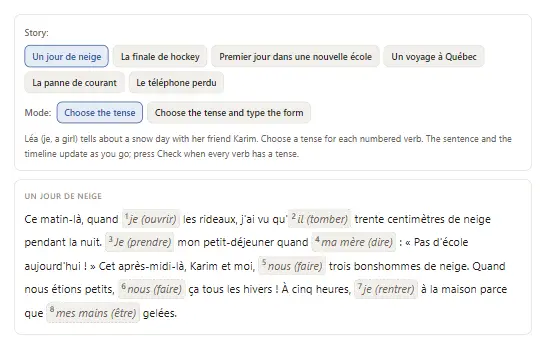
 FSF2D
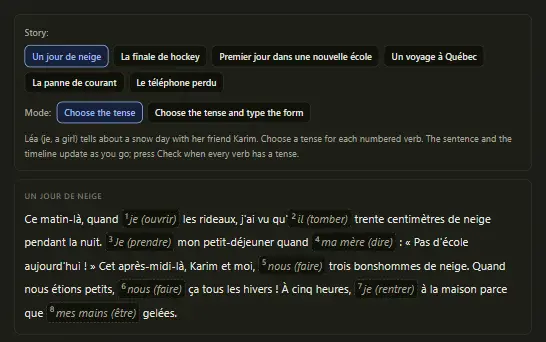
Tell a story in the past by choosing imparfait, passé composé or plus-que-parfait for each verb, and see where each one sits on the timeline.
 FSF2D
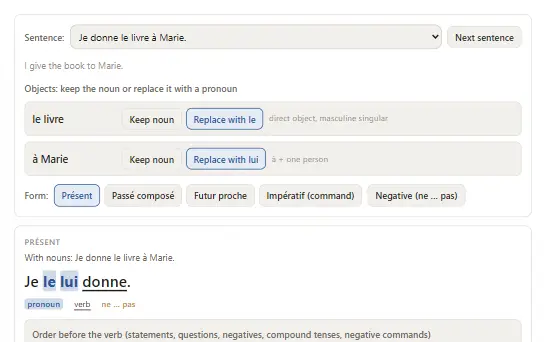
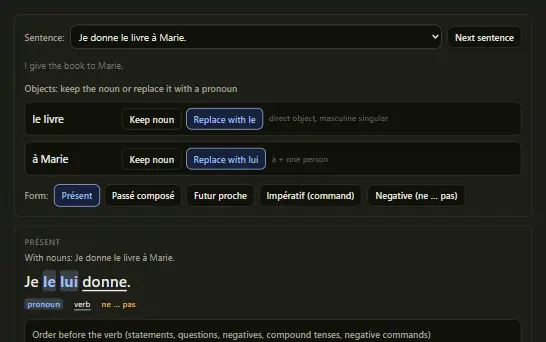
Replace the objects in a sentence with pronouns and watch them slot into the right order in statements, negatives, compound tenses and commands.