80 interactive labs
Simulators
Things that are hard to picture from a textbook are much easier once you can drag them around. Every one of these is live — change an input and the chemistry, the graph or the ledger updates with it.
Mathematics
Mathematics · MTH1W
 MTH1W
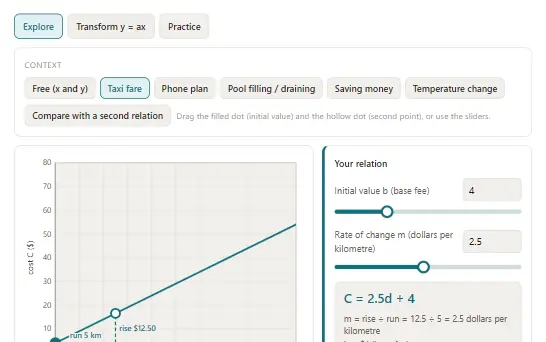
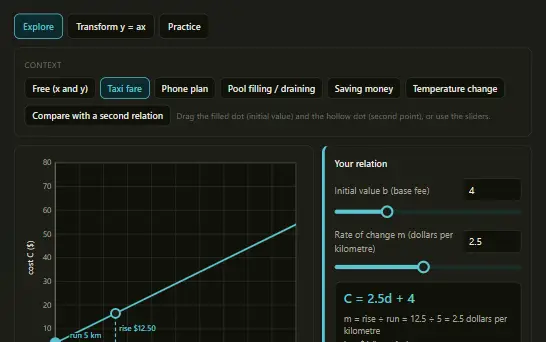
Set the initial value and rate of change in a real context and watch the story, table, graph and equation change together, then compare two options and see where and why they cross.
 MTH1W
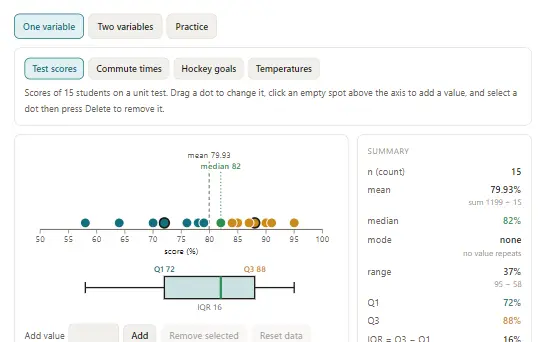
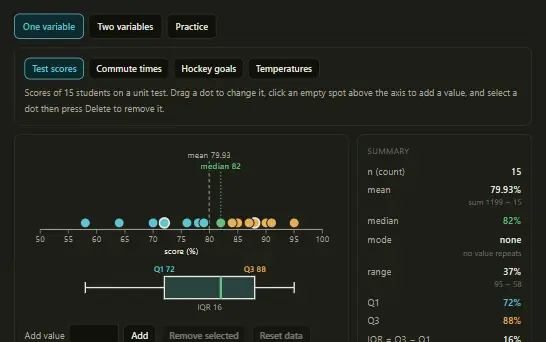
Drag values on a dot plot to watch the mean, median, quartiles and box plot respond, then fit lines and curves to scatter plots and judge correlation and predictions.
 MTH1W
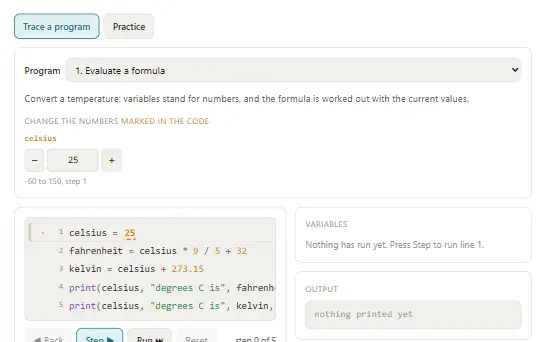
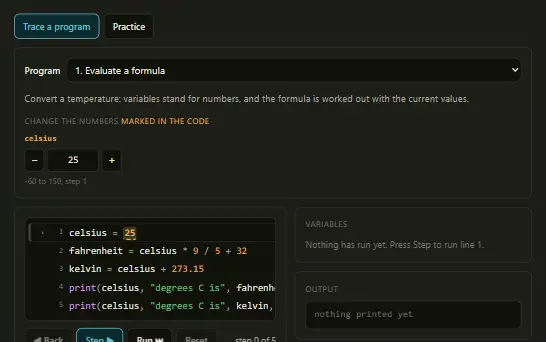
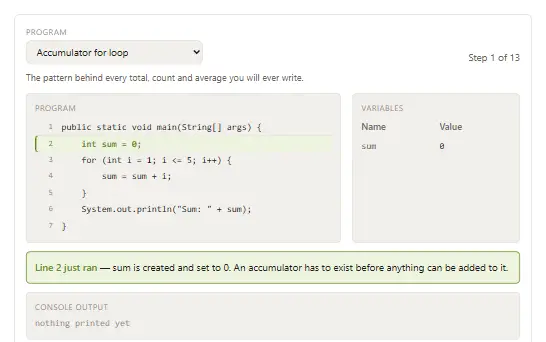
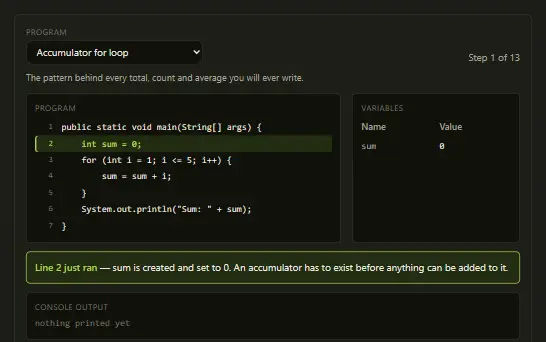
Step through short math programs one line at a time, watching each variable's value and type and the output, then change the marked numbers to model a new situation.
 MTH1W
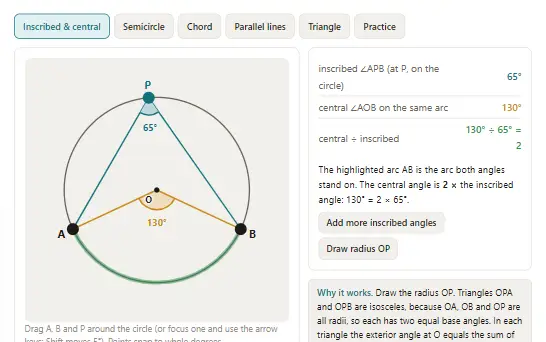
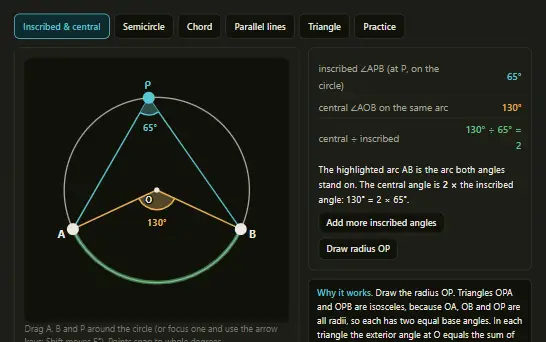
Drag points to see why inscribed and central angles, the angle in a semicircle, chord bisectors, parallel-line angle pairs and triangle properties work, with every measure taken from the diagram.
Principles of Mathematics · MPM2D
 MPM2D
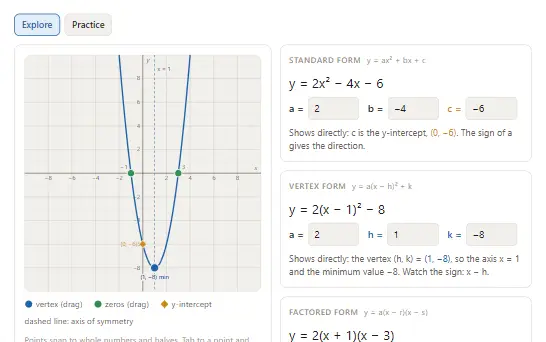
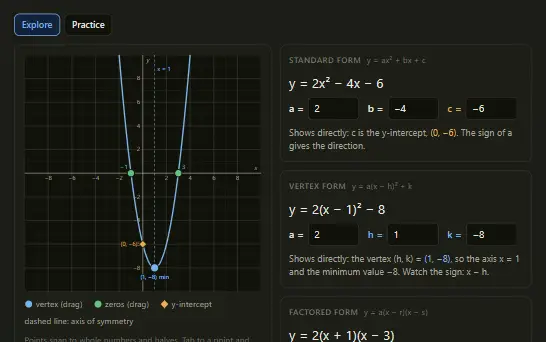
Edit standard, vertex or factored form, or drag the vertex and zeros, and watch the other two forms, the graph, the table of differences and the completing-the-square steps update together.
 MPM2D
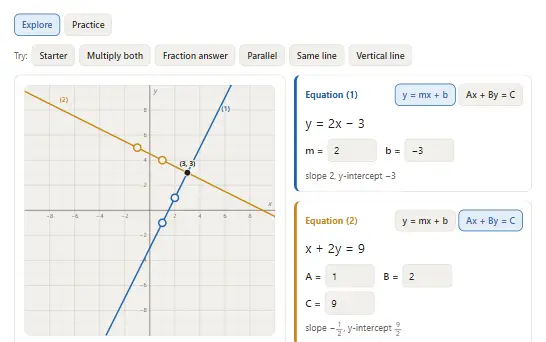
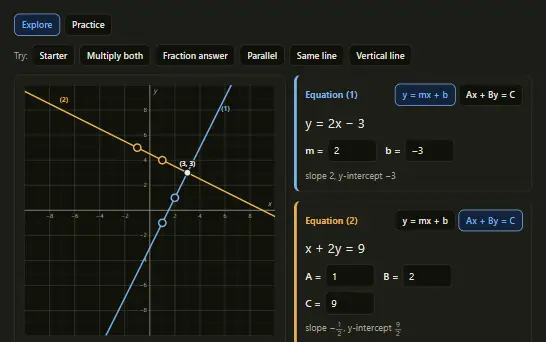
Enter or drag two lines and see graphing, substitution and elimination worked out step by step for the current coefficients, including what parallel and identical lines look like in the algebra.
 MPM2D
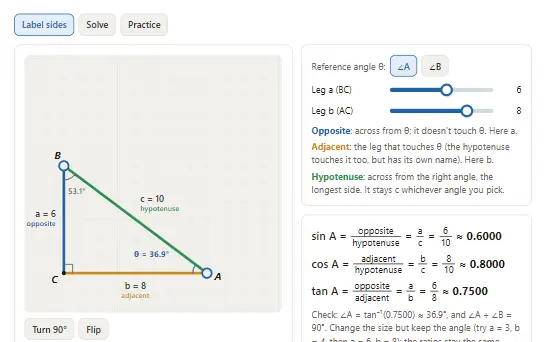
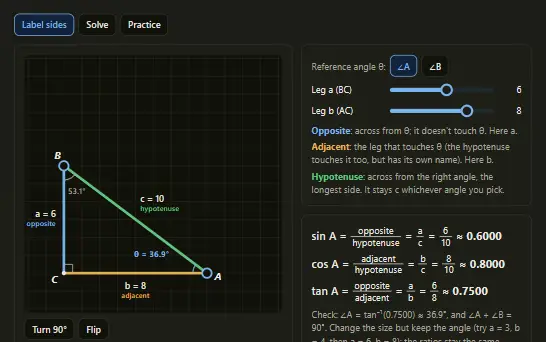
Label opposite, adjacent and hypotenuse, then solve any right or acute triangle step by step with the right tool: SOH CAH TOA, the Pythagorean theorem, or the sine or cosine law.
 MPM2D
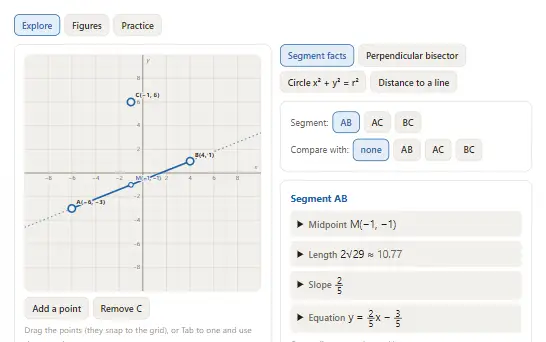
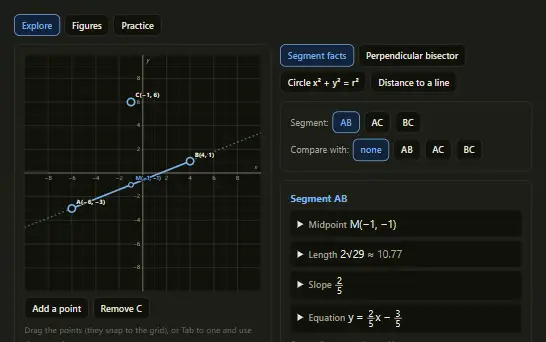
Drag points to get exact midpoints, lengths, slopes and equations, then use them to verify properties of triangles and quadrilaterals.
Functions · MCR3U
 MCR3U
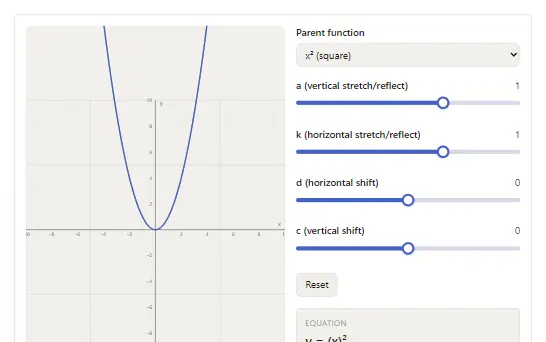
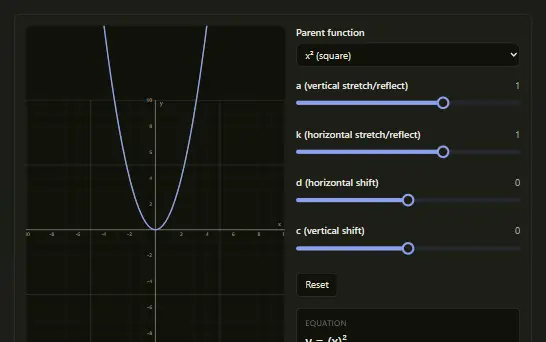
Drag a, k, d and c and watch any parent function stretch, flip and slide.
 MCR3U
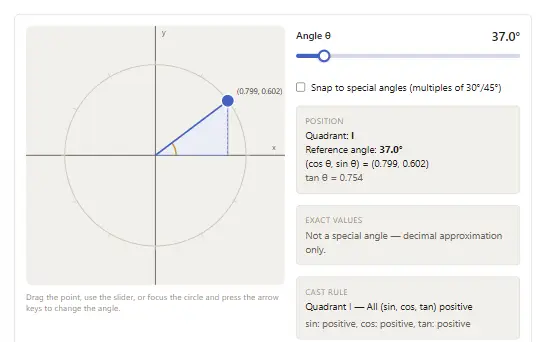
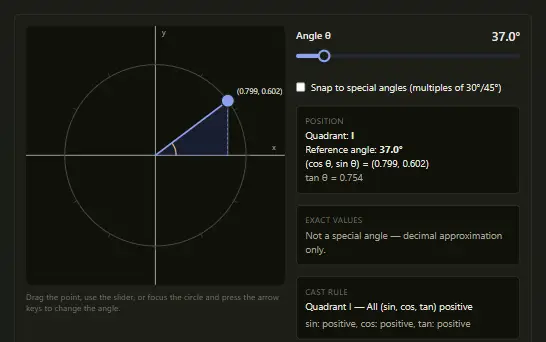
Drag the terminal arm to see exact ratios, reference angles and CAST signs.
 MCR3U
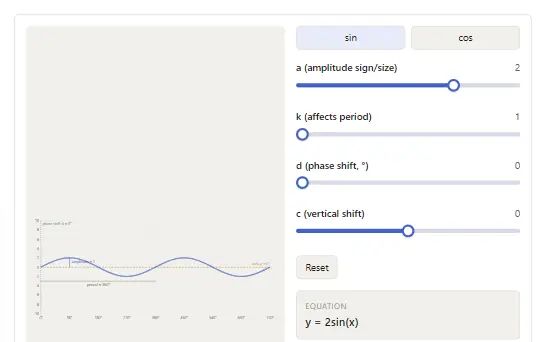
Build a sine or cosine curve, then play match-the-graph against a random target.
 MCR3U
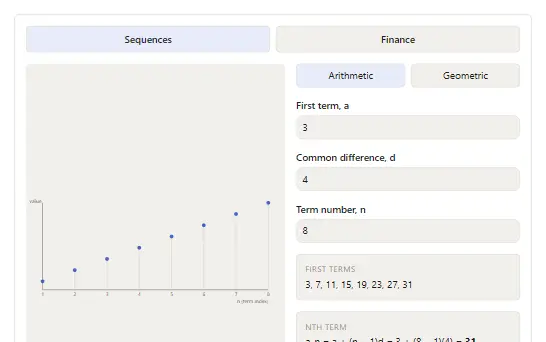
Terms, series sums, compound interest and annuities with the formulas filled in.
Calculus and Vectors · MCV4U
 MCV4U
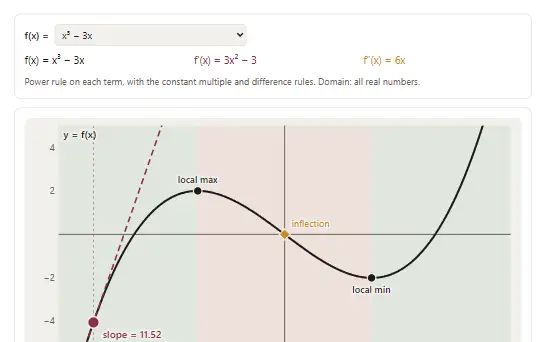
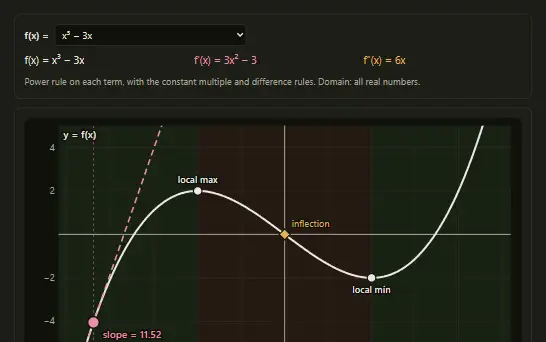
Slide a point along a function to watch its tangent slope, trace the graph of f′ point by point, and see where f′ and f″ reveal maxima, minima and inflection points.
 MCV4U
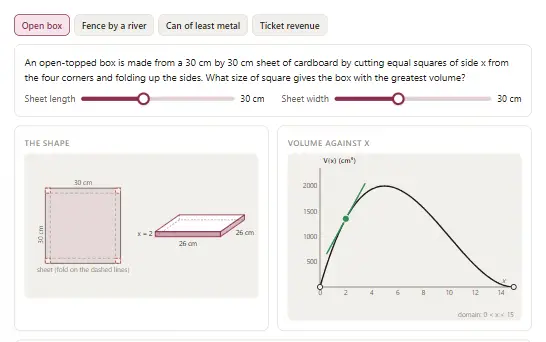
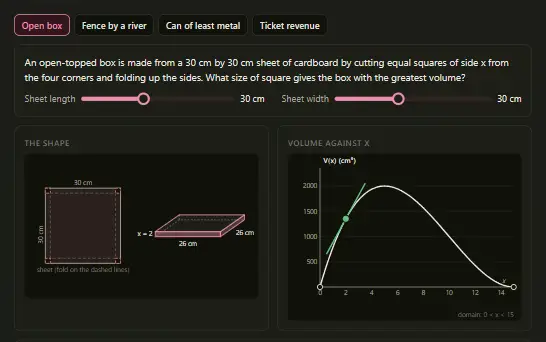
Build a box, fence a field, design a can or price a ticket, then use the derivative to find the size or price that gives the best result.
 MCV4U
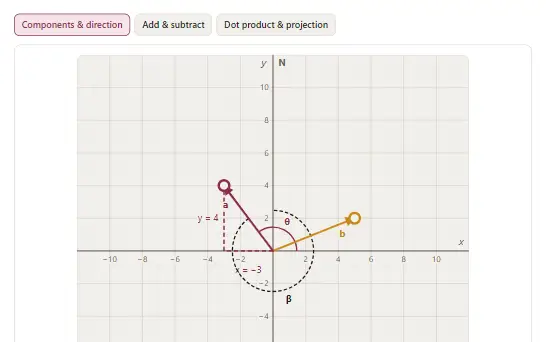
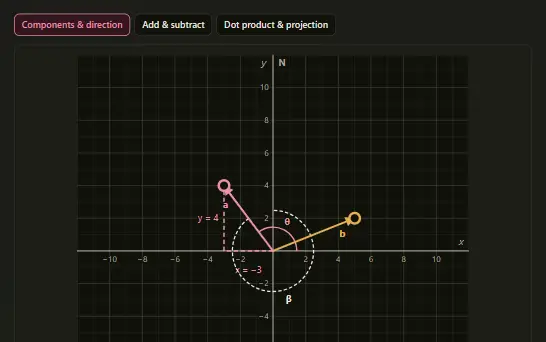
Drag two vectors to see their components, magnitude, angle and bearings, add and subtract them tip-to-tail or by parallelogram, and watch the dot product and projections change.
 MCV4U
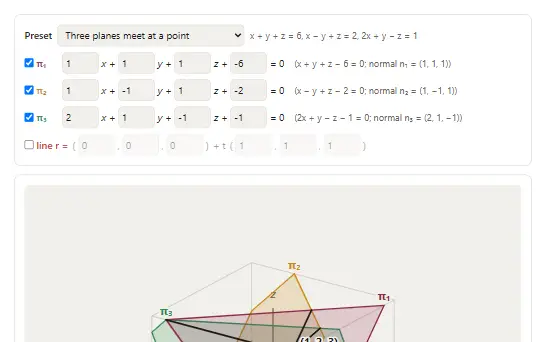
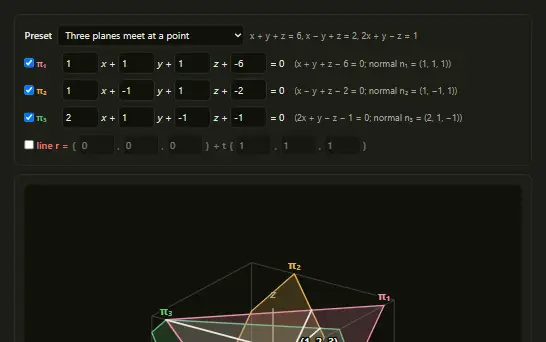
Rotate a 3-D view of up to three planes and a line from their equations to see where they meet (a point, a line, or nowhere) and solve the system step by step.
Advanced Functions · MHF4U
 MHF4U
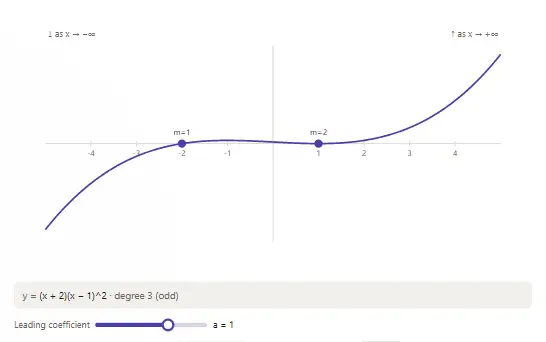
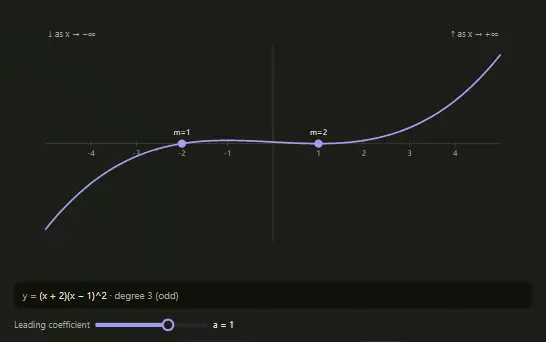
Build a polynomial from its zeros, change each multiplicity, and watch the curve cross, bounce or flatten while the end behaviour follows the degree.
 MHF4U
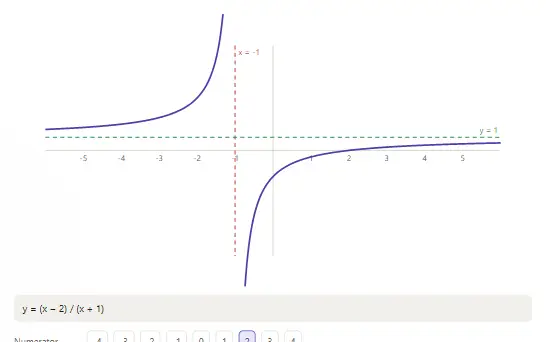
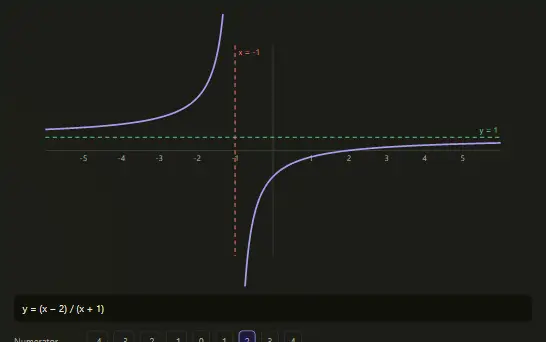
Choose numerator and denominator factors and see which ones become vertical asymptotes, which cancel into holes, and what the degrees do to the ends.
 MHF4U
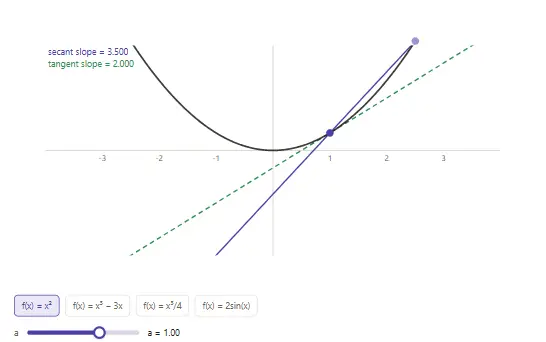
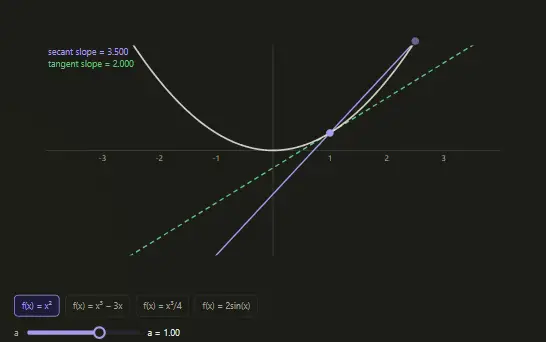
Shrink the interval h and watch the average rate of change converge on the instantaneous rate, with the difference quotient updating as you go.
Science
Biology · SBI3U
 SBI3U
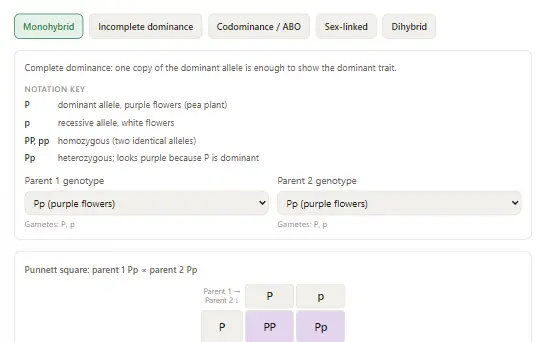
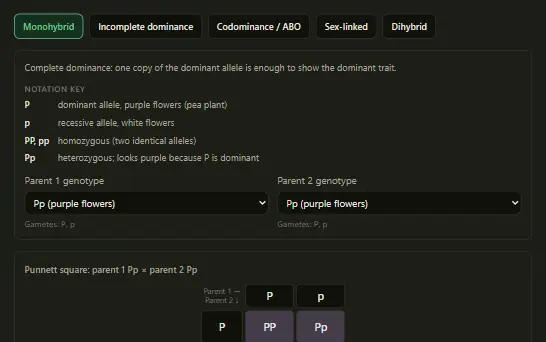
Pick each parent's genotype for simple dominance, incomplete dominance, codominance, sex-linked or dihybrid crosses, then compare the Punnett square's ratios with a random sample of offspring.
 SBI3U
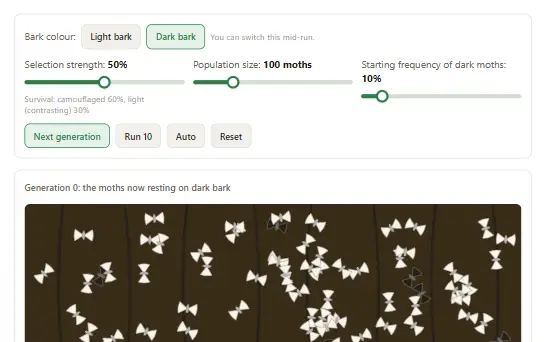
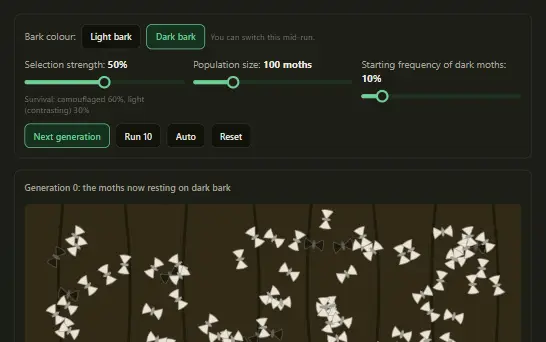
Run a population with a heritable colour trait against a background, set how strongly predators select, and watch the trait's frequency change generation by generation.
Biology · SBI4U
 SBI4U
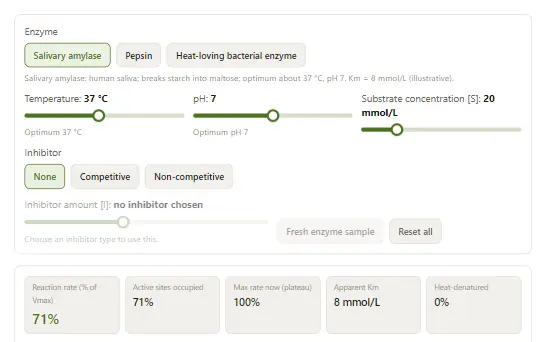
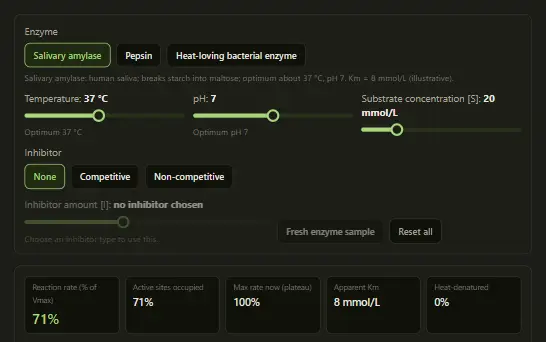
Change temperature, pH and substrate concentration, add a competitive or non-competitive inhibitor, and watch the reaction rate curve respond.
 SBI4U
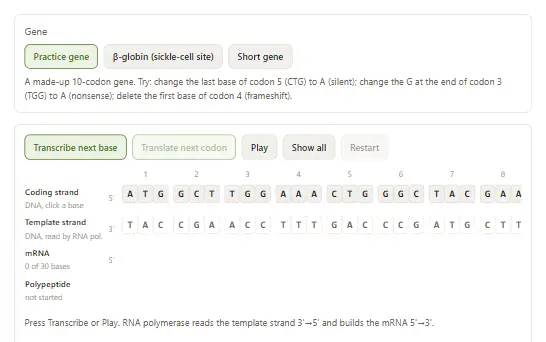
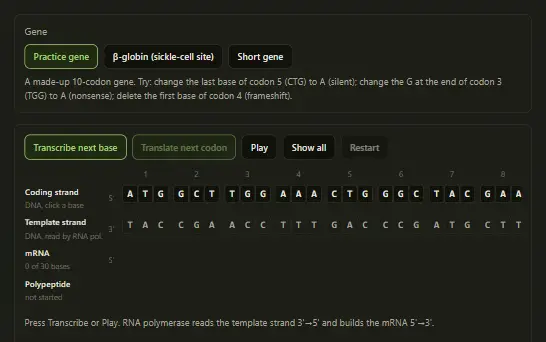
Step a DNA template through transcription and translation, then introduce point mutations and see whether they are silent, missense, nonsense or frameshift.
 SBI4U
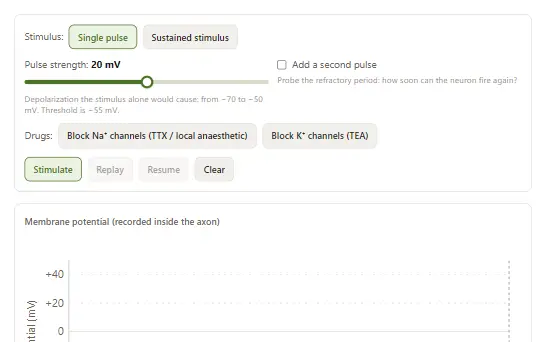
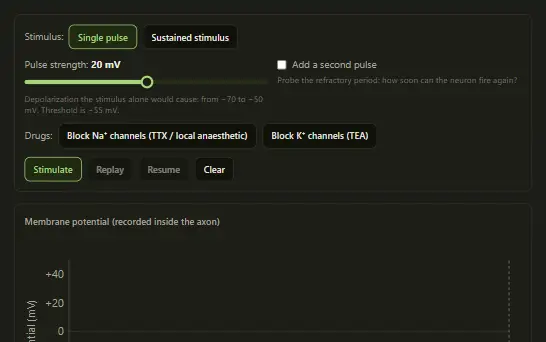
Stimulate a neuron above and below threshold, fire during the refractory period, and follow the Na+ and K+ channels behind each phase of the spike.
 SBI4U
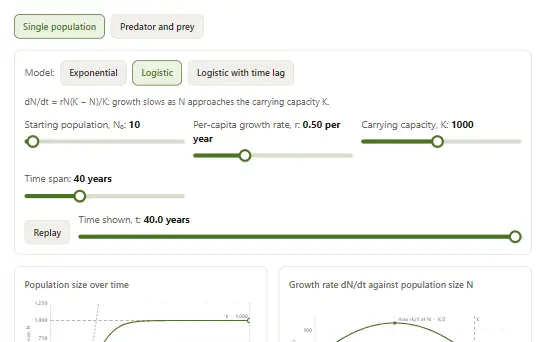
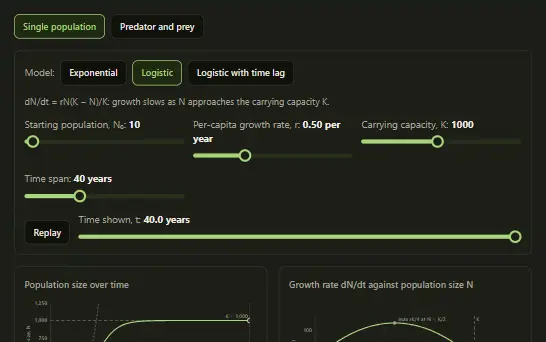
Compare exponential and logistic growth with your own r and K, then switch to predator and prey and watch their populations cycle out of phase.
Chemistry · SCH3U
 SCH3U
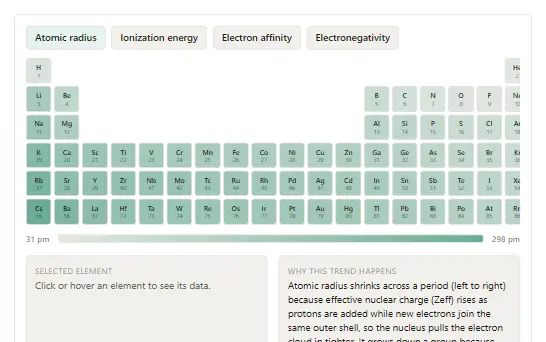
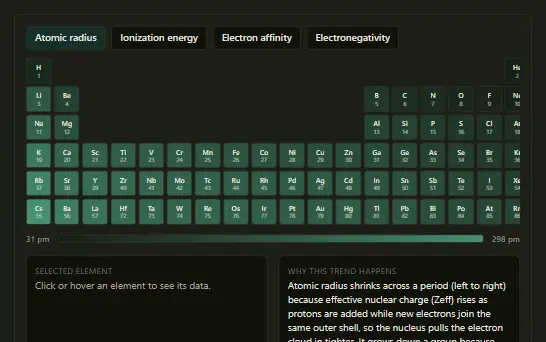
Shade the periodic table by radius, ionization energy, affinity or electronegativity.
 SCH3U
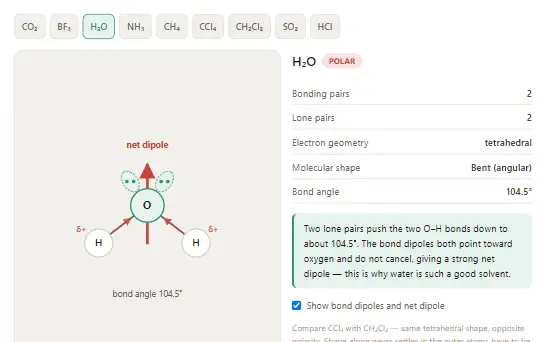
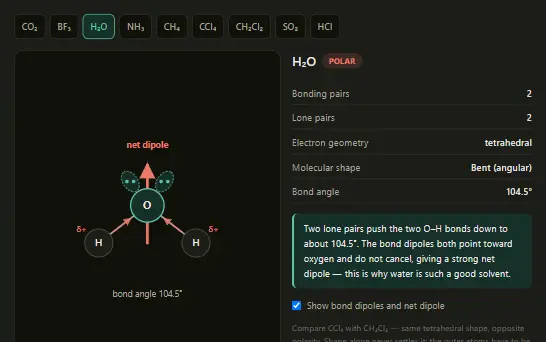
Pick a molecule to see its shape, bond angles and whether the dipoles cancel.
 SCH3U
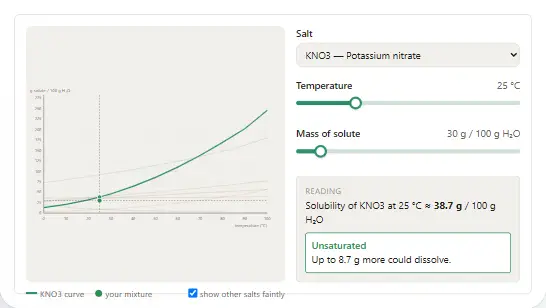
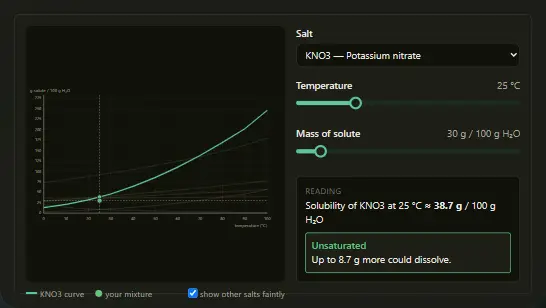
Drag temperature and mass to classify a solution as unsaturated, saturated or supersaturated.
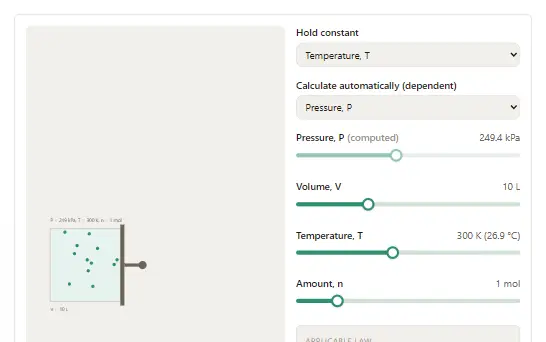
 SCH3U
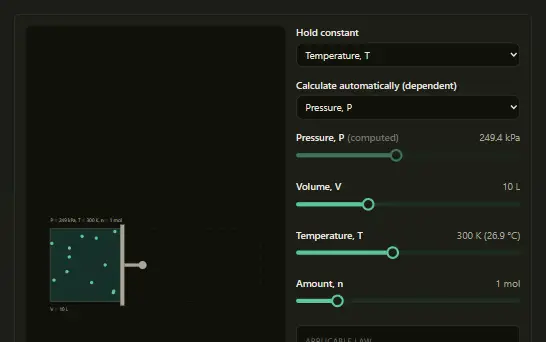
A piston obeying PV = nRT, with particles that speed up as you heat them.
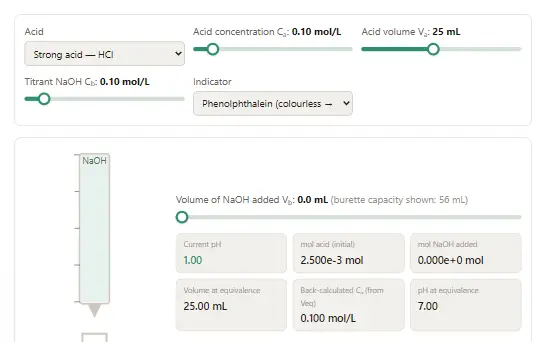
 SCH3U
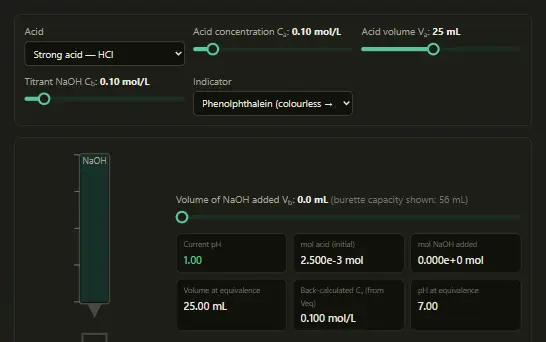
Titrate a strong or weak acid and watch the curve, the indicator and the equivalence point.
Chemistry · SCH4U
 SCH4U
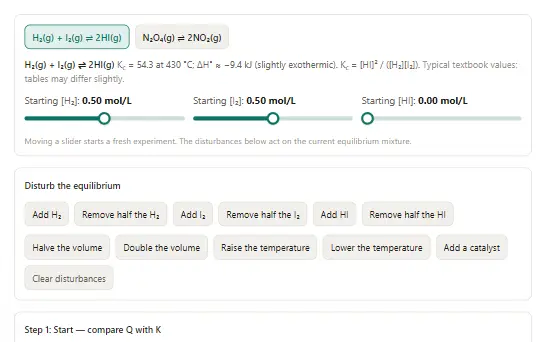
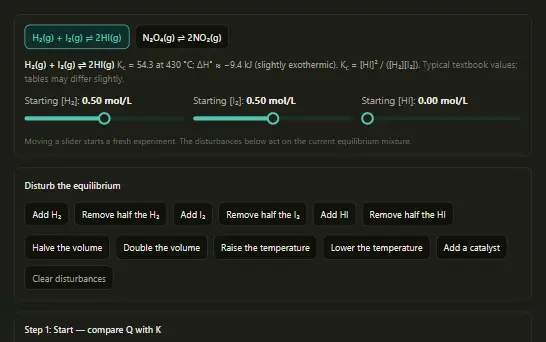
Build an ICE table, compare the reaction quotient with K, and disturb the system with concentration, pressure or temperature changes to see which way it shifts.
 SCH4U
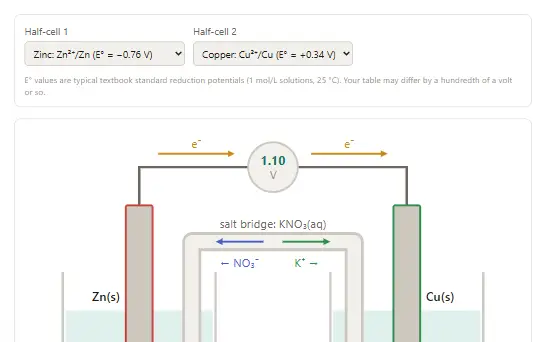
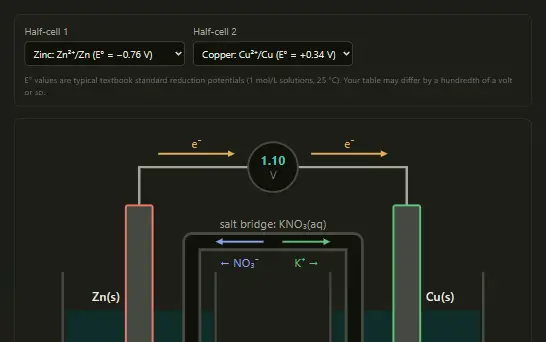
Pick two half-cells, find the anode and cathode, follow the electrons and ions, and calculate the standard cell potential.
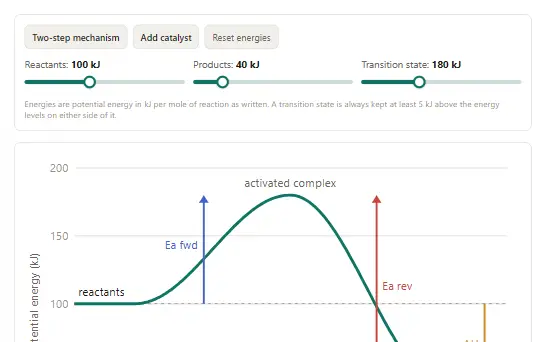
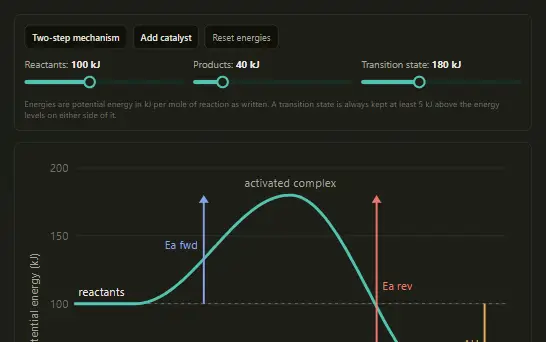 SCH4U
Set the energies of the reactants, products and transition state, add a catalyst, and read the enthalpy change and activation energy straight off the diagram.
Physics · SPH3U
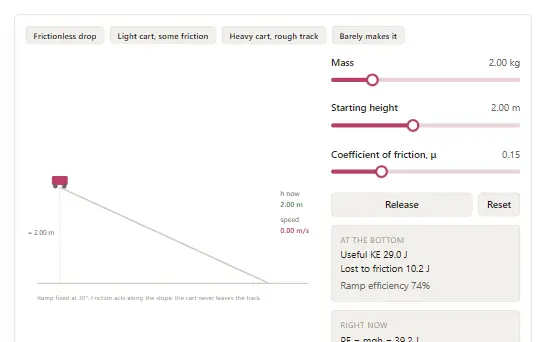
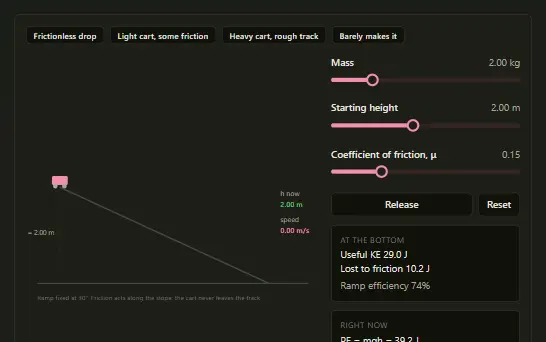 SPH3U
Release a cart down a ramp and watch kinetic, potential and thermal energy trade places while the total holds steady.
 SPH3U
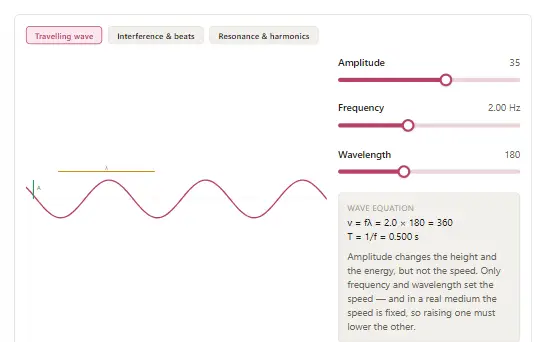
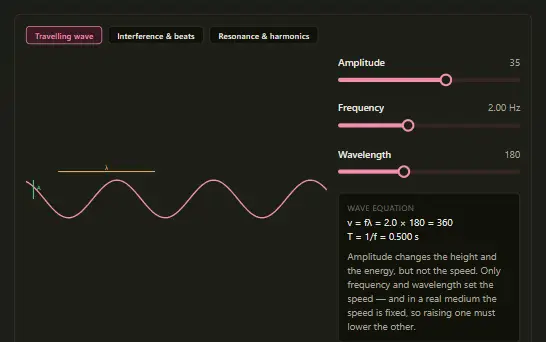
Three tabs: the wave equation, interference and beats, and standing waves in strings and pipes.
 SPH3U
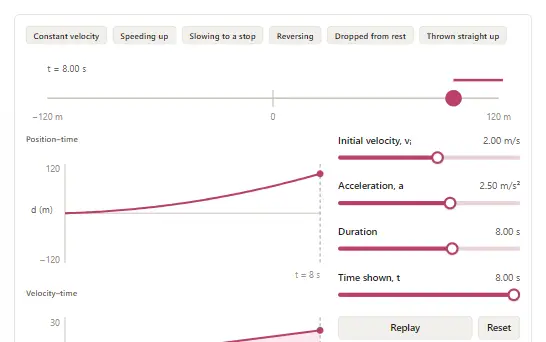
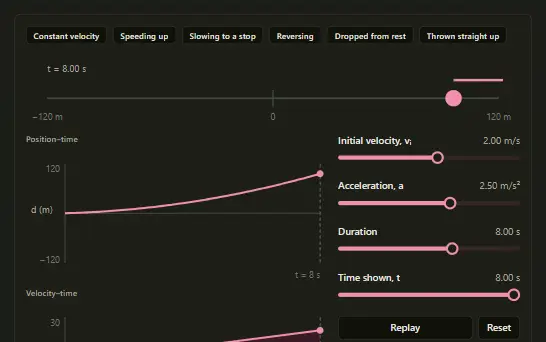
Set an initial velocity and acceleration, then watch position, velocity and acceleration graphs draw in step.
Physics · SPH4U
 SPH4U
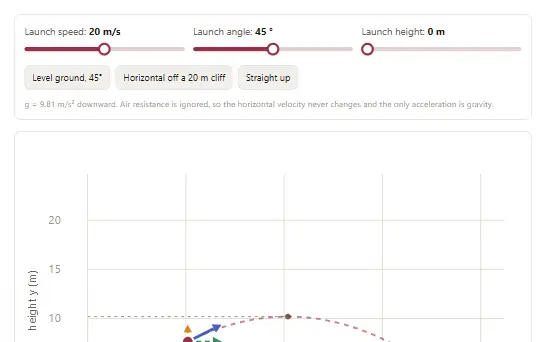
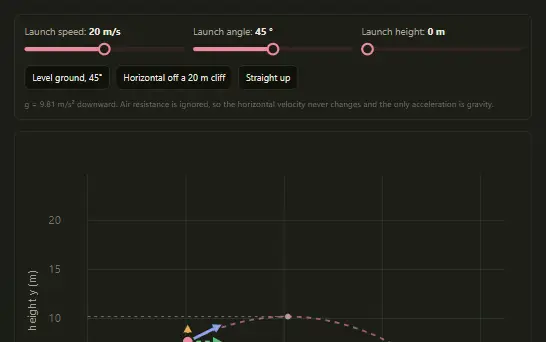
Set launch speed, angle and height and watch the path split into independent horizontal and vertical motion, with range, maximum height and flight time.
 SPH4U
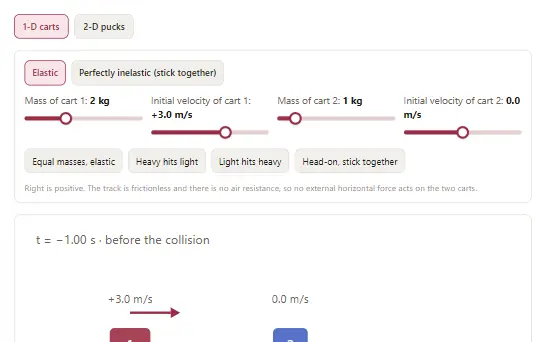
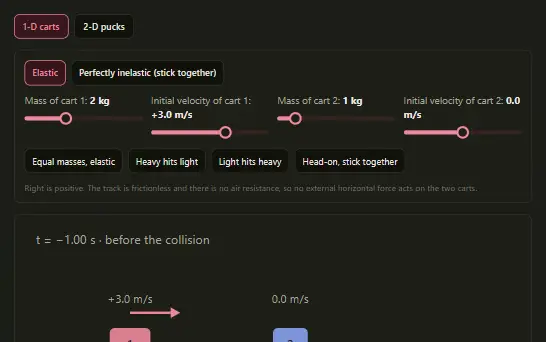
Collide two carts or pucks in one or two dimensions, elastic or perfectly inelastic, and check that momentum is conserved while kinetic energy may not be.
 SPH4U
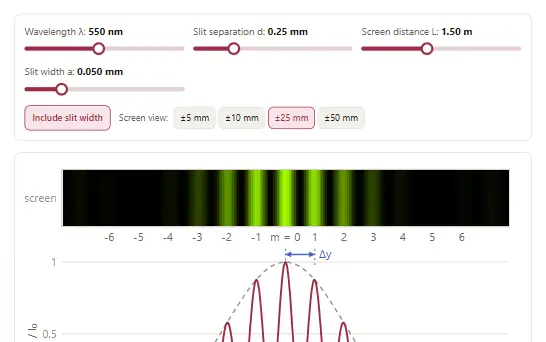
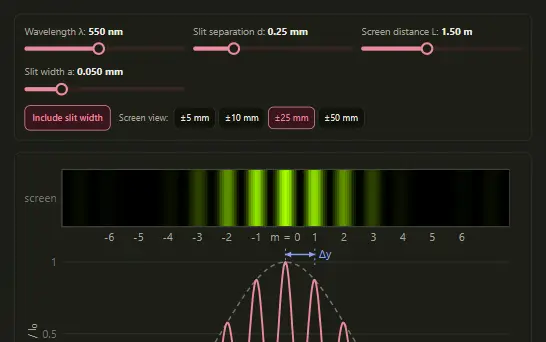
Change the wavelength, slit separation and screen distance and watch the bright fringes spread out or bunch together, with the fringe spacing calculated as you go.
 SPH4U
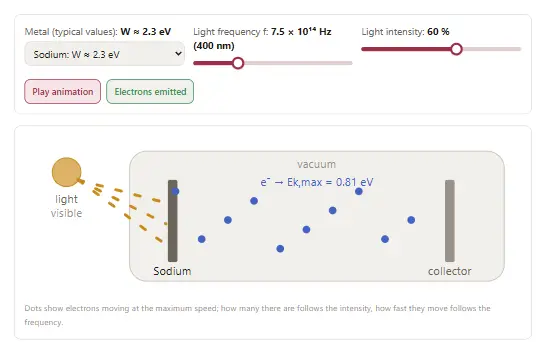
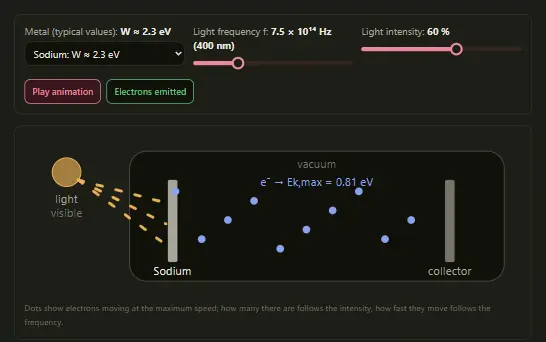
Shine light of any frequency and intensity on a metal and see why frequency, not brightness, decides whether electrons escape and how fast they leave.
Science · SNC1W
 SNC1W
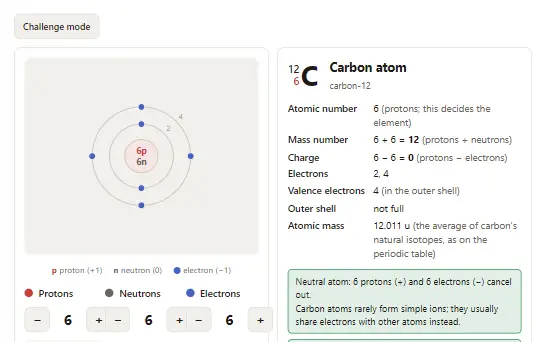
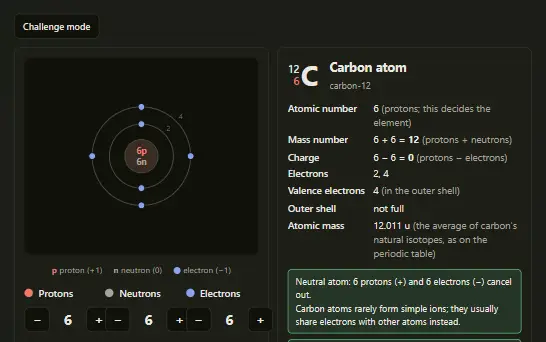
Add and remove protons, neutrons and electrons to build any atom or ion from hydrogen to calcium, and watch its Bohr-Rutherford diagram, mass number, charge and isotope stability update.
 SNC1W
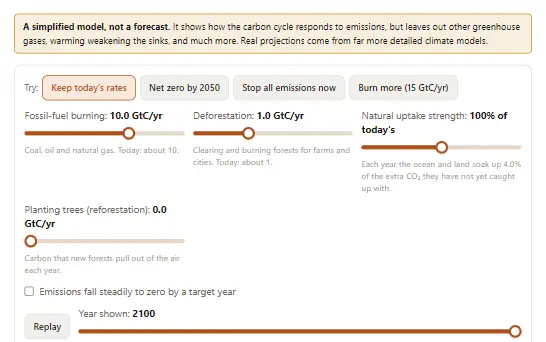
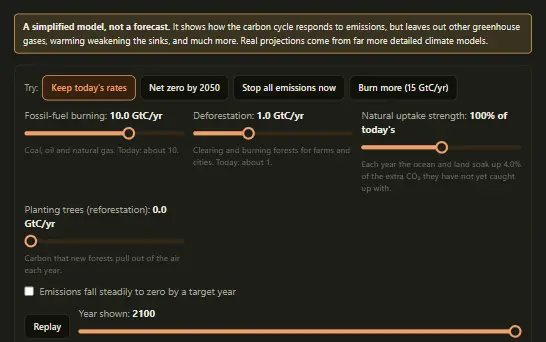
Set fossil-fuel burning, deforestation, tree planting and how strongly oceans and land absorb CO₂, then watch atmospheric CO₂ change from 2025 to 2100 in a simple model of the carbon cycle.
 SNC1W
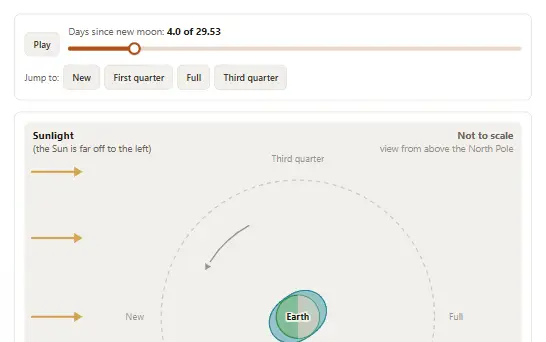
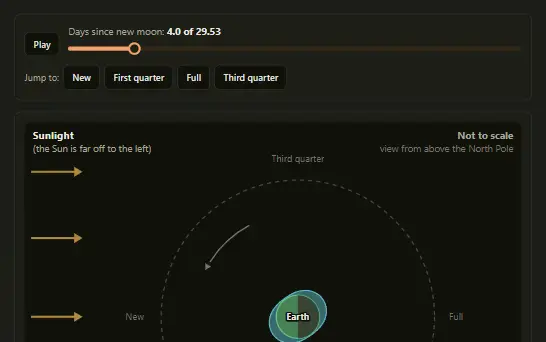
Move the Moon around its orbit to see its phase from Earth, the tidal bulges that make spring and neap tides, and why eclipses happen only when a new or full moon is near a node.
Science · SNC2D
 SNC2D
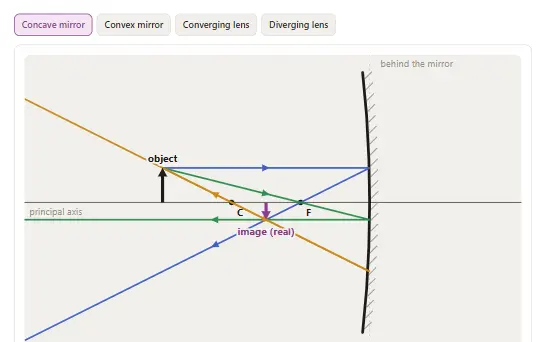
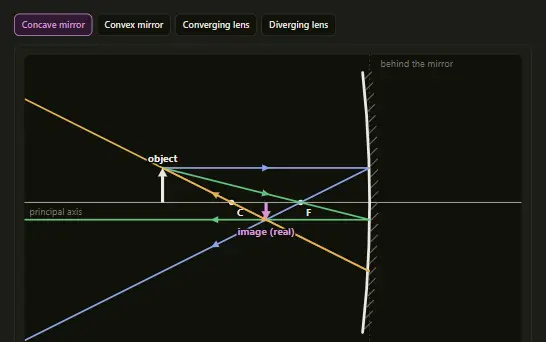
Drag an object in front of a curved mirror or lens to trace the principal rays and see where the image forms, with its size, attitude, location and type checked by the mirror and lens equation.
 SNC2D
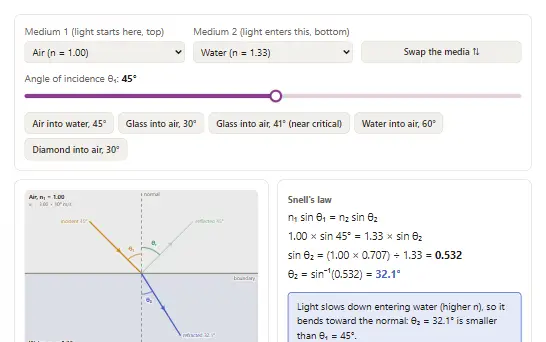
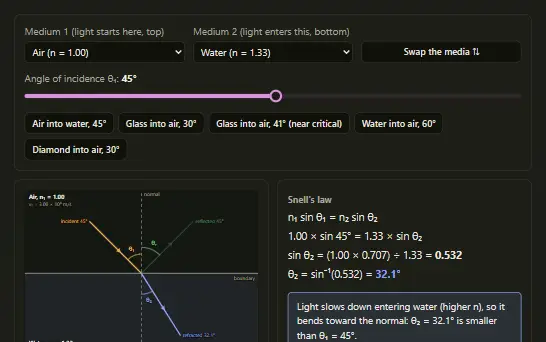
Pick two materials and an angle to watch light bend, with Snell's law, the speed of light in each, the critical angle and total internal reflection worked out.
 SNC2D
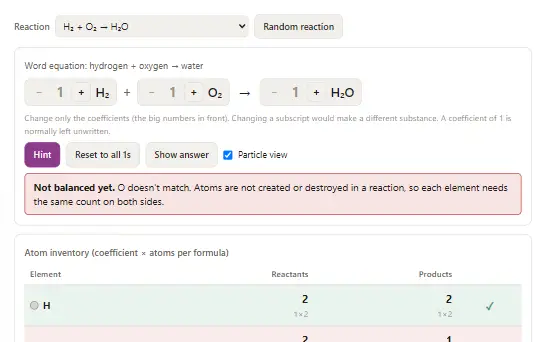
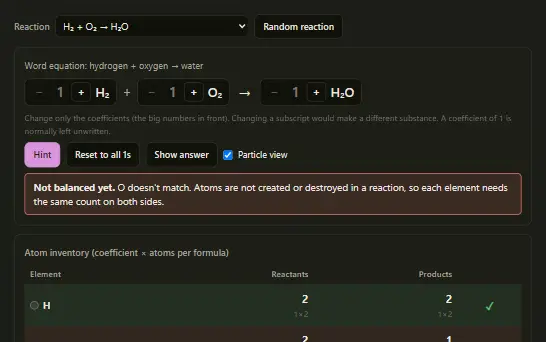
Change the coefficients of 24 real reactions and watch a live atom inventory (and the molecules themselves) until every element balances in lowest terms.
 SNC2D
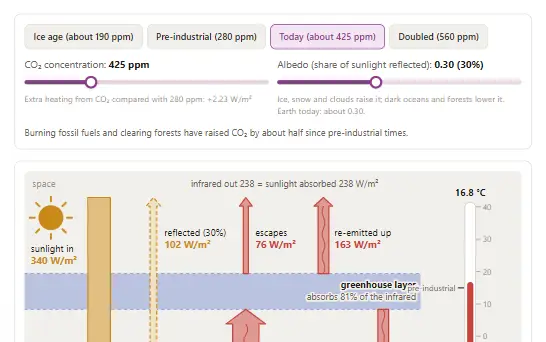
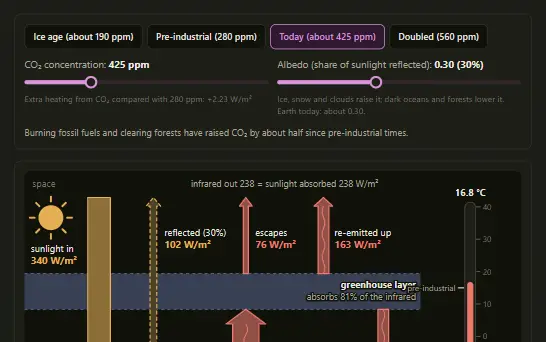
Change CO₂ and albedo in a one-layer energy-balance model and see sunlight, reflection and infrared flows and the temperature Earth's surface settles at, compared with no greenhouse effect.
Technology & Computer Science
Computer Science · ICS3U
Computer Engineering · TEJ3M
 TEJ3M
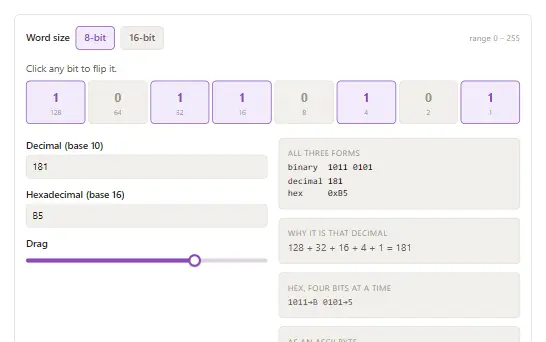
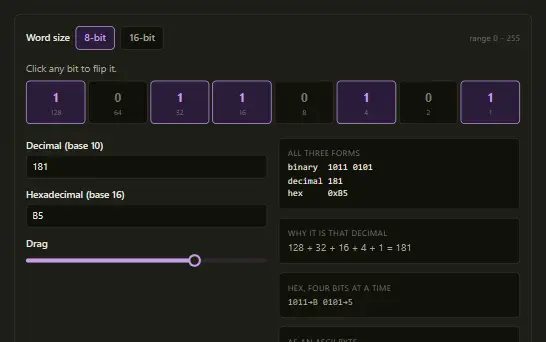
Flip individual bits and watch decimal, hexadecimal and the ASCII character follow.
 TEJ3M
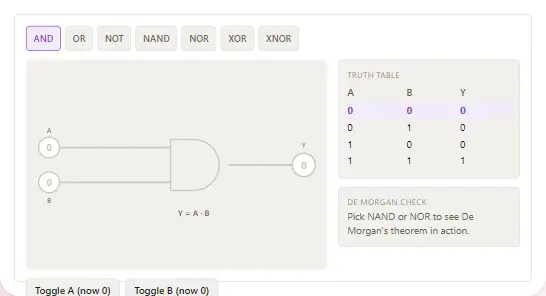
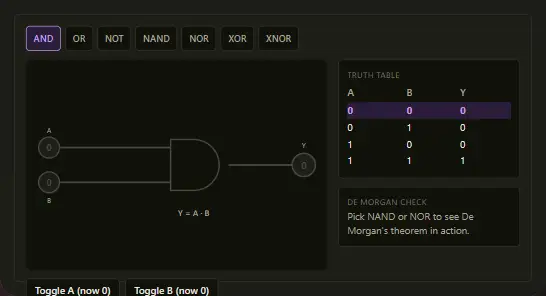
Toggle inputs through any of seven gates and see the truth-table row light up.
 TEJ3M
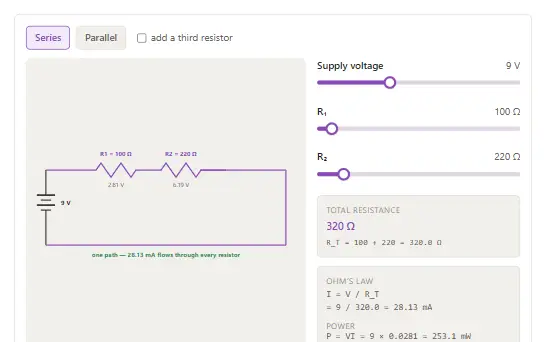
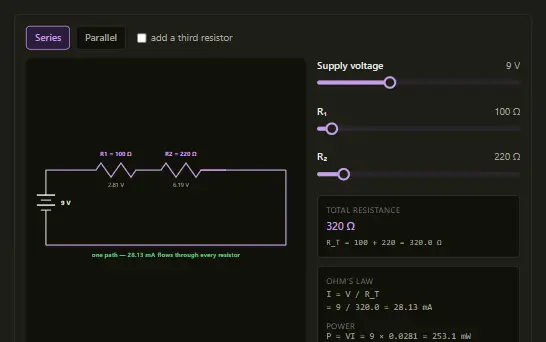
Build a resistor network, then read total resistance, branch currents and power.
 TEJ3M
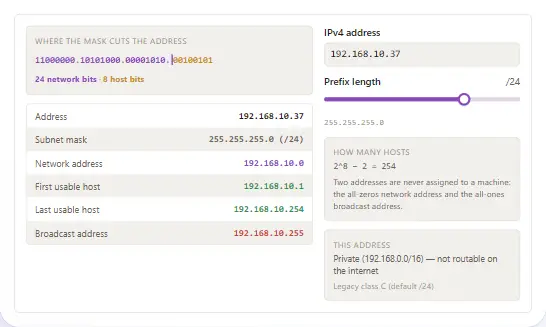
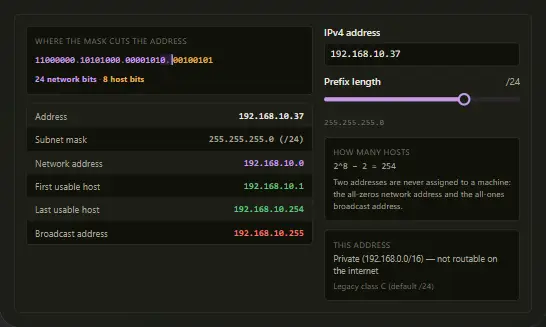
Slide the prefix and watch the mask cut an IP address into network and host bits.
 TEJ3M
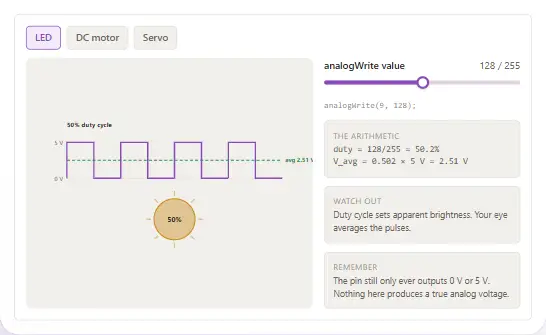
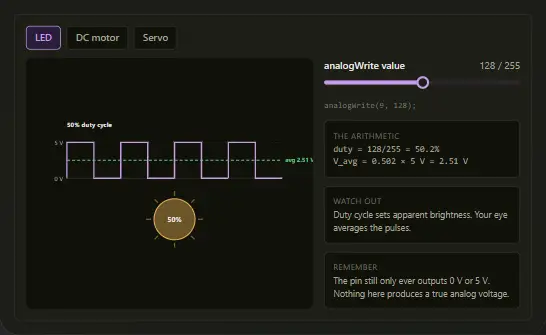
Drive an LED, a motor or a servo and see the waveform behind analogWrite.
Communications Technology · TGJ3M
Business
Launching and Leading a Business · BEP2O
Financial Accounting · BAF3M
 BAF3M
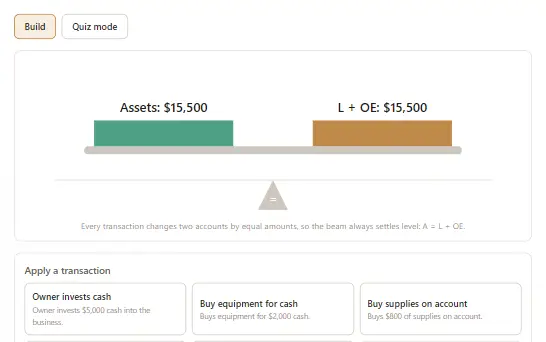
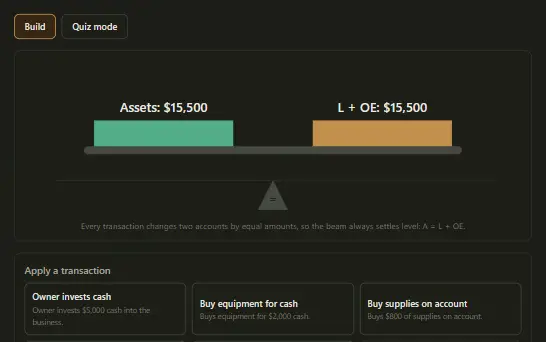
Apply real transactions and watch A = L + OE refuse to break.
 BAF3M
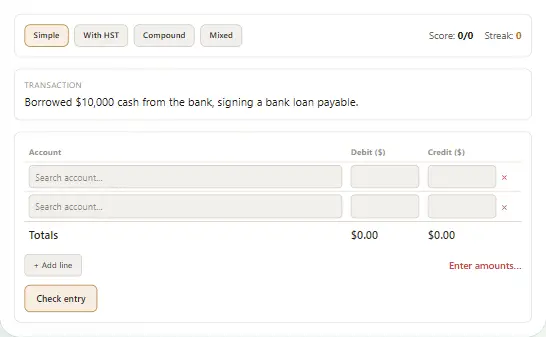
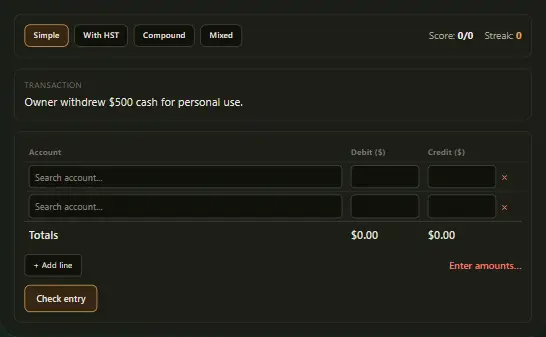
Read a transaction, pick the accounts and sides, get marked instantly.
 BAF3M
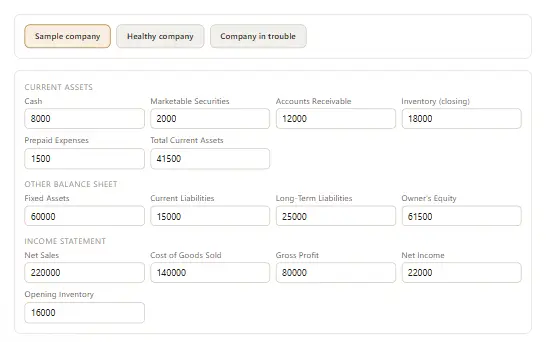
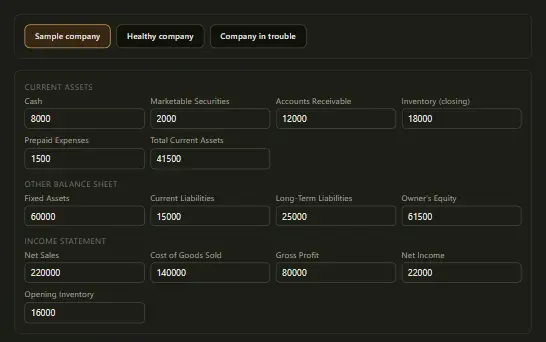
Enter statement figures and get every ratio with its formula and interpretation.
Entrepreneurship: The Venture · BDI3C
 BDI3C
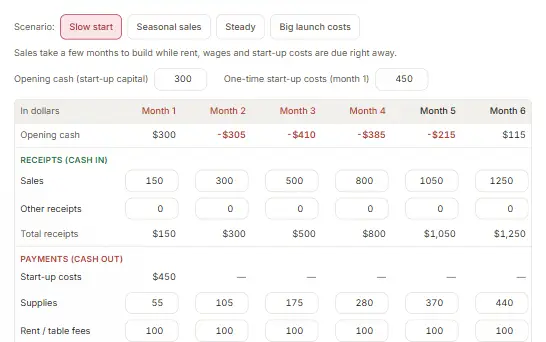
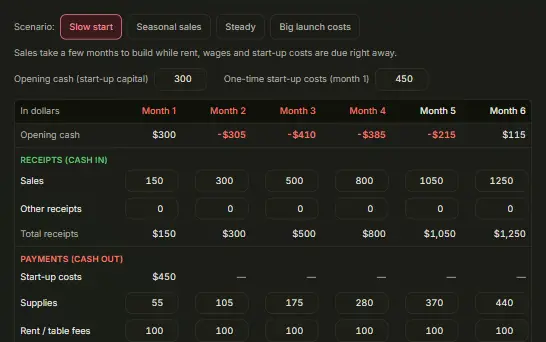
Plan six months of receipts and payments for a small venture and watch closing cash carry into the next month, to see how a business that earns money overall can still run out of cash in one month.
 BDI3C
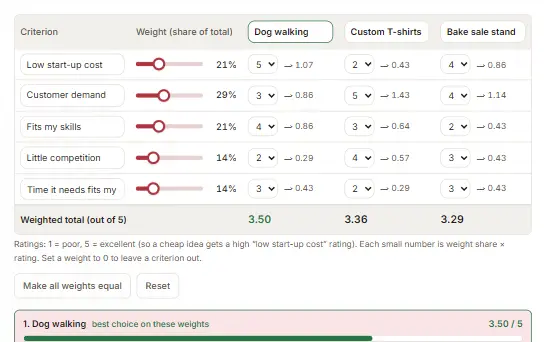
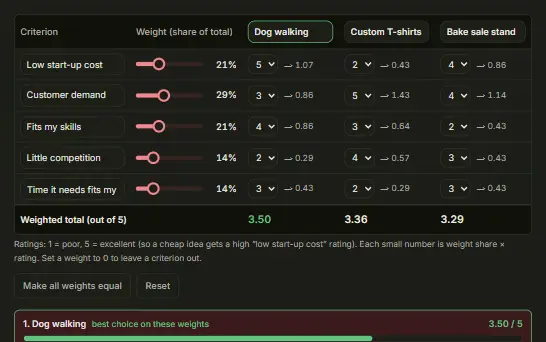
Weight the criteria, rate three venture ideas from 1 to 5 and rank them by weighted score, then see how changing what matters most can change which idea wins.
Marketing · BMI3C
 BMI3C
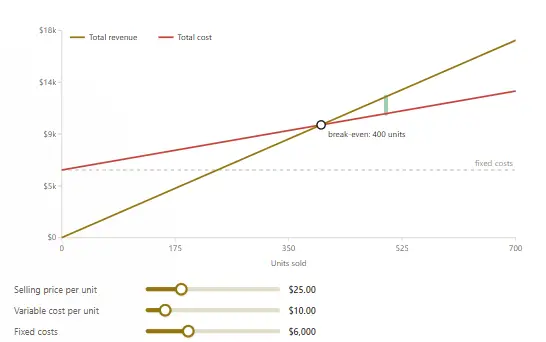
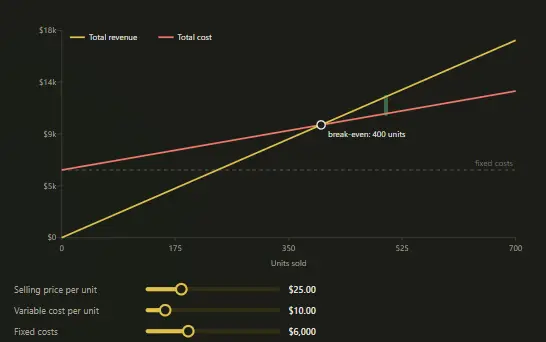
Set price, variable cost and fixed costs and watch the revenue and cost lines cross at the break-even volume, with profit or loss at any sales level.
 BMI3C
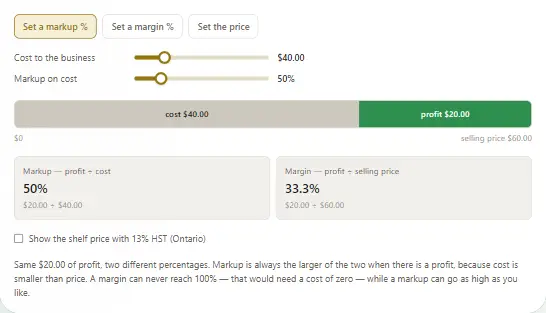
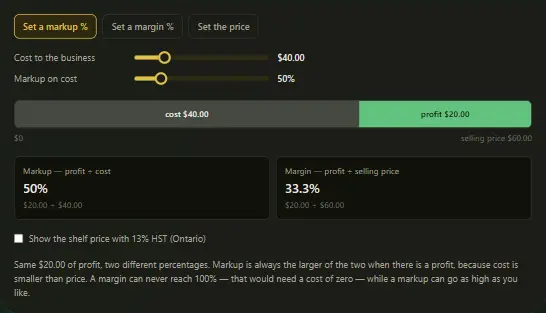
One cost, one price, two percentages. See why markup divides profit by cost and margin divides the same profit by the selling price.
Financial Accounting Principles · BAT4M
 BAT4M
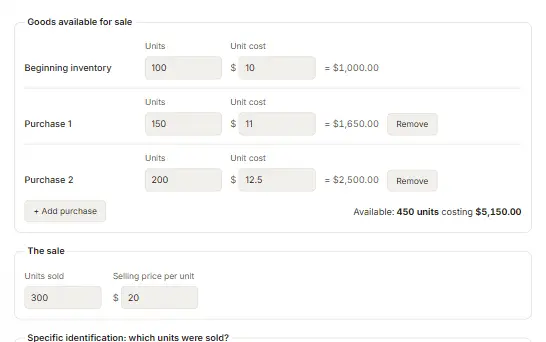
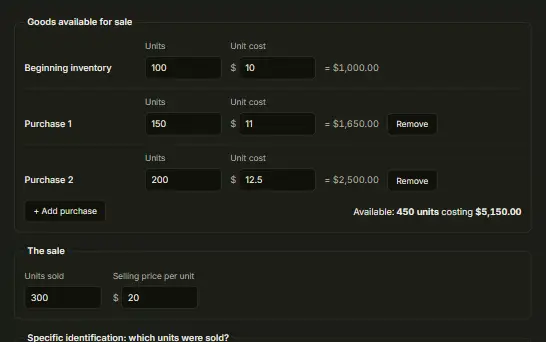
Edit the cost layers and the sale, then compare cost of goods sold, ending inventory and gross profit under FIFO, weighted average and specific identification.
 BAT4M
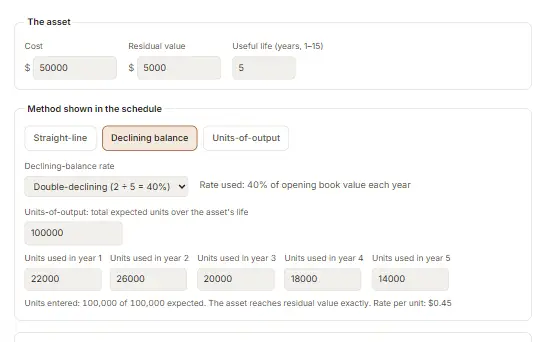
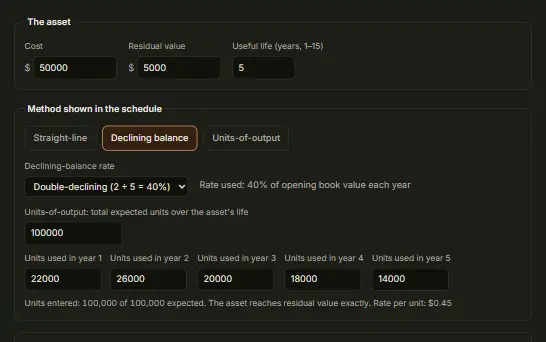
Build straight-line, declining-balance and units-of-output schedules, compare book value over time, and dispose of the asset to see the gain or loss.
 BAT4M
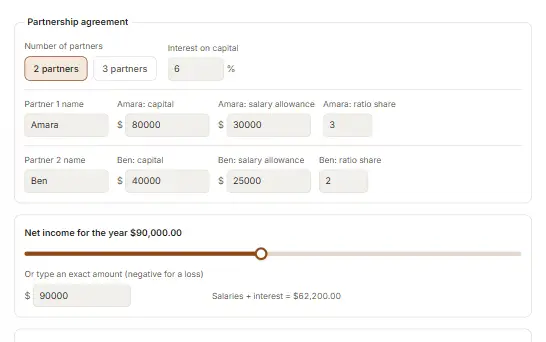
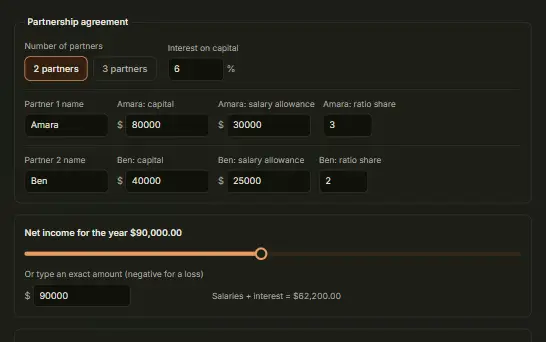
Divide net income or a net loss among two or three partners with salary allowances, interest on capital and a ratio, and watch a negative remainder get shared out.
Canadian & World Studies
Exploring Canadian Geography · CGC1W
 CGC1W
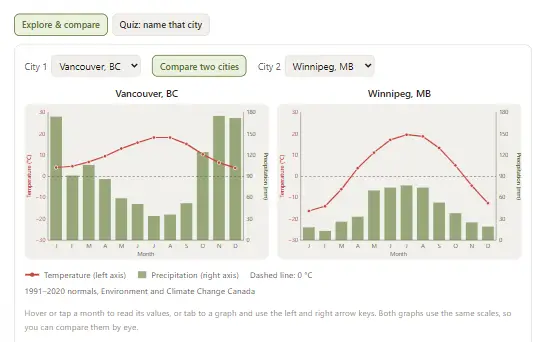
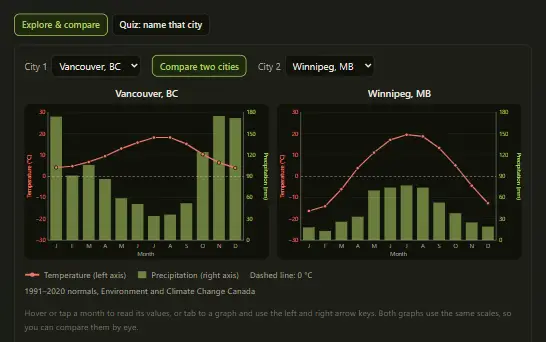
Draw real climate graphs for ten Canadian cities, work out the range, mean and total precipitation, and use LOWERN to explain why Vancouver and Winnipeg are so different.
 CGC1W
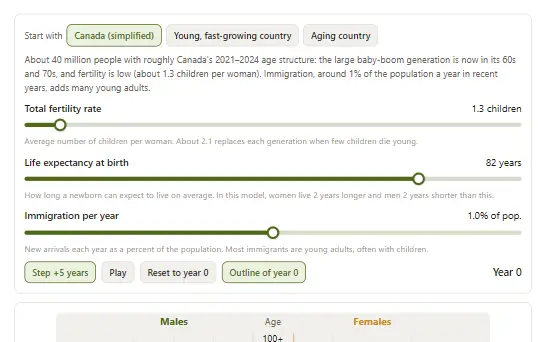
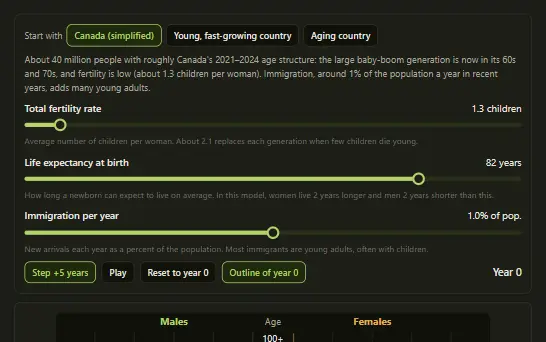
Change fertility, life expectancy and immigration, then watch a population pyramid age five years at a time as the median age and dependency ratio change.
 CGC1W
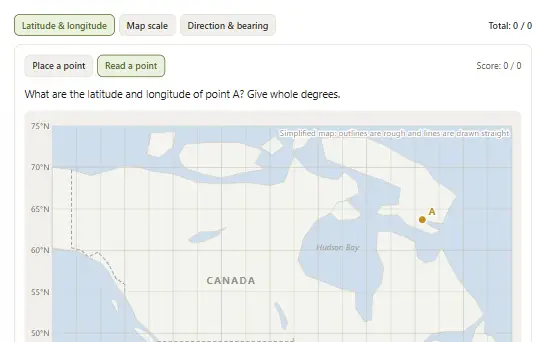
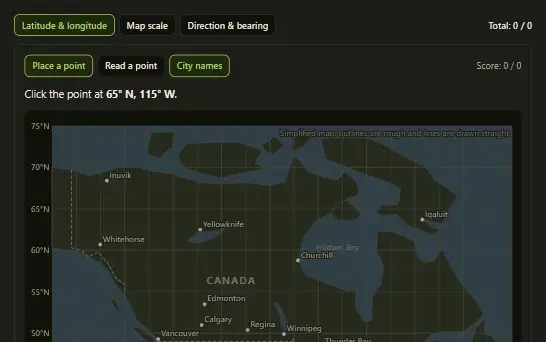
Practise latitude and longitude, map scale and compass bearings with instant feedback and a worked solution for every question.
Canadian History since World War I · CHC2D
 CHC2D
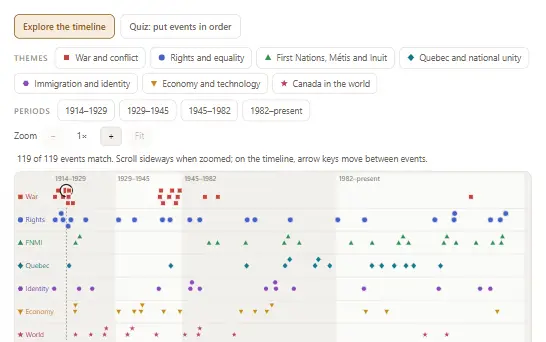
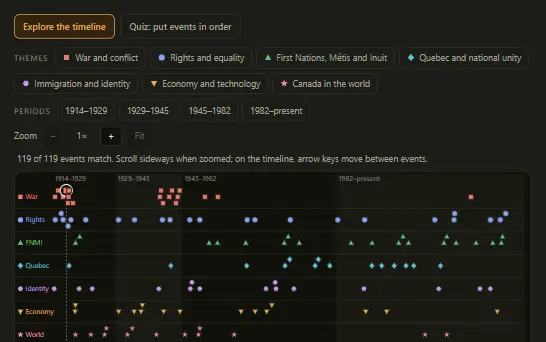
Zoom through Canadian history since 1914 by theme and period, read why each event matters, then test yourself by putting events in order.
 CHC2D
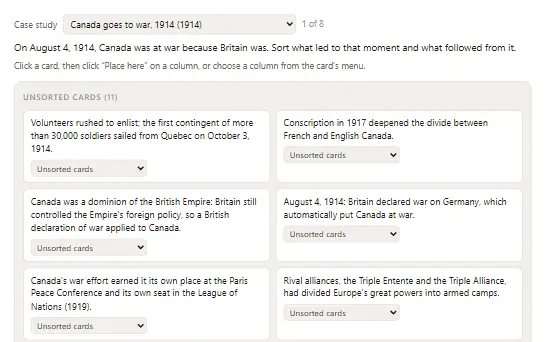
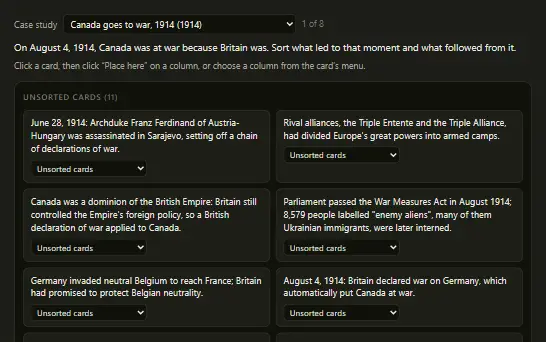
Sort the long- and short-term causes, triggers and consequences of turning points from 1914 to 1995, and see where historians disagree.
English
First Nations, Métis & Inuit Voices · NBE3U
 NBE3U
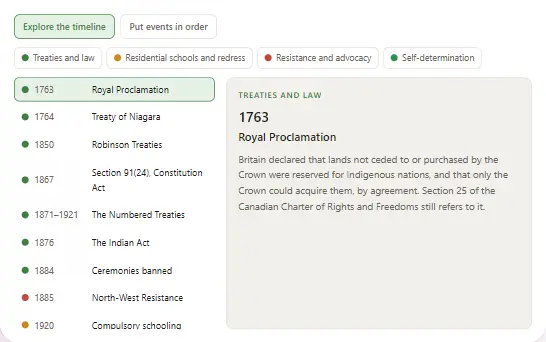
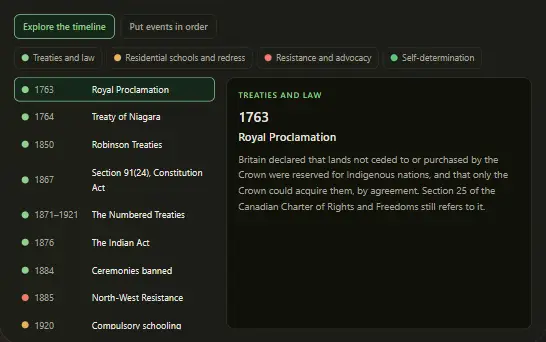
Explore the treaties, laws, court decisions and movements that contemporary First Nations, Métis and Inuit texts refer to, then test yourself by putting events in order.
 NBE3U
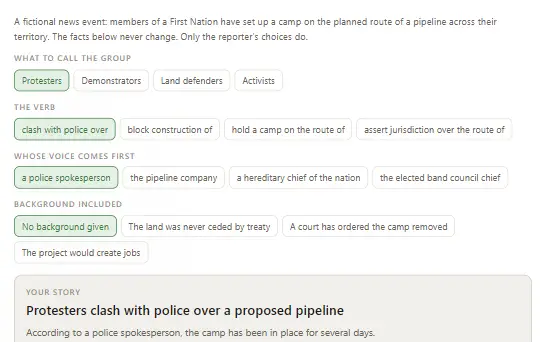
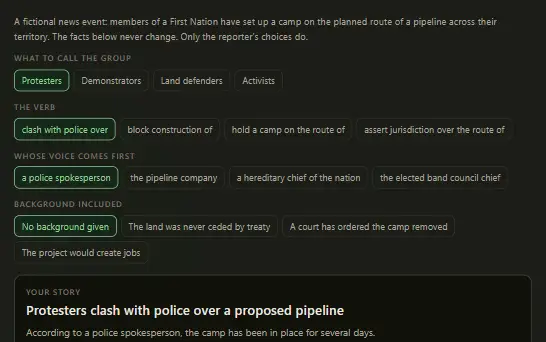
Keep the facts of a fictional news story fixed and change only the words, the first voice and the background, to see how each choice shapes what readers conclude.
French
Core French · FSF1D
 FSF1D
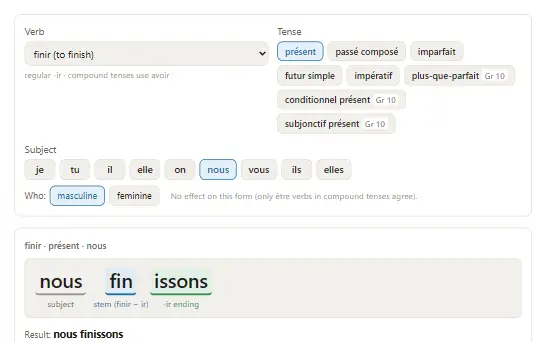
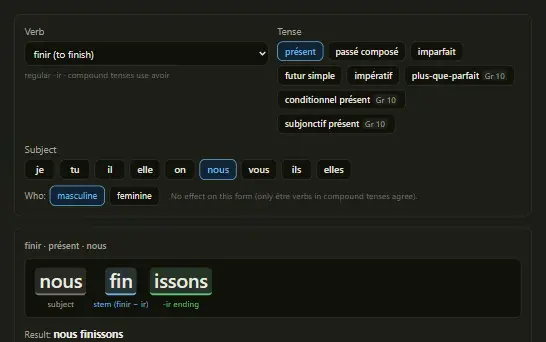
Pick a verb, a subject and a tense and watch the form get built from its stem, ending and auxiliary, then test yourself on the forms that trip people up.
 FSF1D
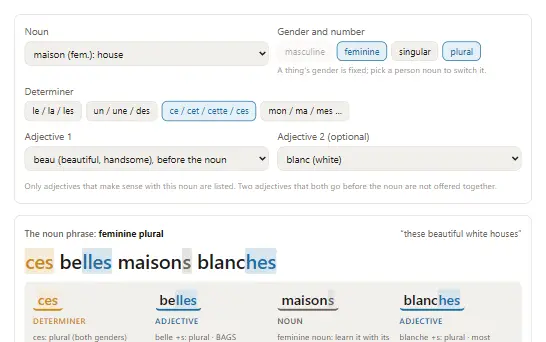
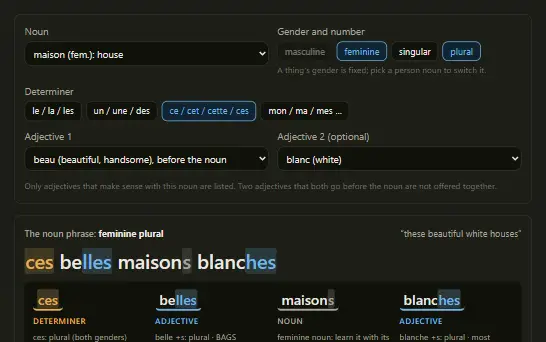
Change a noun's gender and number and watch every article, adjective and past participle around it change to agree, with the rule for each ending shown.
Core French · FSF2D
 FSF2D
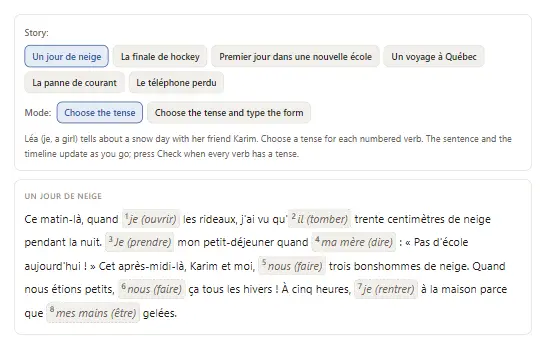
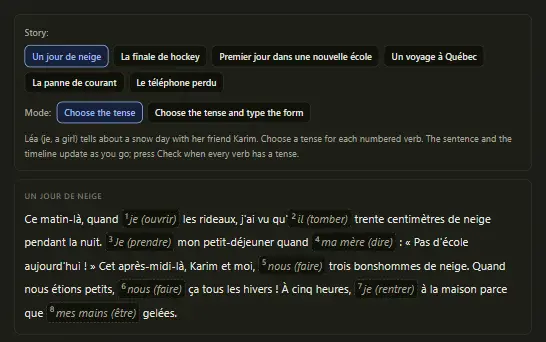
Tell a story in the past by choosing imparfait, passé composé or plus-que-parfait for each verb, and see where each one sits on the timeline.
 FSF2D
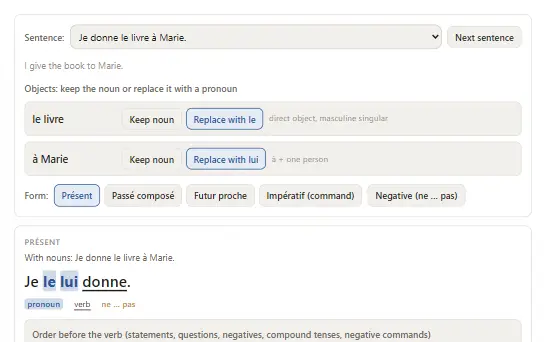
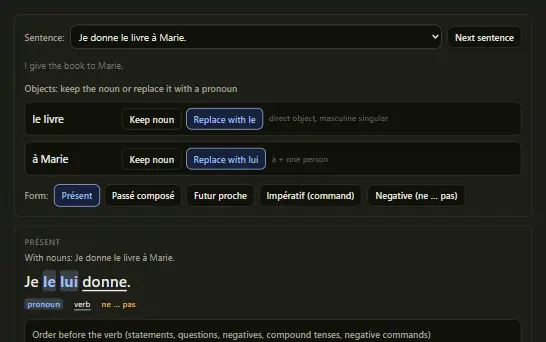
Replace the objects in a sentence with pronouns and watch them slot into the right order in statements, negatives, compound tenses and commands.
Core French · FSF3U
 FSF3U
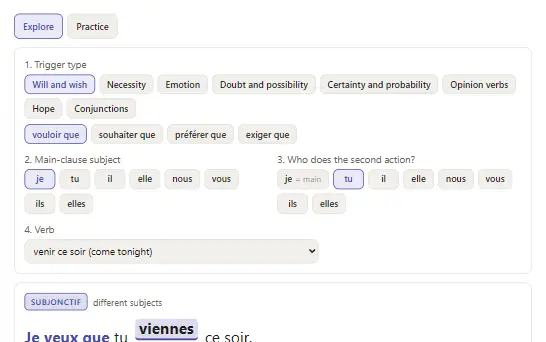
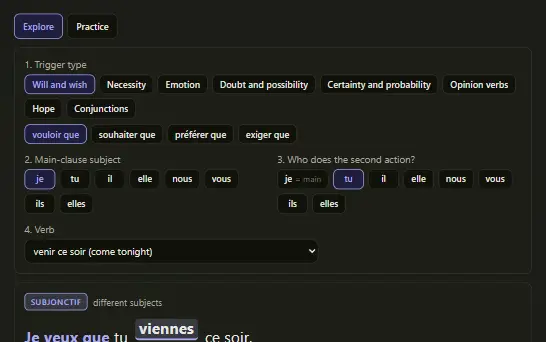
Build a sentence from a trigger, two subjects and a verb, and watch the second verb switch between subjonctif, indicatif and infinitive with the reason for each decision, then practise choosing the mood and typing the form.
 FSF3U
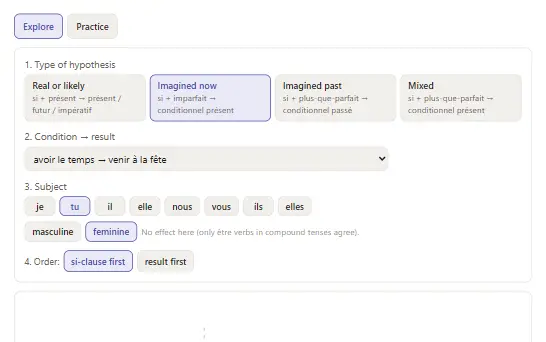
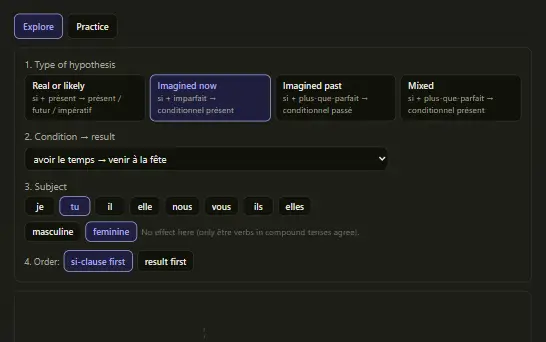
Pick a real, imagined or mixed hypothesis and watch the si-clause and the result take matching tenses on a real-versus-imagined timeline, then fill in clauses and fix the classic si + futur mistake.
Core French · FSF4U
 FSF4U
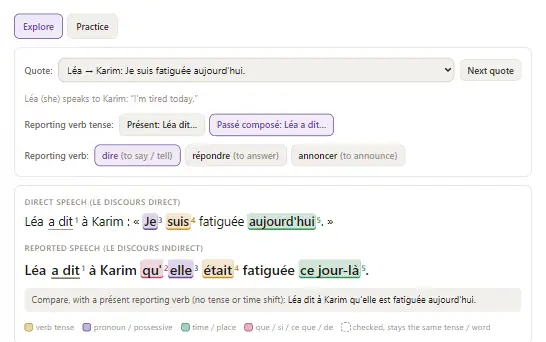
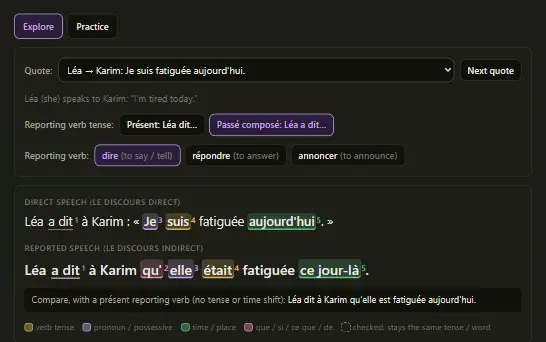
Switch a quote between “Elle dit que…” and “Elle a dit que…” and watch every tense, pronoun, possessive and time word shift, each with its rule, then rebuild reported sentences blank by blank.
 FSF4U
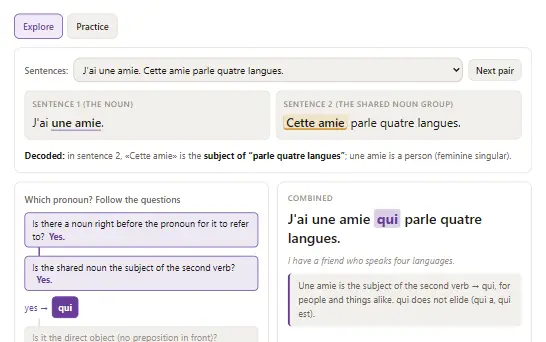
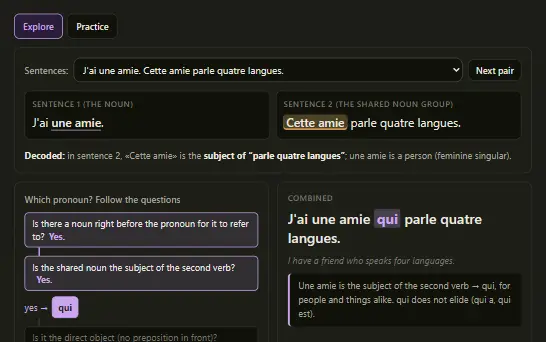
Work out what the shared noun does in the second sentence, follow the decision chart to qui, que, dont, où or a form of lequel, and watch lequel agree and contract after any preposition.