Science
Grade 9 De-streamed, following the Ontario curriculum.
- 5 units
- 37 lessons
- 331 practice questions
- 322 flashcards
- 3 simulators
Units
STEM Skills & Investigations
The skills you use in every science unit: planning fair tests, measuring and graphing data, judging sources and claims, designing and testing prototypes, using Python to model science, and working safely with WHMIS.
Sustainable Ecosystems & Climate Change
How Earth's spheres interact, how energy flows and matter cycles through ecosystems, how photosynthesis and respiration fit together, what keeps ecosystems in balance, how human activity and climate change upset that balance, and the sustainable practices, including First Nations, Métis and Inuit knowledge, that help keep ecosystems healthy.
- 1Earth's Spheres and Ecosystem Components
- 2Energy Flow: Food Chains, Food Webs and Trophic Levels
- 3Photosynthesis and Cellular Respiration
- 4Cycling of Matter: Carbon, Nitrogen and Water CyclesInteractive
- 5Biodiversity, Succession and Ecosystem SustainabilityInteractive
- 6Human Impacts on Ecosystems
- 7Climate Change and Ecosystems
The Nature of Matter
What everything is made of: how to classify matter, tell physical from chemical changes, how scientists built the model of the atom, how the periodic table is organized, what chemical formulas mean, and how the chemicals in everyday products affect people and the planet.
- 1Pure Substances and Mixtures
- 2Physical and Chemical Properties and Changes
- 3How Models of the Atom Developed
- 4Protons, Neutrons, Electrons and Bohr-Rutherford DiagramsInteractive
- 5The Periodic Table
- 6Patterns in the Periodic TableInteractive
- 7Compounds and Chemical Formulas
- 8Chemistry, Consumer Products and Society
Principles & Applications of Electricity
Static charge and why electrons move, conductors and safety, circuits and the meters that measure them, Ohm's law, series and parallel circuits, electrical energy, power, cost and efficiency, and how Ontario generates, stores and saves electricity.
Space Exploration
The Sun and how it powers Earth, the Moon's phases, eclipses and tides, the planets and the vast distances between stars and galaxies, the evidence for how the universe and solar system began (including Indigenous sky knowledge), and how space technology helps life on Earth.
Simulators
Simulators for every course →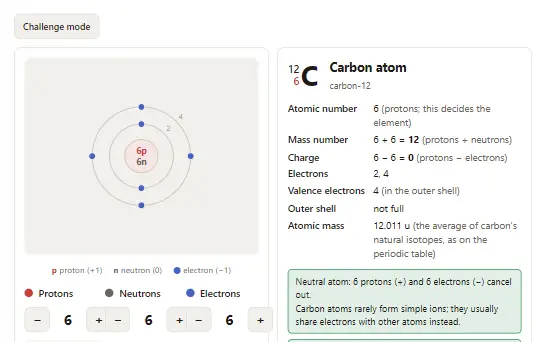
 SNC1W
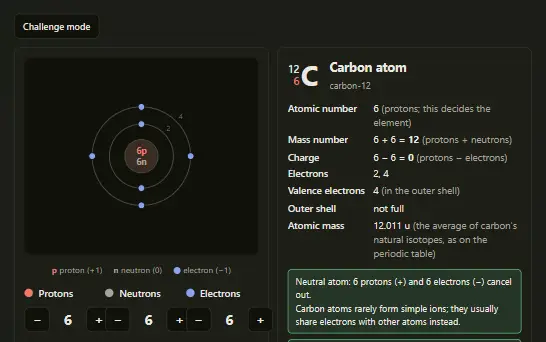
Add and remove protons, neutrons and electrons to build any atom or ion from hydrogen to calcium, and watch its Bohr-Rutherford diagram, mass number, charge and isotope stability update.
 SNC1W
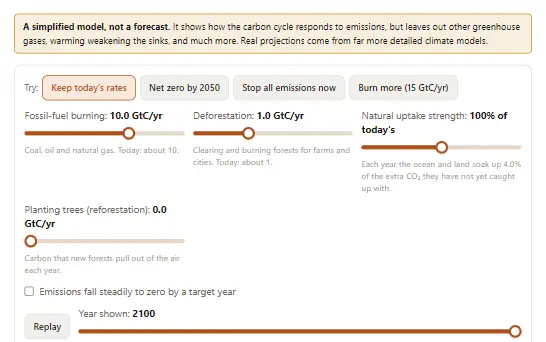
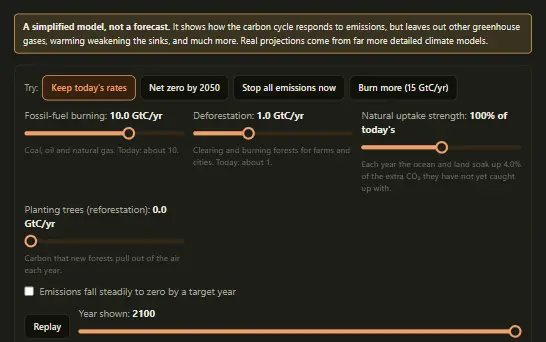
Set fossil-fuel burning, deforestation, tree planting and how strongly oceans and land absorb CO₂, then watch atmospheric CO₂ change from 2025 to 2100 in a simple model of the carbon cycle.
 SNC1W
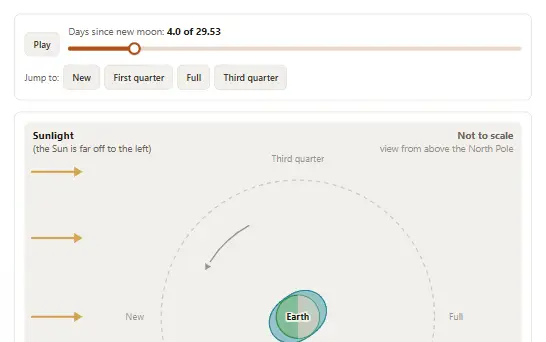
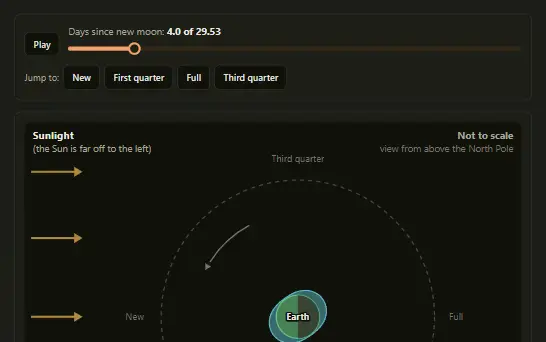
Move the Moon around its orbit to see its phase from Earth, the tidal bulges that make spring and neap tides, and why eclipses happen only when a new or full moon is near a node.