Chemistry
Grade 11 University Preparation, following the Ontario curriculum.
- 5 units
- 49 lessons
- 540 practice questions
- 452 flashcards
- 5 simulators
Units
Matter, Chemical Trends & Bonding
How atoms are built, how the periodic table organizes their behaviour, and how atoms bond and interact to form the compounds around us.
- 1Atomic Models & Bohr Theory
- 2Isotopes, Atomic Mass & Isotopic Abundance
- 3Organization of the Periodic Table
- 4Periodic TrendsInteractive
- 5Ionic Bonding & Compounds
- 6IUPAC Nomenclature
- 7Covalent Bonding & Lewis Structures
- 8Bond Types & Electronegativity Difference
- 9Molecular Shape (VSEPR) & PolarityInteractive
- 10Intermolecular Forces
- 11The Special Properties of Water
Chemical Reactions
How to write, balance, classify, and predict the products of chemical reactions — from simple synthesis to full ionic equations.
Quantities in Chemical Reactions
The mole lets chemists count invisibly small particles by weighing them on a scale, and stoichiometry uses that idea to predict exactly how much of each substance reacts or forms.
Solutions & Solubility
How substances dissolve, how to measure and manipulate concentration, and how dissolved ions react, precipitate, and behave as acids and bases.
- 1Characteristics of Solutions
- 2How Dissolving Happens
- 3Solubility CurvesInteractive
- 4Concentration
- 5Dilutions
- 6Ions in Solution & Precipitation Reactions
- 7Qualitative Analysis: Identifying Unknown Ions
- 8Solution Stoichiometry
- 9Properties & Naming of Acids and Bases
- 10Arrhenius Theory of Acids and Bases
- 11The pH Scale
- 12TitrationInteractive
Gases & Atmospheric Chemistry
How gases behave under changing pressure, volume, and temperature, and how that behaviour connects to the chemistry of Earth's atmosphere.
Simulators
Simulators for every course →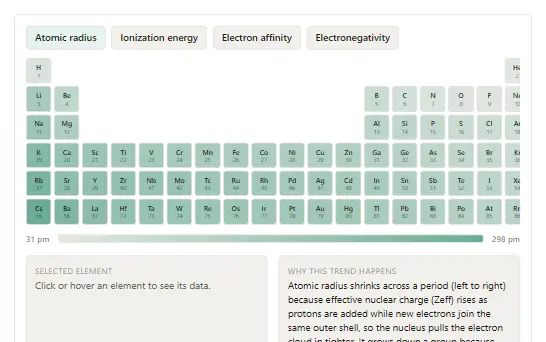
 SCH3U
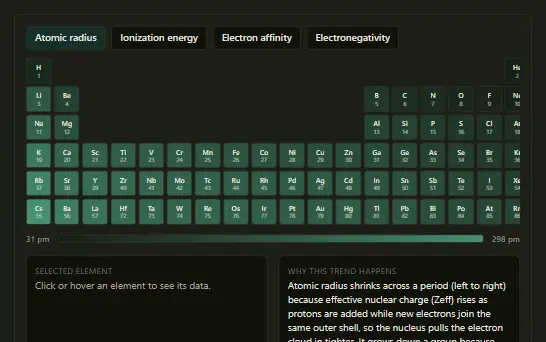
Shade the periodic table by radius, ionization energy, affinity or electronegativity.
 SCH3U
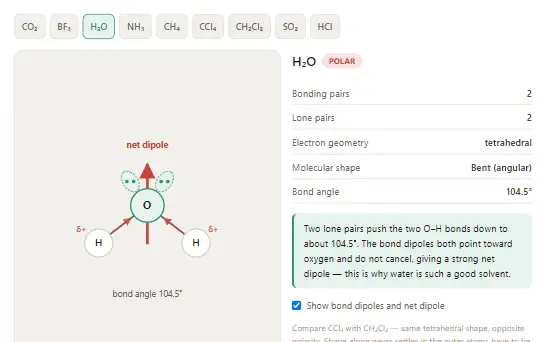
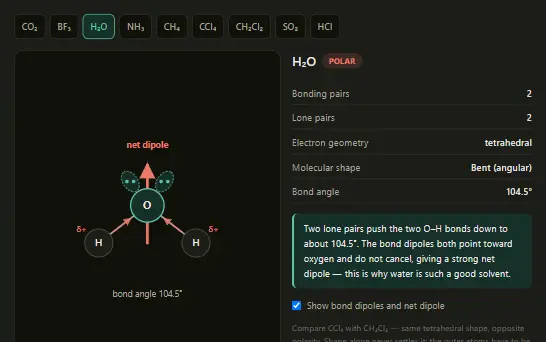
Pick a molecule to see its shape, bond angles and whether the dipoles cancel.
 SCH3U
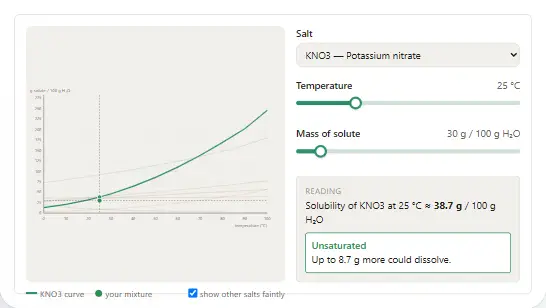
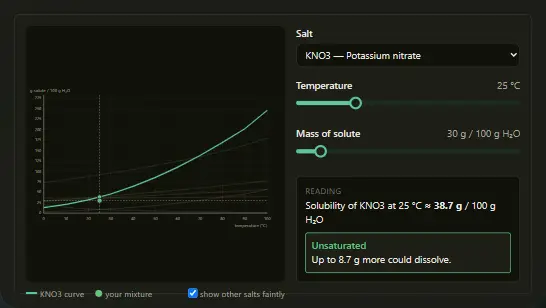
Drag temperature and mass to classify a solution as unsaturated, saturated or supersaturated.
 SCH3U
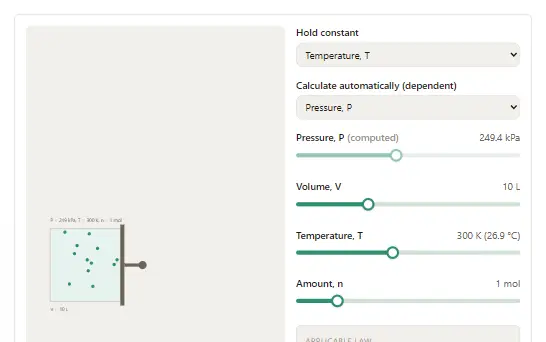
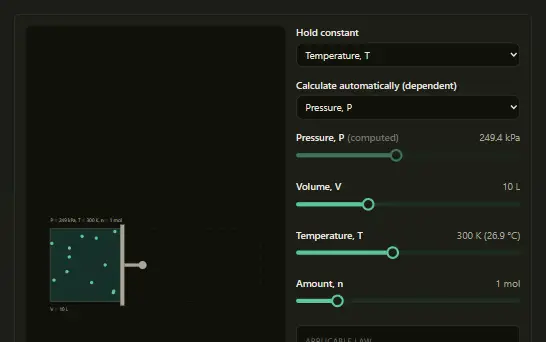
A piston obeying PV = nRT, with particles that speed up as you heat them.
 SCH3U
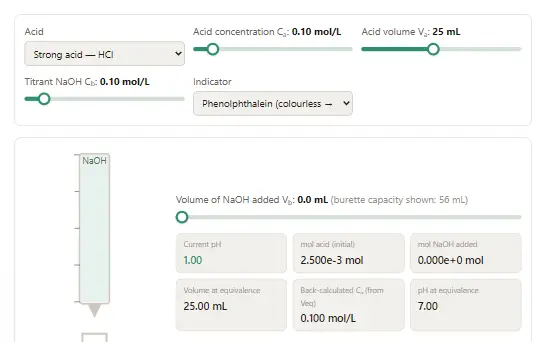
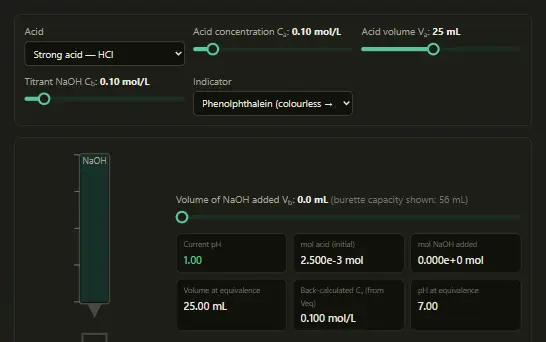
Titrate a strong or weak acid and watch the curve, the indicator and the equivalence point.