Science
Grade 10 Academic, following the Ontario curriculum.
- 4 units
- 35 lessons
- 305 practice questions
- 283 flashcards
- 4 simulators
Units
Tissues, Organs & Systems of Living Things
How cells divide, specialize and work together as tissues, organs and organ systems in animals and plants, what happens when cell division goes wrong, and the medical technologies and public health choices built on that knowledge.
- 1Plant and Animal Cells and the Microscope
- 2The Cell Cycle and Mitosis
- 3Cancer: When Cell Division Goes Wrong
- 4Cell Specialization, Differentiation and Stem Cells
- 5From Cells to Systems in Animals
- 6The Digestive System
- 7The Circulatory and Respiratory Systems
- 8Plant Tissues, Organs and Systems
- 9Medical Imaging, Public Health and Ethics
Chemical Reactions
How to name compounds and write their formulas, recognize and balance chemical reactions, classify them as synthesis, decomposition, displacement or combustion, measure acids and bases with pH, and use neutralization to solve real environmental problems.
- 1Naming and Writing Formulas for Ionic Compounds
- 2Polyatomic Ions, Molecular Compounds and Acids
- 3Evidence of Chemical Change and Conservation of Mass
- 4Word Equations and Balanced Chemical EquationsInteractive
- 5Synthesis and Decomposition ReactionsInteractive
- 6Single Displacement, Double Displacement and Combustion
- 7Acids, Bases, pH and Indicators
- 8Neutralization and Reactions in the Environment
Climate Change
How Earth's climate system works, how heat moves through air and water, why greenhouse gases warm the planet, how scientists know the climate is changing, and what the effects and responses look like in Canada and around the world.
- 1Weather, Climate and Earth's Climate System
- 2Heat Transfer in the Atmosphere and Hydrosphere
- 3The Natural and Anthropogenic Greenhouse EffectInteractive
- 4Greenhouse Gases: Sources, Sinks and the Carbon Cycle
- 5Evidence of Past and Present Climate Change
- 6Oceans, Water and Climate PatternsInteractive
- 7Ozone Depletion, Ground-Level Ozone and Smog
- 8Impacts of Climate Change and How We Respond
Light & Geometric Optics
What light is and where it comes from, how mirrors and lenses bend it into images, and how the same rules explain rainbows, fibre optics, eyeglasses and cameras.
- 1What Light Is: The Electromagnetic Spectrum and Sources of Light
- 2Rays, the Laws of Reflection and Plane Mirrors
- 3Concave and Convex Mirrors with Ray DiagramsInteractive
- 4The Mirror and Magnification EquationsInteractive
- 5Refraction, Index of Refraction and the Speed of LightInteractive
- 6Snell's LawInteractive
- 7Total Internal Reflection, the Critical Angle and Natural PhenomenaInteractive
- 8Converging and Diverging Lenses with Ray DiagramsInteractive
- 9The Thin Lens Equation and MagnificationInteractive
- 10The Eye, Vision Correction and Optical Devices
Simulators
Simulators for every course →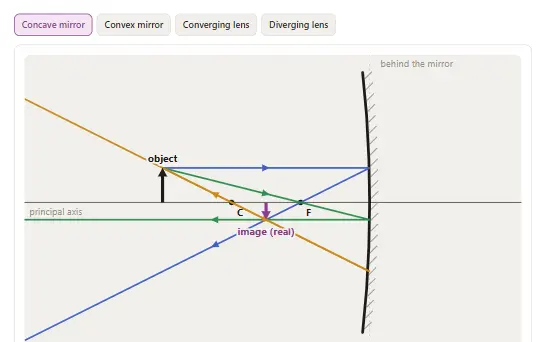
 SNC2D
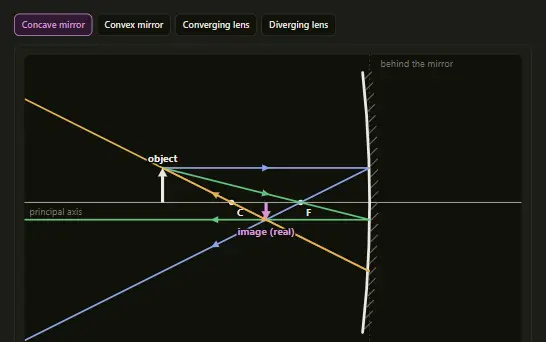
Drag an object in front of a curved mirror or lens to trace the principal rays and see where the image forms, with its size, attitude, location and type checked by the mirror and lens equation.
 SNC2D
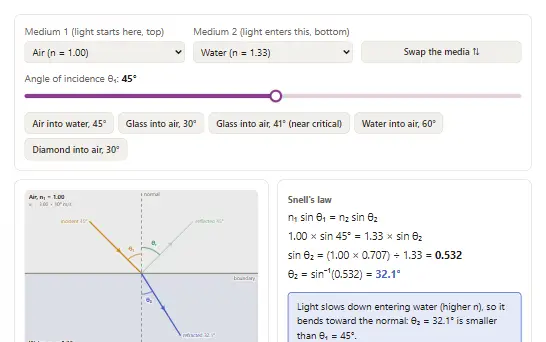
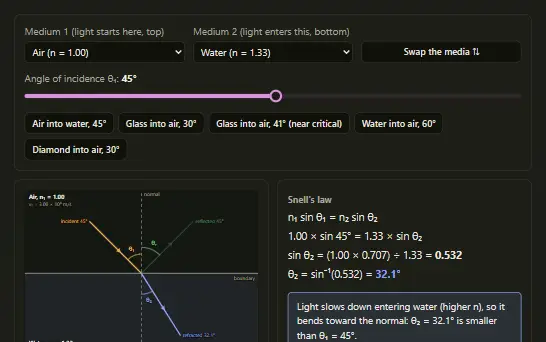
Pick two materials and an angle to watch light bend, with Snell's law, the speed of light in each, the critical angle and total internal reflection worked out.
 SNC2D
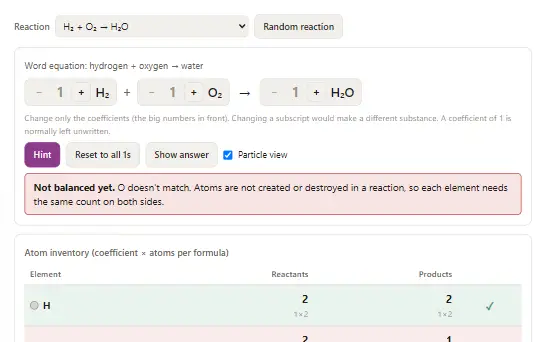
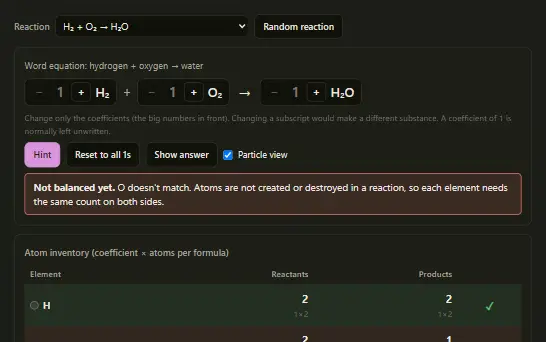
Change the coefficients of 24 real reactions and watch a live atom inventory (and the molecules themselves) until every element balances in lowest terms.
 SNC2D
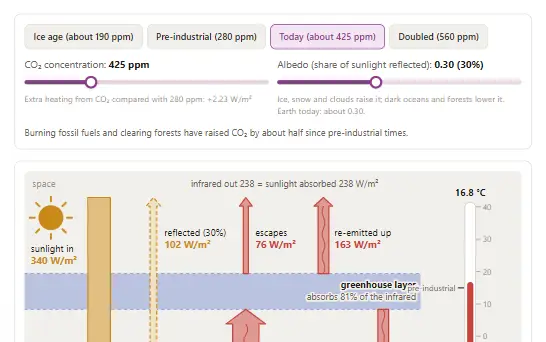
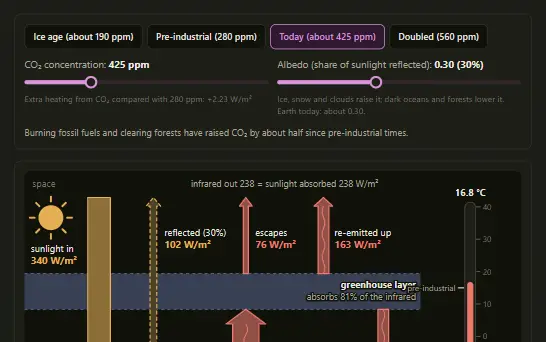
Change CO₂ and albedo in a one-layer energy-balance model and see sunlight, reflection and infrared flows and the temperature Earth's surface settles at, compared with no greenhouse effect.