Principles of Mathematics
Grade 10 Academic, following the Ontario curriculum.
- 7 units
- 27 lessons
- 297 practice questions
- 216 flashcards
- 4 simulators
Units
Linear Systems
Find the point where two lines meet: solve systems of two linear equations by graphing, substitution and elimination, tell when a system has one, no or infinitely many solutions, and use systems to solve real problems about money, mixtures and rates.
Analytic Geometry
Use coordinates to measure and prove: find the midpoint and length of a line segment, write the equation of a circle centred at the origin, build perpendicular bisectors, find the shortest distance from a point to a line, and verify properties of triangles and quadrilaterals with algebra.
Quadratic Expressions
Multiply binomials and simplify second-degree expressions, then run the process backwards: factor out common factors, group, factor trinomials, and spot perfect squares and differences of squares.
Quadratic Relations
Meet the parabola: recognize quadratic relations from data, tables and equations, read the vertex, axis, zeros and maximum or minimum, graph y = a(x − h)² + k by transforming y = x², use factored form and completing the square, and compare y = x² with y = 2ˣ to make sense of zero and negative exponents.
Quadratic Equations
Solve quadratic equations by factoring, with the quadratic formula and by graphing, use the discriminant to tell whether there are two, one or no real roots, and answer real questions about heights, times, areas and revenue.
Similar Triangles and Right-Triangle Trigonometry
Use ratio and proportion to work with similar triangles (shadows, mirrors, scale models, surveying), then build the sine, cosine and tangent ratios from similar right triangles and use them with the Pythagorean theorem to find unknown sides and angles in real situations.
Trigonometry of Acute Triangles
Follow where the sine law and the cosine law come from, use them to find missing sides and angles in triangles with no right angle, and choose the right tool to solve real measurement problems.
Simulators
Simulators for every course →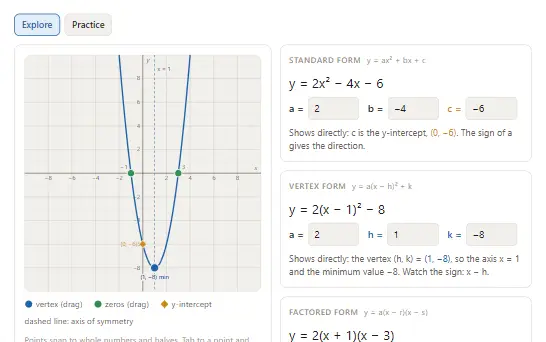
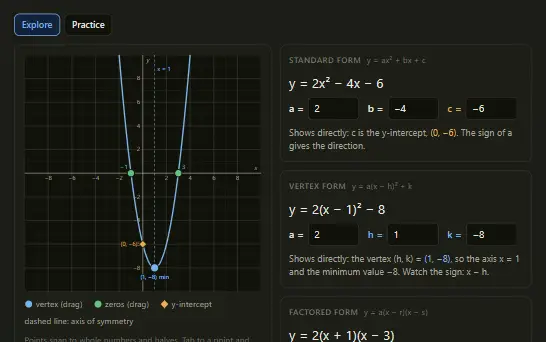 MPM2D
Edit standard, vertex or factored form, or drag the vertex and zeros, and watch the other two forms, the graph, the table of differences and the completing-the-square steps update together.
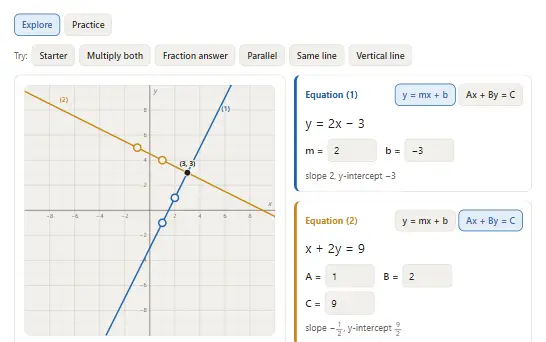
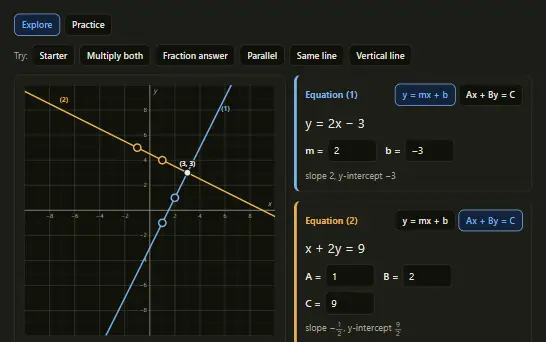 MPM2D
Enter or drag two lines and see graphing, substitution and elimination worked out step by step for the current coefficients, including what parallel and identical lines look like in the algebra.
 MPM2D
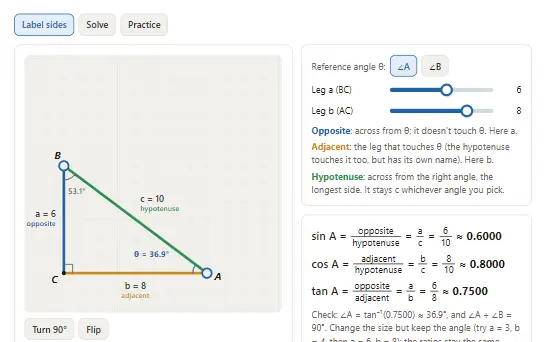
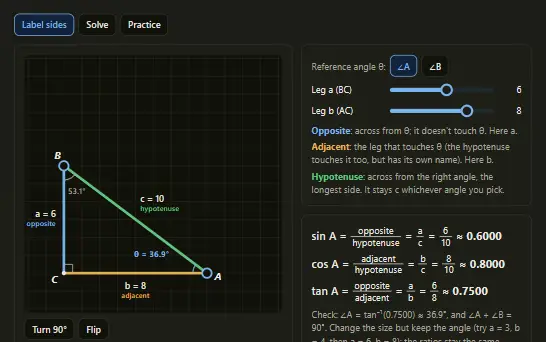
Label opposite, adjacent and hypotenuse, then solve any right or acute triangle step by step with the right tool: SOH CAH TOA, the Pythagorean theorem, or the sine or cosine law.
 MPM2D
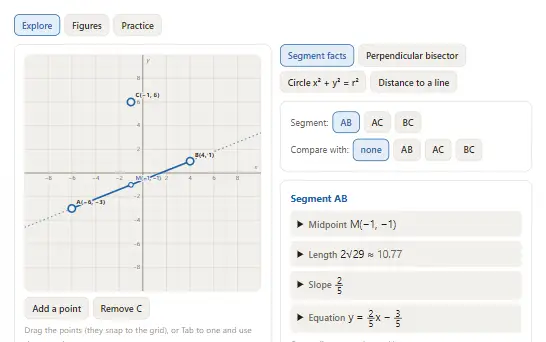
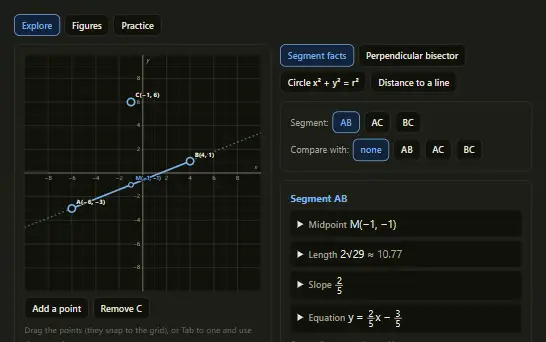
Drag points to get exact midpoints, lengths, slopes and equations, then use them to verify properties of triangles and quadrilaterals.