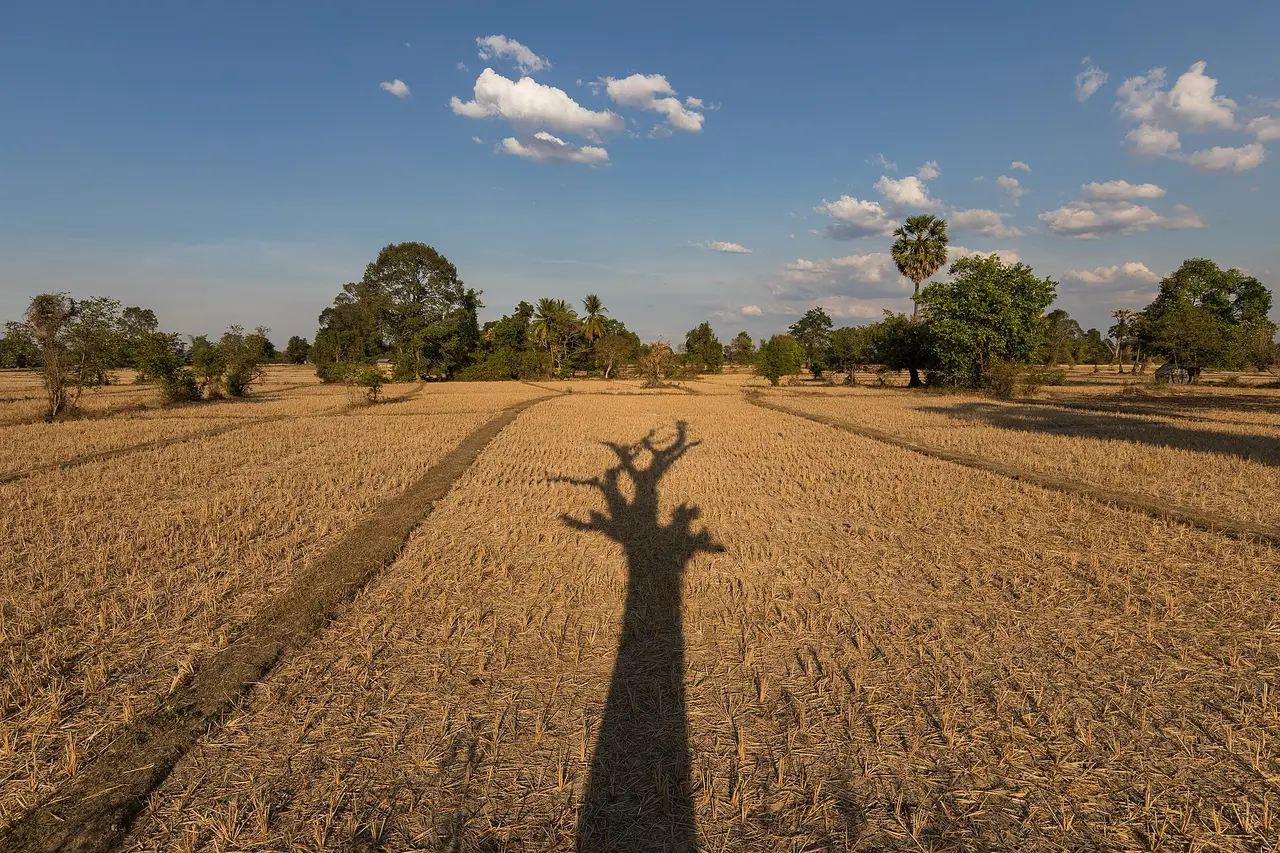
You want to know how tall a tree in the schoolyard is, but you cannot climb it and no tape measure is long enough. On a sunny afternoon you hold a metre stick straight up and measure its shadow: m. At the same moment the tree's shadow is m long. The stick's shadow is times the stick's height, and because the sun lights the stick and the tree from the same direction, the tree's shadow is also times the tree's height. So the tree is m tall. The idea that makes this work is similarity: the stick, its shadow and the sun's ray form a small triangle, and the tree, its shadow and the sun's ray form a large triangle with exactly the same shape. This lesson makes that idea precise and turns it into a tool you can use for shadows, mirrors, maps, scale models and surveying.
Same shape, possibly a different size
Two triangles are similar when one is an enlargement or a reduction of the other, possibly turned or flipped. In similar triangles, corresponding angles (angles in matching positions) are equal, and corresponding sides (sides in matching positions) are proportional, which means every side of one triangle is the matching side of the other multiplied by the same number. That number is the scale factor, usually called . If the second triangle is an enlargement, if it is a reduction, and if the triangles are the same size. The symbol means "is similar to". The order of the letters matters: says that matches , matches and matches . So side matches , side matches , and side matches .
| Measure in triangle ABC | Matching measure in triangle DEF | Ratio DEF to ABC |
|---|---|---|
| cm | cm | |
| cm | cm | |
| cm | cm | |
| equal | ||
| equal | ||
| equal |
- Same shape; the sizes can differ
- Corresponding angles are equal
- Corresponding sides are proportional, with any scale factor
- Written
- Shown by AA, SSS similarity or SAS similarity
- Same shape and the same size
- Corresponding angles are equal
- Corresponding sides are equal, so the scale factor is
- Written
- Shown by SSS, SAS, ASA or AAS
Every pair of congruent triangles is also similar (with ), but most similar triangles are not congruent. Equal angles alone never prove congruence: a triangle with sides , , cm and one with sides , , cm have the same three angles but are clearly different sizes.
How to show two triangles are similar
You do not have to check all six measurements. Any one of these three tests is enough. AA (angle-angle): two angles of one triangle equal two angles of the other. This works because the angles of any triangle add to , so once two pairs of angles match, the third pair must match too. AA is the test you will use most, because angles are often easier to know than sides: a right angle, a shared angle, or angles made by parallel lines. SSS similarity: all three pairs of corresponding sides are in the same ratio. Sides , , and , , give , so those triangles are similar. SAS similarity: two pairs of corresponding sides are in the same ratio and the angles between those sides are equal.
Finding a missing side
Once you know two triangles are similar, write a proportion: an equation saying two ratios are equal. Use one pair of corresponding sides that you know completely, and the pair that contains the unknown. Pair the sides by the angles they are opposite, not by where they sit on the page, because similar triangles are often turned or flipped. Keep the same order in both ratios: if the first ratio is "big triangle over small triangle", the second must be too. Then solve, either by multiplying both sides by the denominator under the unknown or by cross-multiplying. For example, if with , and , then gives , so .
Three classic situations produce similar triangles, and each one is a case of AA. Shadows: the sun is so far away that its rays are, for all practical purposes, parallel, so they meet level ground at the same angle everywhere nearby. An object standing straight up makes a right angle with the ground. Two angles match, so the triangles are similar, provided both shadows are measured at the same time on level ground. Mirrors: light bounces off a flat mirror at the same angle it arrives, so if you lay a mirror on level ground and step back until you see the top of a building in it, your line of sight and the building's line make equal angles with the ground. With the two right angles (you and the building both stand upright), that is AA again. Surveying: two triangles that share an angle, or that have vertically opposite angles (the equal angles across from each other where two straight lines cross), plus a right angle in each, are similar. A surveyor can measure a short, reachable triangle on land and scale up to a distance across a river.
Scale models and maps use the same idea. A model built to a scale of has every length equal to of the real length, so every real length is times the model length: a model bridge cm long stands for a real bridge cm m long. The perimeters of similar figures are also in the ratio , but their areas are in the ratio , because area multiplies two lengths that are each scaled by . Doubling every side of a triangle doubles its perimeter and multiplies its area by .