Skip to content
Study Hall
Lesson 4 of 4Linear Systems
Unit 1 · Lesson 4 of 4

Problems Using Linear Systems

Turn a word problem with two unknowns into a linear system: define the variables, organize the facts in a table, write one equation per fact, solve, and verify the answer against the original words. Investments, mixtures, tickets, speeds with a current, and comparing plans.

4 min read11 practice questionsAsk AI about this →

Key things to remember

  1. 1Define each variable precisely, with its units, before writing equations.
  2. 2Most problems give an amount equation (totals of quantities) and a value equation (totals of cost, value or interest).
  3. 3Simple interest: ; for one year , with the rate as a decimal ().
  4. 4With a current and still-water speed : downstream speed , upstream speed ; distance = speed × time.
  5. 5Verify the solution in the original words and state it in a sentence with units.

The Robotics Club raised $5000 to build a robot for a future competition. The club invested part of the money in an account that paid 4% annual interest, and the rest in a government bond that paid 3.5% simple interest per year. After one year, the club had earned a total of $190 in interest. How much was invested at each rate? There are two unknown amounts, and the problem gives two facts that connect them: the amounts add up to $5000, and the interest adds up to $190. Two unknowns and two independent facts are exactly what a linear system needs. Most of the work is not the algebra, which you already know, but turning the words into equations correctly.

A plan for any word problem

  1. Define the variables precisely, with units: "Let be the number of dollars invested at 4%", not just " = 4%".
  2. Organize the information, often in a table with one row per item and a column for each quantity.
  3. Write two equations, one for each fact. Many problems have an amount equation (how many, or how much, in total) and a value equation (what the total is worth or costs).
  4. Solve with the method that suits the equations: substitution, elimination or graphing.
  5. Verify the answer against the original words (not only your equations, which could be wrong), and state it in a sentence with units.
5000 dollars invested: part in an account at 4%, the rest in a bond at 3.5%.Total simple interest after one year: 190 dollars. How much is at each rate?Let x = dollars invested at 4%, and y = dollars invested at 3.5%.Amount (dollars)RateInterest after 1 year (dollars)Account at 4%x0.040.04xBond at 3.5%y0.0350.035yTotal5000190x + y = 5000amount equation0.04x + 0.035y = 190interest equationSolve:(interest eq. × 1000) − (amount eq. × 35)40x + 35y − (35x + 35y) = 190 000 − 175 000, so 5x = 15 000So:x = 3000 and y = 5000 − 3000 = 2000Verify in the words:0.04(3000) + 0.035(2000) = 120 + 70 = 190 ✓3000 dollars in the account at 4%, 2000 dollars in the bond at 3.5%
Fig 1The Robotics Club problem organized in a table. The amount column gives x + y = 5000, the interest column gives 0.04x + 0.035y = 190, and the solution 3000 dollars at 4 percent and 2000 dollars at 3.5 percent is verified.
VideoDefining two variables, writing one equation for each fact, and solving the system to answer a word problem.Watch on YouTube

Investments and simple interest

Simple interest is interest paid only on the original amount: , where is the principal (the amount invested), is the annual interest rate written as a decimal, and is the time in years. For one year, . Write each percent as a decimal by dividing by 100: and . With dollars at 4% and dollars at 3.5%, the amount equation is and the interest equation is . Clear the decimals by multiplying the interest equation by 1000, then eliminate :

The second line is the amount equation multiplied by 35.

Verify in the words: $3000 at 4% earns dollars, and $2000 at 3.5% earns dollars. The amounts total dollars and the interest totals dollars, matching both facts. The club invested $3000 in the account and $2000 in the bond.

Mixtures, tickets and coins

Mixture problems use the same two-equation pattern. A store wants 30 kg of trail mix worth $9/kg, made from peanuts at $6/kg and cashews at $15/kg. Let be the mass of peanuts and the mass of cashews, in kilograms. The amount equation adds masses; the value equation adds (mass × price) for each ingredient and sets it equal to the value of the whole mix. Ticket sales (number of tickets and total revenue) and jars of coins (number of coins and total value) work exactly the same way.

IngredientMass (kg)Price (dollars per kg)Value (dollars)
Peanuts6
Cashews15
Mix309
Equation
Each column that adds up gives one equation

Rates: travelling with and against a current

A current or a wind helps in one direction and hurts in the other. If a boat moves at km/h in still water and the river's current is km/h, then going downstream (with the current) its speed is , and going upstream (against it) its speed is . Each trip gives an equation from distance = speed × time. For example, if a boat covers 36 km downstream in 2 h, then , so . The same reasoning applies to a plane flying with or against the wind, or to walking on a moving walkway.
Does the answer make sense
Before you finish, ask: are the values positive? Are counts (tickets, coins, people) whole numbers? Do the two amounts really add to the given total? An answer like 87.5 tickets or a negative mass usually means an equation or a step is wrong, even if the algebra looked fine; recheck before you report it.
Percents and units
Convert percents to decimals by dividing by 100: is , not . Keep units consistent: if prices are in dollars per kilogram, masses must be in kilograms, and if speeds are in km/h, times must be in hours (so 30 min is h).
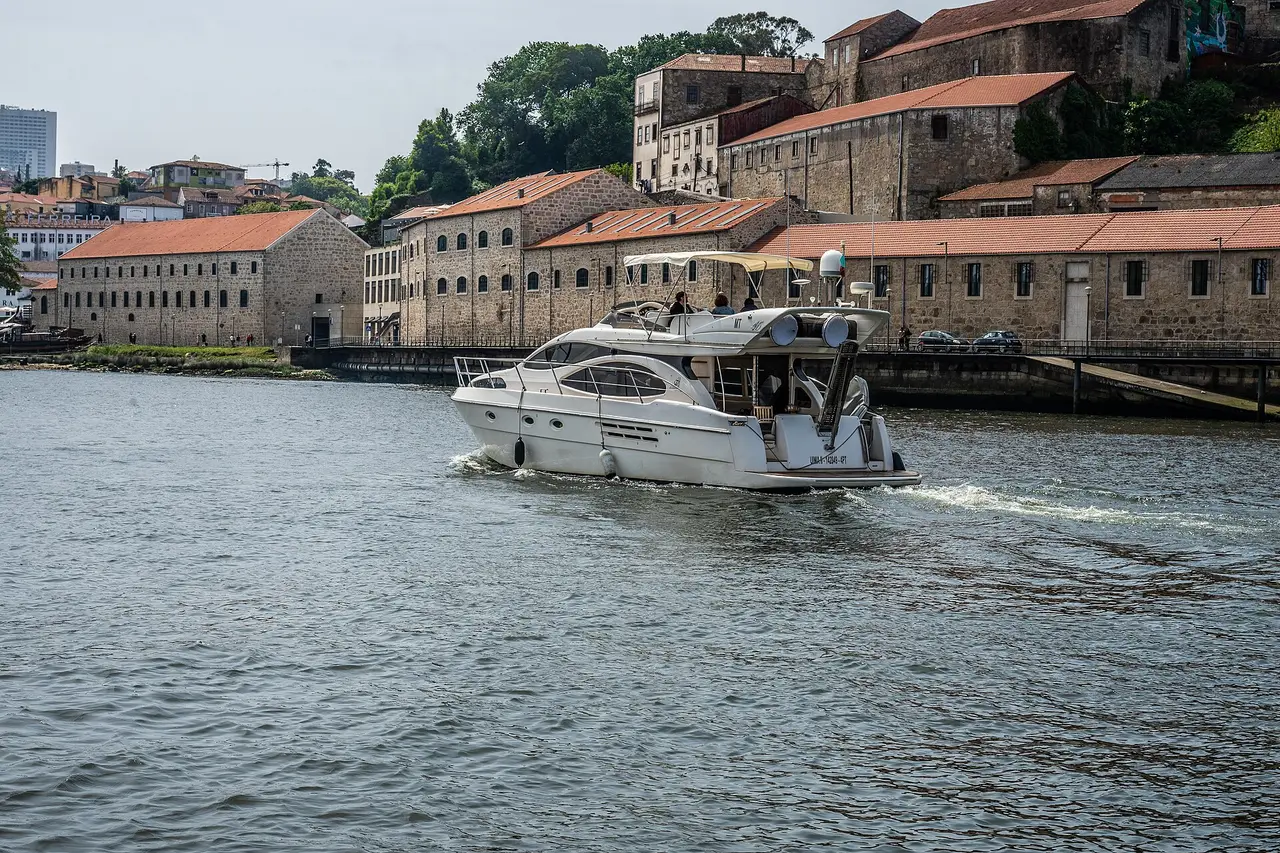
A white motor yacht crossing a river and leaving a foamy wake, with old stone buildings along the far bank.
PhotoA boat on a river moves faster downstream and slower upstream, and timing both trips gives two equations for the boat's speed and the current's speed.Michael Gaylard from Horsham, UK, CC BY 4.0, via Wikimedia Commons

Worked examples

Reveal one step at a time and try to beat it to the next line.

Example 1
A store mixes peanuts worth $6/kg with cashews worth $15/kg to make 30 kg of trail mix worth $9/kg. How many kilograms of each should it use?
Example 2
A boat travels 36 km downstream in 2 h. The return trip of 36 km upstream takes 3 h. Find the speed of the boat in still water and the speed of the current.
Example 3
A school play sold 250 tickets. Adult tickets cost $12 and student tickets cost $8. Ticket sales totalled $2440. How many of each type were sold?
Example 4
Car rental: Company A charges $40 per day plus $0.20 per kilometre. Company B charges $60 per day plus $0.10 per kilometre. For a one-day rental, at what distance do they cost the same, and which is cheaper for a 150 km trip and for a 300 km trip?

Where marks get lost

  • Defining variables vaguely (" = adults"). Say exactly what is counted and in what unit: " = the number of adult tickets sold".
  • Converting percents wrongly: is (not or ), and is (not ).
  • Mixing up the two equations in a mixture problem, for example writing instead of : the value of the mix is its price per kilogram times its total mass.
  • Using for both directions in a current problem. Against the current the speeds subtract: .
  • Stopping at the values of x and y, or not checking that they make sense (whole numbers of tickets, positive amounts) and answering the actual question in a sentence.

Flashcards 8

Steps for a linear-system word problem
Amount equation
Value equation
Simple interest
+ 4 more

Practice

1
For the Robotics Club problem ($5000 split between 4% and 3.5%), which is the best definition of the variables?
2
Leah invested $8000, part at 5% and the rest at 3% simple interest per year. After one year she earned $340 in interest. How many dollars did she invest at 5%?
dollars
3
A jar holds 45 coins, all dimes and quarters, worth $7.65 in total. Let be the number of dimes and the number of quarters. Which system models the situation?
4
Solve the coin problem: 45 dimes and quarters worth $7.65. How many quarters are in the jar?
quarters
5
How many litres of a 10% salt solution must be mixed with a 40% salt solution to make 30 L of a 20% salt solution?
L
6
A plane flies 1200 km with the wind in 2 h. The return trip against the same wind takes 2.5 h. What is the speed of the wind?
km/h
7
Gym A charges a $50 sign-up fee plus $8 per visit. Gym B has no sign-up fee and charges $13 per visit. After how many visits is the total cost the same?
visits
8
What is 3.5% written as a decimal?
9
The length of a rectangle is 3 m more than twice its width. Its perimeter is 36 m. What is its length?
m
10
Solving a ticket problem, a student finds that 87.5 adult tickets were sold. What should the student conclude?
11
Put the steps for solving a word problem with a linear system in order.
  1. 1Write two equations, one for each fact in the problem
  2. 2Verify the values in the original words and state the answer in a sentence
  3. 3Solve the system by substitution, elimination or graphing
  4. 4Define two variables, with units

Spot a mistake on this page? Let us know