Skip to content
Study Hall
Lesson 2 of 5Quadratic Relations
Unit 4 · Lesson 2 of 5

Transformations and Vertex Form

Every parabola in this course is a copy of y = x² that may be stretched or compressed, flipped, and slid to a new position. Learn what a, h and k do in y = a(x − h)² + k, sketch a parabola by hand from its vertex, and find the equation of a parabola from its graph.

6 min read11 practice questionsInteractiveAsk AI about this →

Key things to remember

  1. 1 has vertex and axis of symmetry .
  2. 2 moves the graph up () or down (). moves it right () or left (): has .
  3. 3 reflects in the x-axis (opens down). beyond or stretches vertically; between and (not 0) compresses vertically.
  4. 4From the vertex, the step pattern 1, 3, 5 of becomes , , .
  5. 5Equation from a graph: read , substitute one other point into , and solve for .

A fountain designer wants six identical arcs of water, each starting from a different nozzle around a pool. Every arc has the same shape; only its position changes. Another fountain needs taller, narrower jets, and a third shoots its water downward into a basin. All of these are the same basic curve, the parabola , after it has been moved, stretched or flipped. Once you know how each change shows up in an equation, you can sketch a parabola in seconds without a table of values, and you can go the other way: look at a graph and write its equation. The equation that makes all of this visible is called vertex form, .

Start with the parent parabola . Its table is with . The vertex is and the axis of symmetry is . Notice the step pattern: starting at the vertex, go 1 unit right and 1 unit up to reach ; go 1 more right and 3 up to reach ; then 1 more right and 5 up to reach . The same steps work to the left. This 1, 3, 5 pattern (the first differences of ) lets you sketch any parabola from its vertex. Now change the equation one parameter at a time.

  • Vertical translation, : every -value is more, so the whole graph slides up units if or down if . The vertex moves to . Example: is moved down 2, vertex .
  • Horizontal translation, : the graph slides right units if or left if . The vertex moves to . Example: moves right 3, because the bracket becomes (the lowest output) when . And moves left 2, with vertex .
  • Vertical stretch or compression, with : every -value is multiplied by . If the graph is stretched vertically and looks narrower; if it is compressed vertically and looks wider. The step pattern becomes : for the steps are 2, 6, 10.
  • Reflection in the x-axis, : every -value changes sign, so the parabola flips and opens down. With the graph is reflected, and it is also stretched if or compressed if . For the steps are .
Loading interactive…
Choose the parent x² and drag the sliders. The sim uses different letters: its a is the a of this lesson, its d slider (horizontal shift) plays the role of h, and its c slider (vertical shift) plays the role of k. Keep the sim's k slider at 1, because that slider is a horizontal stretch, which this lesson does not use.
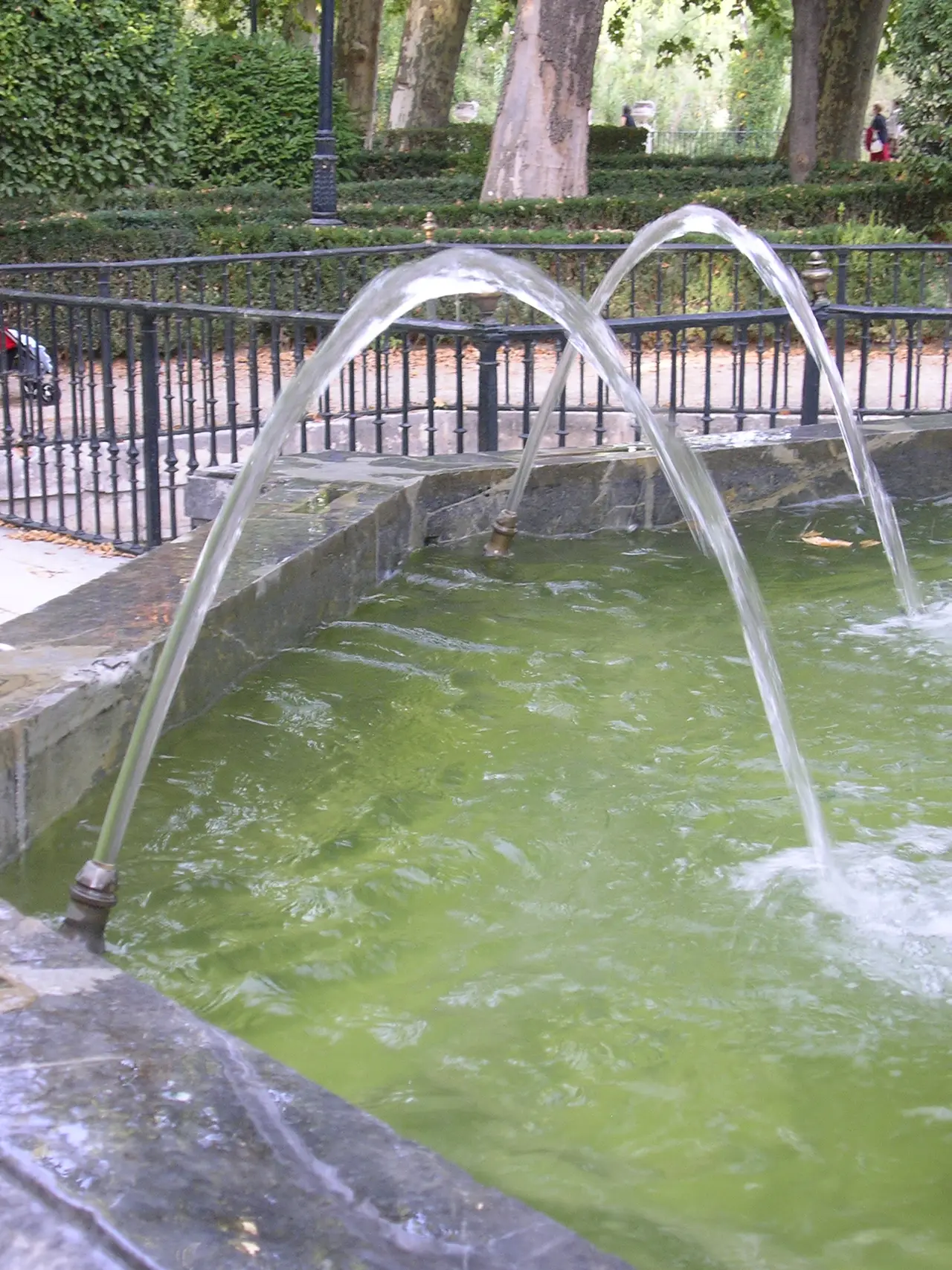
Two arcing jets of water from nozzles at the edge of a stone fountain pool
PhotoThese two jets have the same shape but start from different nozzles, so one arc is a translation of the other, just like shifting y equals x squared.GuidoB, CC BY-SA 3.0, via Wikimedia Commons

Putting it together: vertex form

ParameterWhat it doesExample
opens up; vertex is a minimum: minimum value
reflection in the x-axis; opens down; vertex is a maximum: maximum value
or vertical stretch (narrower); a < −1 also reflects: steps
, vertical compression (wider); a < 0 also reflects: steps
horizontal translation: right if h > 0, left if h < 0: left 5,
vertical translation: up if k > 0, down if k < 0: down 6
The roles of a, h and k in y = a(x − h)² + k
−4−3−2−11234567−6−4−22468xyright 3, up 4(3, 4)(6, −0.5)(5, 2)(4, 3.5)Start: y = x²Step 1: reflect in the x-axisand compress by ½y = −½x²Step 2: translate 3 rightand 4 upy = −½(x − 3)² + 4Steps from the vertexover 1, down ½over 1, down 3/2over 1, down 5/2(1, 3, 5 times −½)
Fig 1Building y = −½(x − 3)² + 4 from y = x². The dashed parent is first reflected in the x-axis and compressed by a factor of one half (dotted), then translated 3 right and 4 up (solid). The marked points come from the step pattern −½, −3/2, −5/2.
  1. Read , and . Watch the sign of : in , and .
  2. Plot the vertex and draw the axis of symmetry as a dashed line.
  3. From the vertex, step 1 unit right and 1 unit left and move units vertically (down if is negative). Then step 1 more and move , then 1 more and move .
  4. Join the points with a smooth U-shaped curve (not a V), and label the vertex and the equation.

Why does this order work? Each point on goes to on : first multiply the -coordinate by (stretch, compress or reflect), then add to and to (translate). For example, the point on goes to on . If you translated first and then multiplied by , you would also multiply by and put the vertex in the wrong place.

Count the zeros without solving
Vertex form tells you how many zeros there are. If and , the lowest point is above the x-axis: no zeros. If and , the highest point is below it: no zeros. If , the vertex is on the x-axis: one zero. If and have opposite signs, the parabola crosses the x-axis twice.
VideoSee how a, h and k in vertex form stretch, reflect and translate the parent parabola y equals x squared.Watch on YouTube

Finding the equation from a graph

To write the equation of a parabola you are shown, read the vertex from the graph and substitute it into . The vertex alone does not fix the shape, so pick one more point on the curve whose coordinates you can read exactly (a grid point), substitute it, and solve for . Then check: does the sign of match the direction of opening? Does the step pattern from the vertex land on the graph? The Parabola Forms Lab below lets you test your answer by dragging the vertex and editing .
Loading interactive…
Edit a, h and k in the vertex form panel or drag the vertex on the graph. Tick the box that shows y = x² and the transformations to compare your parabola with the parent.
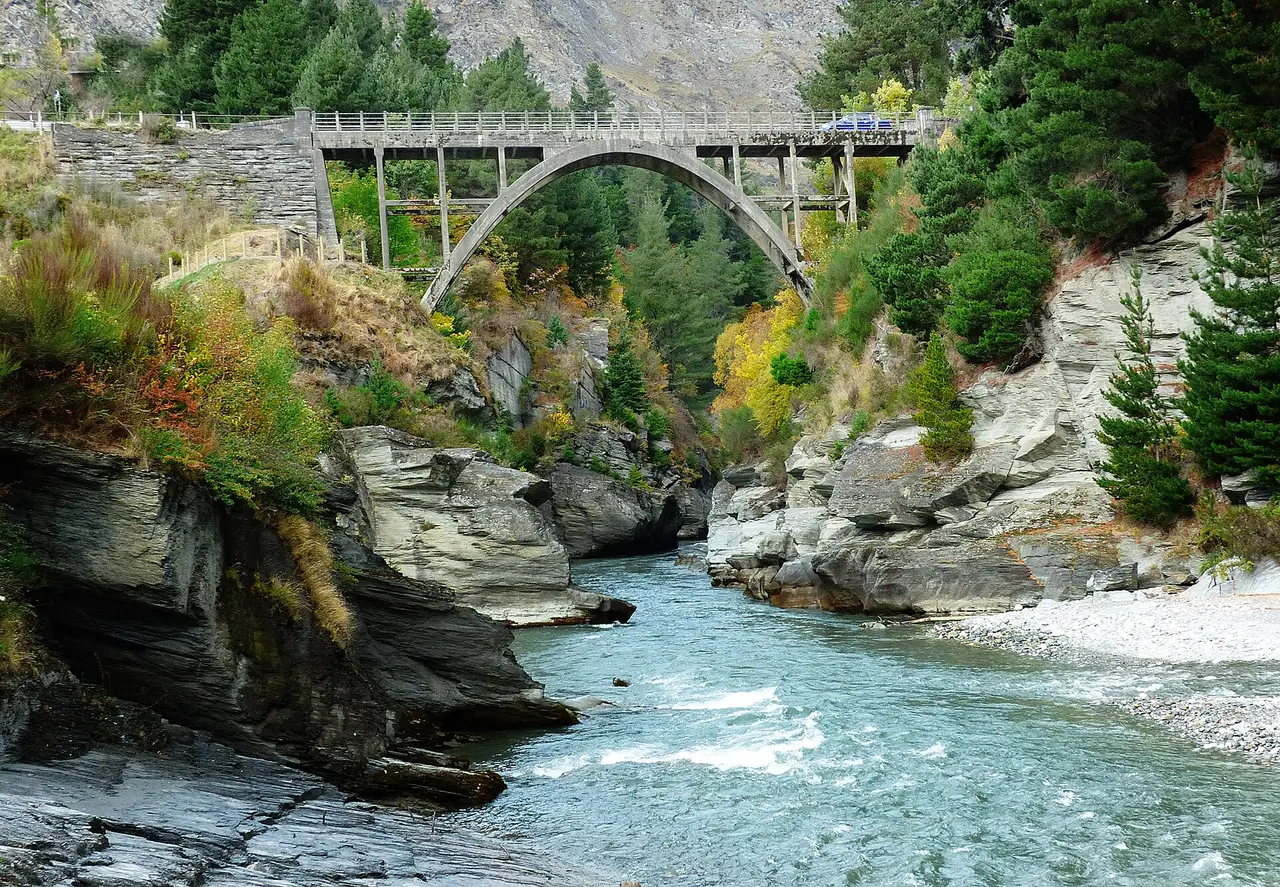
A concrete arch bridge spanning a rocky river gorge with green and autumn trees
PhotoAn arch like the one under this bridge in New Zealand can be modelled with a parabola: with the vertex at the top and one point where it meets the rock, you could write its equation in vertex form.Bernard Spragg. NZ from Christchurch, New Zealand, CC0, via Wikimedia Commons

Worked examples

Reveal one step at a time and try to beat it to the next line.

Example 1
Sketch by transforming . State the vertex, axis of symmetry and maximum value.
Example 2
For , describe the transformations of , then find the vertex, the -intercept and the zeros.
Example 3
A parabola has its vertex at and passes through the point . Find its equation in vertex form.
Example 4
A parabolic arch over a walking path is 8 m wide at the ground and 4 m tall at its centre. Place the vertex at , with the ground along the x-axis. Find the equation, then decide whether a trailer 2 m wide and 3 m tall can pass through if it stays centred.

Where marks get lost

  • Reading with the wrong sign. In the graph moves left 4 and the vertex is , because .
  • Thinking is narrower than . Multiplying the -values by is a vertical compression, so the graph is wider.
  • Stepping 1, 3, 5 from the vertex without multiplying by . For the steps are 3, 9, 15.
  • Treating as the -intercept. For the -intercept is ; is the minimum value.
  • When finding , forgetting to square the bracket: gives , not .

Flashcards 8

Vertex form
Effect of
Effect of
Effect of a negative
+ 4 more

Practice

1
What is the vertex of ?
2
How is the graph of related to the graph of ?
3
Match each equation with how it changes the graph of .
4
What is the -intercept of ?
5
Write the equation of the axis of symmetry of .
6
Which statement describes ?
7
A parabola has vertex and passes through . Find in .
8
The point is on . After the transformations that give , its image is . Find .
9
How many zeros does have?
10
Which parabola has vertex , opens down and is narrower than ?
11
Put the steps for sketching by hand in order.
  1. 1Plot the vertex (h, k) and draw the axis of symmetry x = h.
  2. 2Join the plotted points with a smooth curve.
  3. 3From the vertex, step 1 unit left and right at a time, moving vertically a, then 3a, then 5a.
  4. 4Read the values of a, h and k from the equation.

Spot a mistake on this page? Let us know