A surveyor wants the width of a river without crossing it. A coast guard dispatcher needs the distance between two boats. A landscaper needs the angle at the corner of a triangular lot. Each of these is a triangle problem, but none of them says "use the sine law". The work in this lesson is deciding: turning words into a labelled sketch, spotting which measures you have, and picking the tool that can actually use them. Sometimes one tool finishes the job; often you need two in a row, where the answer from the first becomes a given for the second.
- Sketch the triangle roughly to shape and label the vertices. Put each given measure in its place.
- Mark the unknown with a question mark, and name the sides by their opposite angles.
- Choose the tool from what is given (see the chart below). If two angles are known, find the third angle first.
- Solve, keeping unrounded values in your calculator from one step to the next.
- Check that the answer is reasonable, then state it in a sentence with units, sides to one decimal place and angles to the nearest degree.
| What you know | Name | First tool | Then |
|---|---|---|---|
| Two angles and a side not between them | AAS | Sine law | Angle sum, then the sine law for the last side |
| Two angles and the side between them | ASA | Angle sum (third angle) | Sine law for the other sides |
| Two sides and the angle between them | SAS | Cosine law for the third side | Sine law for an angle (opposite the shorter known side), then the angle sum |
| Three sides | SSS | Cosine law for the largest angle | Cosine law or sine law for a second angle, then the angle sum |
| Two sides and an angle opposite one of them | SSA | Sine law for an angle | Angle sum, then the sine law (in an acute triangle; the ambiguous case is Grade 11) |
- Needs a complete opposite pair: an angle and the side across from it.
- Finds a side: .
- Finds an angle with ; correct in an acute triangle.
- Cases: AAS, ASA (after the angle sum), SSA.
- Needs SAS or SSS: no complete pair is required.
- Finds a side: .
- Finds an angle with : .
- Cases: SAS, SSS. More arithmetic, so watch the order of operations.
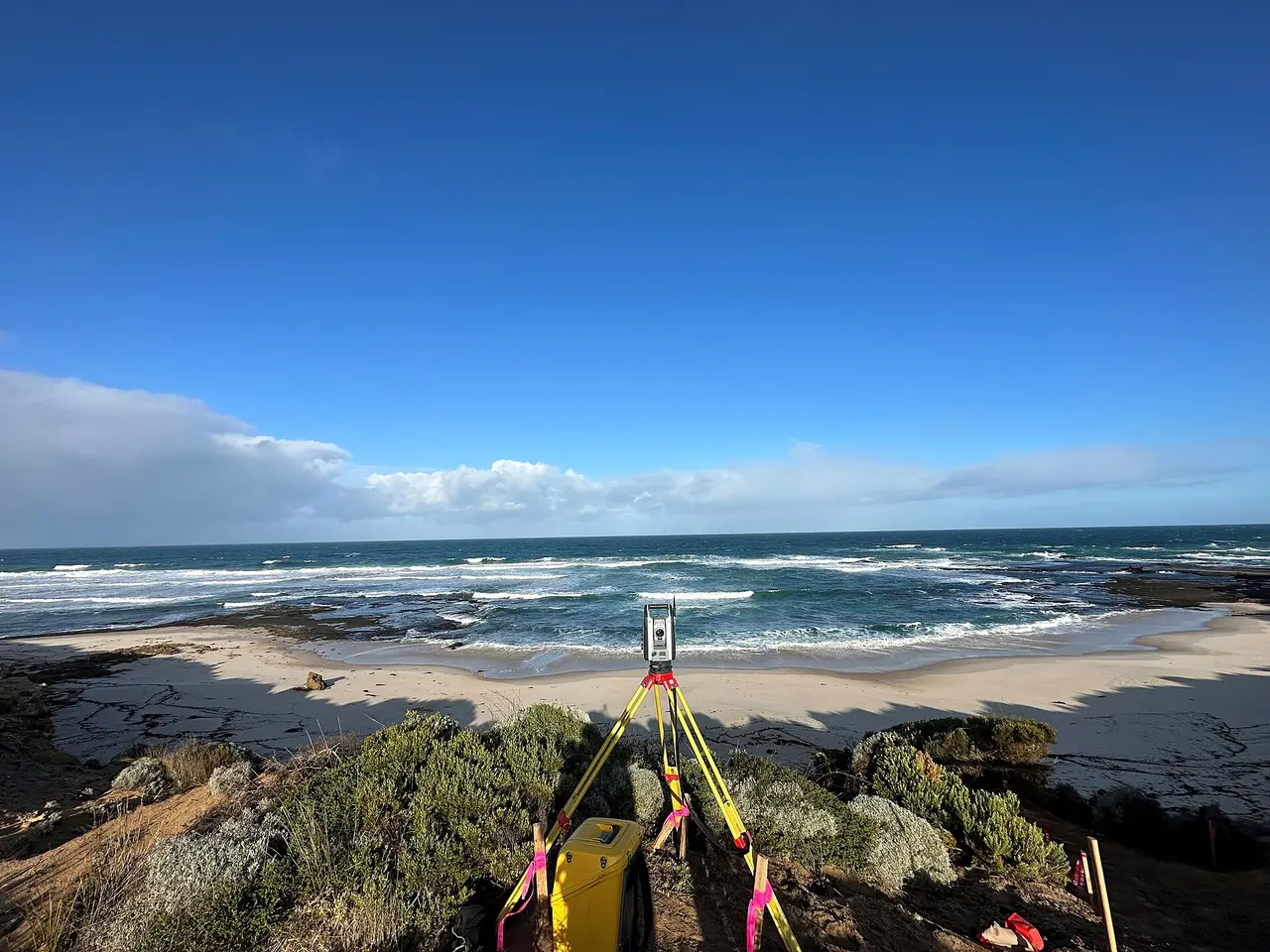
Problems that take more than one step
Here is a classic. Two stakes, and , are 150 m apart on one bank of a river. A tree stands on the far bank. The angle between and the line of sight to the tree is at and at . How wide is the river? The width is the perpendicular distance from the tree to the line , which is not a side of triangle . So the plan has two stages. First, solve the oblique triangle: , and the sine law gives . Second, drop a perpendicular from to . It makes a right triangle with hypotenuse and angle at , so the width is , straight from SOH CAH TOA. Working out the numbers gives a width of about 183.3 m (see the first worked example). Mixing the new laws with right-triangle trig like this is very common.
Checking your answers
- The three angles should add to (rounded angles may be off by ; the unrounded ones should not).
- The longest side should face the largest angle, and the shortest side the smallest angle.
- Each side must be shorter than the other two sides added together.
- A second route should agree: if you found a side with the cosine law, the sine law ratio should match for the finished triangle.
- A sketch to scale (or the triangle solver above) should look like your numbers.