Physics
Grade 12 University Preparation, following the Ontario curriculum.
- 5 units
- 27 lessons
- 294 practice questions
- 221 flashcards
- 4 simulators
Units
Dynamics
Forces and motion in a plane: projectiles and relative velocity, inclines and friction, connected objects and accelerating frames, and the forces behind uniform circular motion.
Energy and Momentum
The two quantities that are never created or destroyed: work and energy with friction and springs, simple harmonic motion, impulse, and collisions in one and two dimensions.
Gravitational, Electric, and Magnetic Fields
Forces that act across empty space: gravity and orbits, electric forces, fields and potential, and the magnetic force on moving charges and currents.
The Wave Nature of Light
Interference, diffraction, thin films and polarization: the evidence that light is a transverse electromagnetic wave, the mathematics that measures its wavelength, and the technologies built on it.
Revolutions in Modern Physics
Where classical physics breaks: time and length that depend on motion, light that arrives in packets, matter that diffracts like a wave, and the small set of particles everything is made of.
- 1Special Relativity
- 2Mass-Energy Equivalence and Relativistic Energy
- 3Blackbody Radiation and Planck's Quantum Hypothesis
- 4Photons and the Photoelectric EffectInteractive
- 5Matter Waves and Wave-Particle Duality
- 6The Uncertainty Principle and Probability WavesInteractive
- 7The Standard Model of Particle Physics
Simulators
Simulators for every course →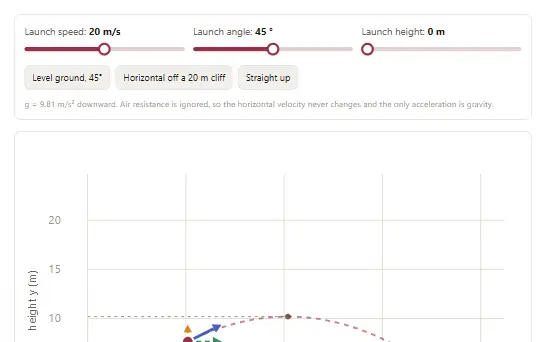
 SPH4U
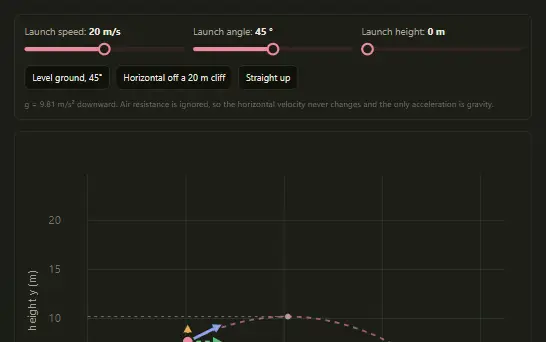
Set launch speed, angle and height and watch the path split into independent horizontal and vertical motion, with range, maximum height and flight time.
 SPH4U
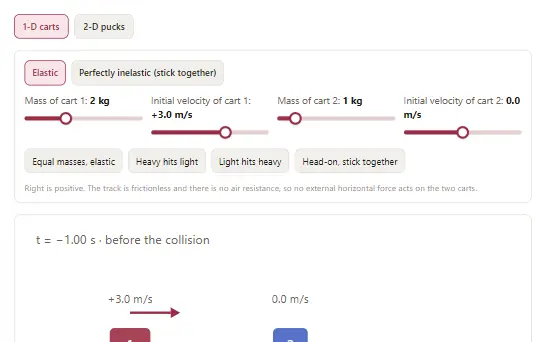
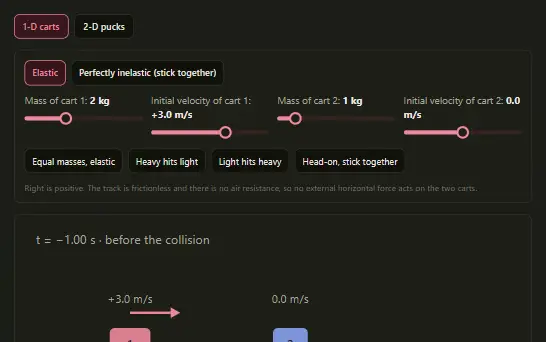
Collide two carts or pucks in one or two dimensions, elastic or perfectly inelastic, and check that momentum is conserved while kinetic energy may not be.
 SPH4U
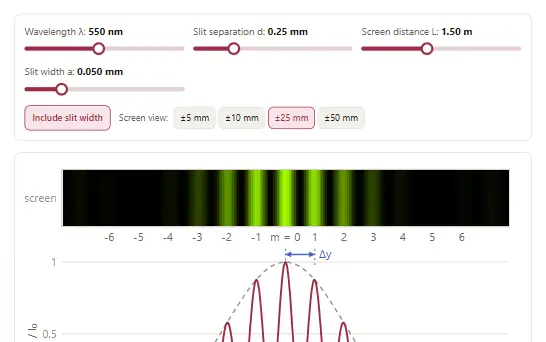
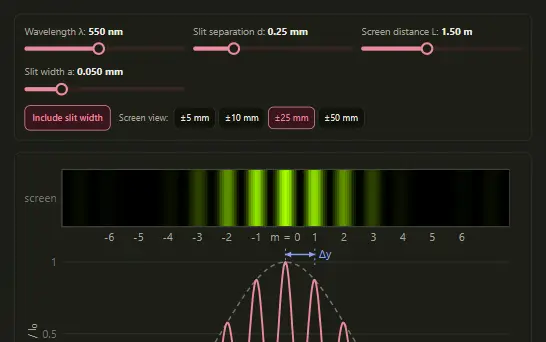
Change the wavelength, slit separation and screen distance and watch the bright fringes spread out or bunch together, with the fringe spacing calculated as you go.
 SPH4U
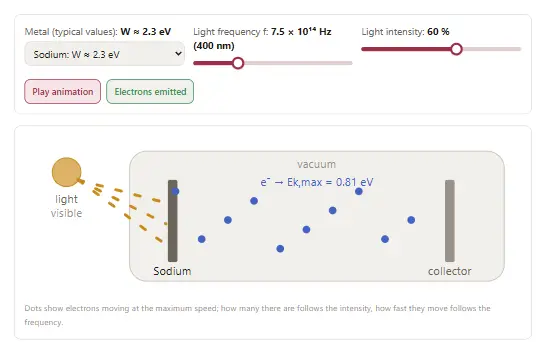
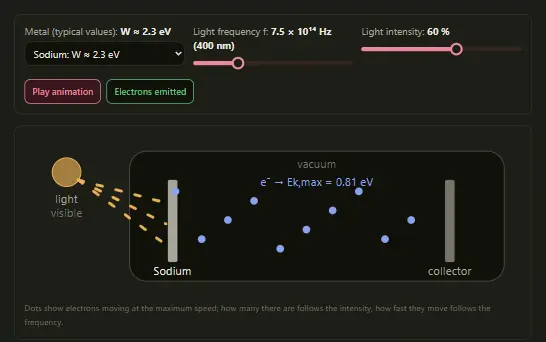
Shine light of any frequency and intensity on a metal and see why frequency, not brightness, decides whether electrons escape and how fast they leave.