Calculus and Vectors
Grade 12 University Mathematics, following the Ontario curriculum.
- 6 units
- 29 lessons
- 282 practice questions
- 215 flashcards
- 4 simulators
Units
Rates of Change & Limits
How fast is something changing right now? Secants give average rates over an interval, limits shrink that interval to a single point, and the result is the derivative, the idea the rest of calculus is built on.
Derivative Rules
Stop taking limits by hand: the power, sum, product, chain and quotient rules, then the derivatives of sine, cosine, eˣ and aˣ, so any function in the course can be differentiated in a few lines.
Curve Sketching
Use the first and second derivatives to find exactly where a graph rises, falls, turns and bends, then put it all together to sketch polynomial and simple rational functions, and to read a function's story from the graph of its derivative.
Applications of Derivatives
Put the derivative to work: velocity and acceleration of moving objects, instantaneous rates in population, decay, temperature, daylight, tides and prices, and optimization problems that find the biggest box, the cheapest can and the fare that earns the most.
Vectors
Quantities with a direction: describe them three ways, add and scale them, write them as components in 2-space and 3-space, steer planes through the wind, and multiply them with the dot and cross products.
Lines & Planes
Describe lines and planes with scalar, vector and parametric equations, sort out how lines and planes meet in 3-space, solve systems of three equations as three planes, and measure the shortest distances between them.
Simulators
Simulators for every course →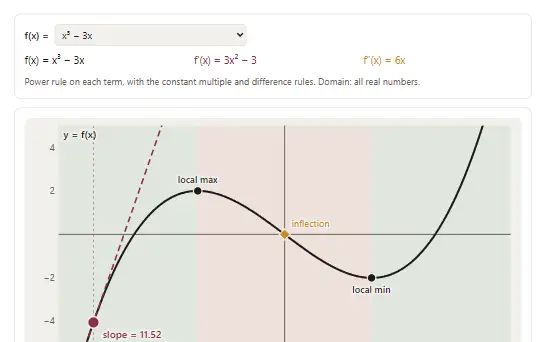
 MCV4U
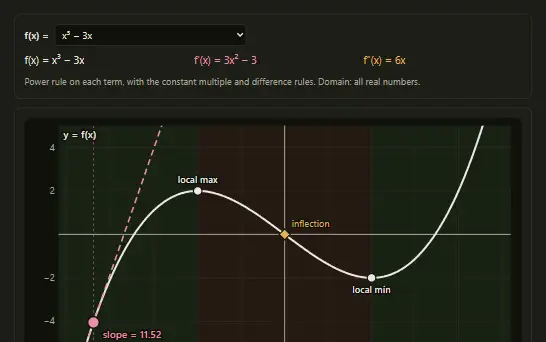
Slide a point along a function to watch its tangent slope, trace the graph of f′ point by point, and see where f′ and f″ reveal maxima, minima and inflection points.
 MCV4U
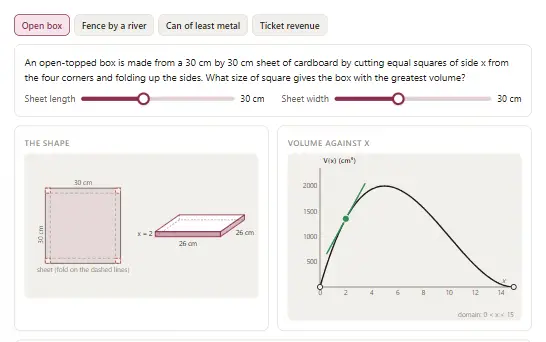
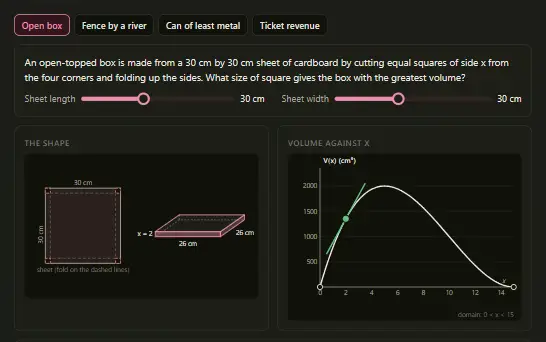
Build a box, fence a field, design a can or price a ticket, then use the derivative to find the size or price that gives the best result.
 MCV4U
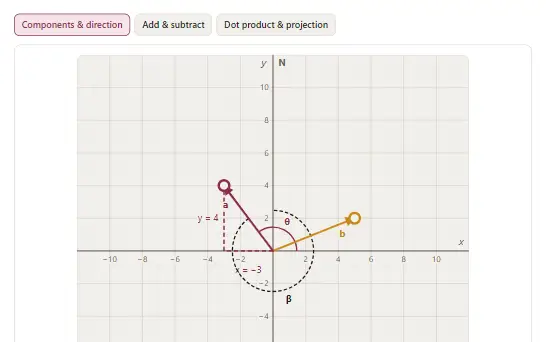
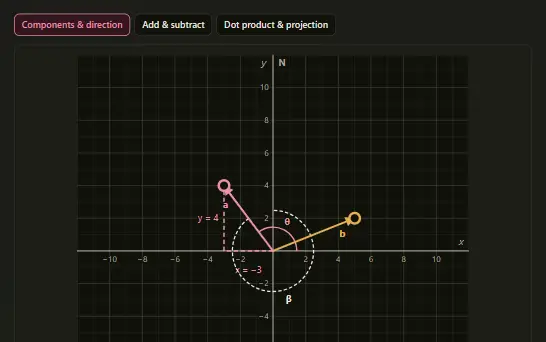
Drag two vectors to see their components, magnitude, angle and bearings, add and subtract them tip-to-tail or by parallelogram, and watch the dot product and projections change.
 MCV4U
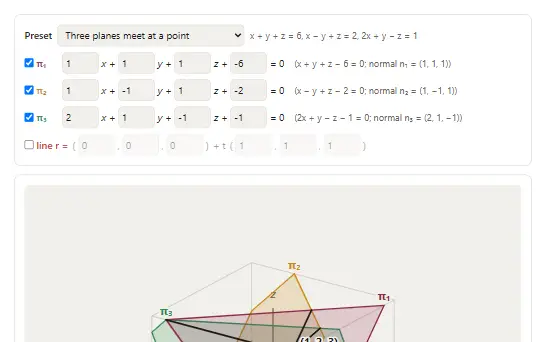
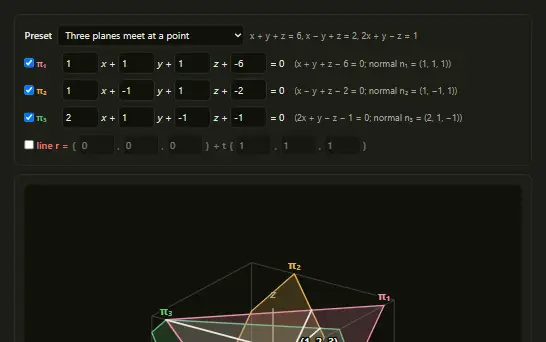
Rotate a 3-D view of up to three planes and a line from their equations to see where they meet (a point, a line, or nowhere) and solve the system step by step.