Loosening a stuck bolt with a wrench depends on three things: how hard you push, how far from the bolt you push, and the angle between your push and the handle. Push along the handle and nothing turns; push square to it at the very end and you get the most turning effect. Notice too that the bolt turns about an axis that is perpendicular to both the handle and your push. A product that takes two vectors and returns a vector perpendicular to both, with a size that grows with , is exactly what this situation needs. That is the CROSS PRODUCT, and in this course it is defined only for vectors in 3-space.
The definition
A reliable way to remember it: write the components of in a row, then those of underneath. To get the first component, cover the first column and cross-multiply what is left: . For the second component, cover the second column but cross-multiply in the order that starts from the THIRD column, (this is the one people get backwards). For the third, cover the third column: . Always check your answer by dotting it with and with : both results must be .
- Direction: is perpendicular to both and . Point the fingers of your right hand along and curl them toward ; your thumb points along (the RIGHT-HAND RULE).
- Magnitude: , where is the angle between the vectors tail to tail.
- Unit vectors: , , , and reversing any pair gives the negative.
Properties
| Property | Statement |
|---|---|
| Anti-commutative | |
| Collinear vectors | , and since |
| Distributive | |
| Scalars factor out | |
| Perpendicular to both | and |
| Not associative | , but |
Torque
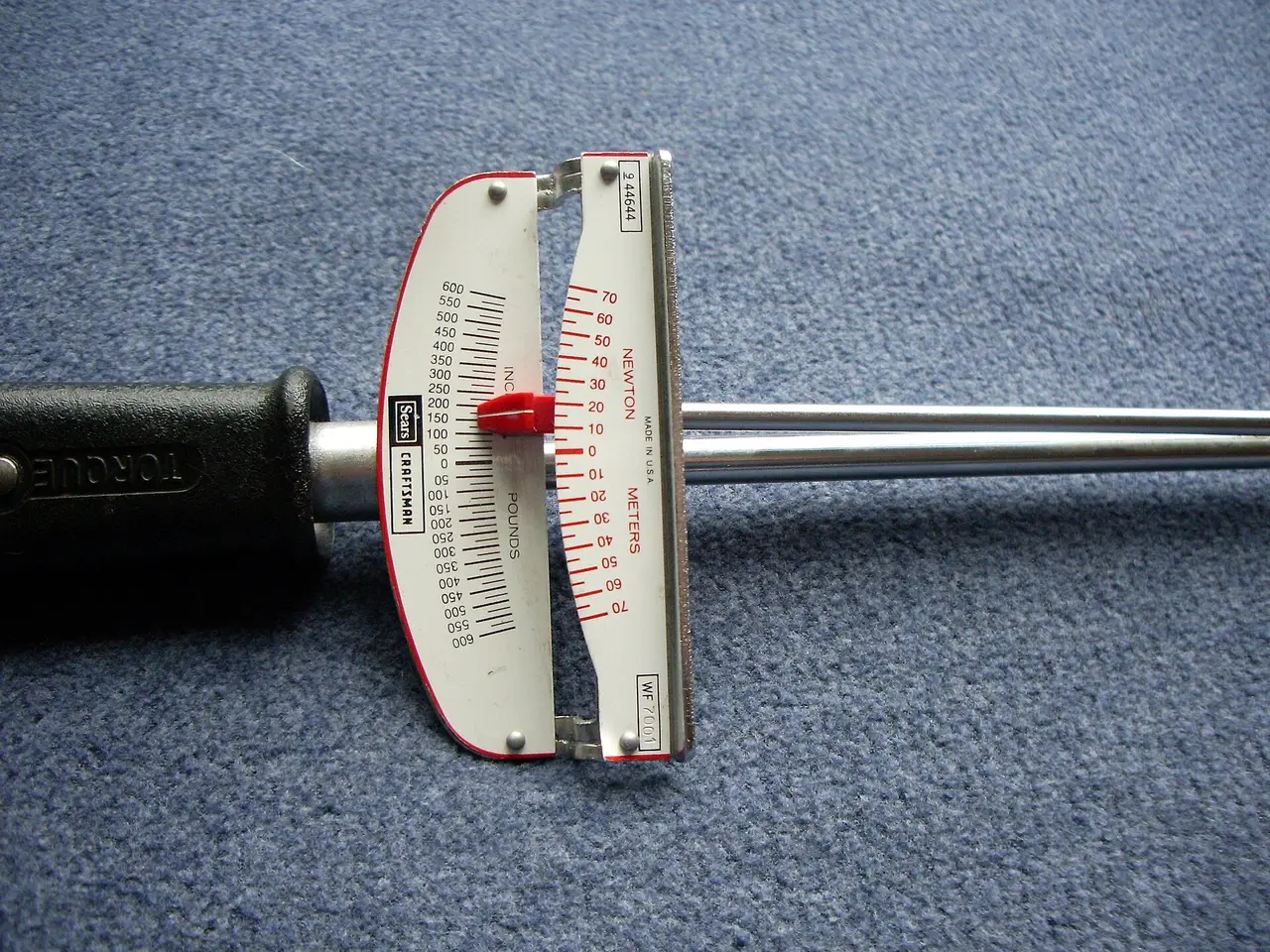
The turning effect of a force is the TORQUE, , where runs from the pivot (the bolt) to the point where the force acts. Its magnitude is newton-metres, and its direction (by the right-hand rule) lies along the axis the bolt turns about. To maximize torque, push at the far end of the handle (large ) and at to it (). In a cramped engine bay you often cannot swing the handle far. A ratchet lets the wrench turn the bolt one way and click freely back the other, so you can make short strokes and reset your grip each time, keeping the push close to instead of lifting the wrench off and refitting it.
Volume of a parallelepiped
A parallelepiped is a slanted box whose edges from one corner are , and . Its base, the parallelogram on and , has area , and is perpendicular to that base. The height is the scalar projection of onto . Multiplying base by height leaves , the absolute value of the SCALAR TRIPLE PRODUCT. If it equals , the box is flat: the three vectors lie in one plane (they are coplanar).