Chemistry
Grade 12 University Preparation, following the Ontario curriculum.
- 5 units
- 26 lessons
- 265 practice questions
- 220 flashcards
- 3 simulators
Units
Organic Chemistry
Carbon's ability to form four bonds, long chains and rings gives millions of compounds, and a handful of naming rules, functional groups and reaction types let you predict how each one behaves.
Structure and Properties of Matter
How the arrangement of electrons inside atoms decides how atoms bond, what shape molecules take, and why a substance is a gas, a brittle crystal, a hard gem or a shiny metal.
Energy Changes and Rates of Reaction
How much energy a reaction releases or absorbs, how to measure and predict that energy with calorimetry, Hess's law and bond energies, and why some reactions are explosive while others take years.
Chemical Systems and Equilibrium
Many reactions never run to completion: they settle into a dynamic balance that can be described with an equilibrium constant, pushed around by changing conditions, and used to calculate pH, solubility and the shape of a titration curve.
Electrochemistry
Redox reactions move electrons from one substance to another. Keep track of those electrons and you can balance any redox equation, build a battery, predict whether a reaction will happen, and explain electroplating and rust.
Simulators
Simulators for every course →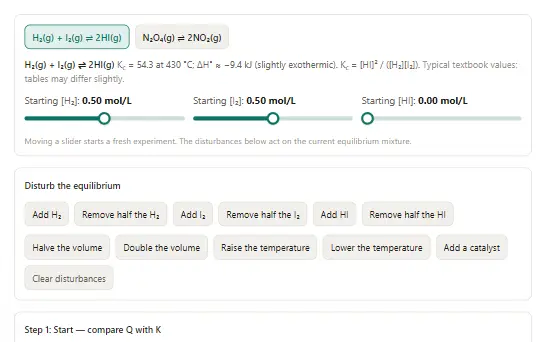
 SCH4U
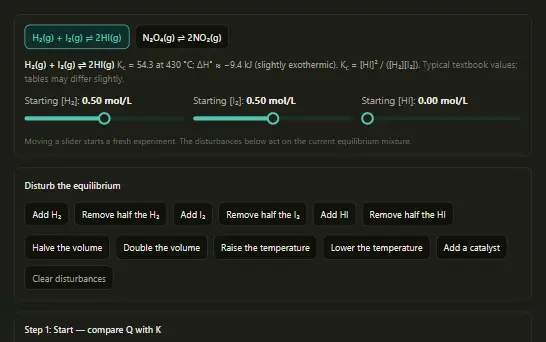
Build an ICE table, compare the reaction quotient with K, and disturb the system with concentration, pressure or temperature changes to see which way it shifts.
 SCH4U
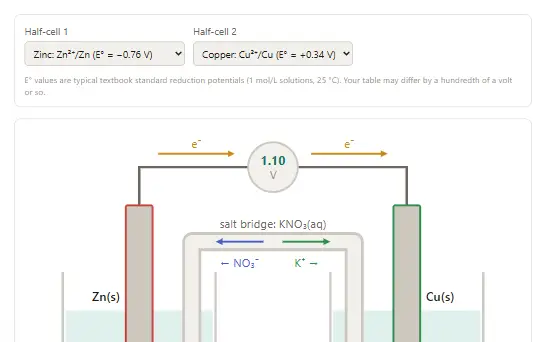
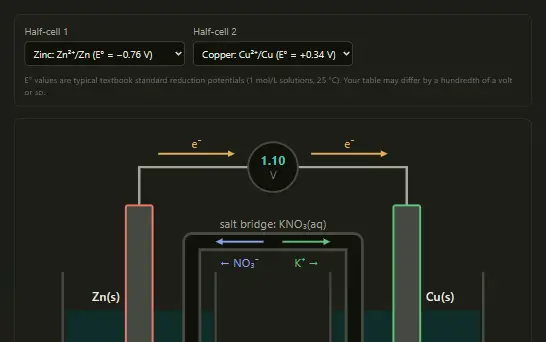
Pick two half-cells, find the anode and cathode, follow the electrons and ions, and calculate the standard cell potential.
 SCH4U
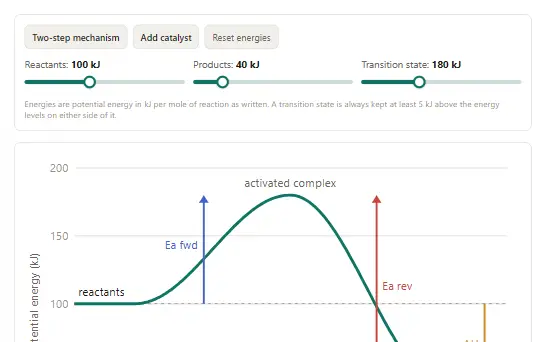
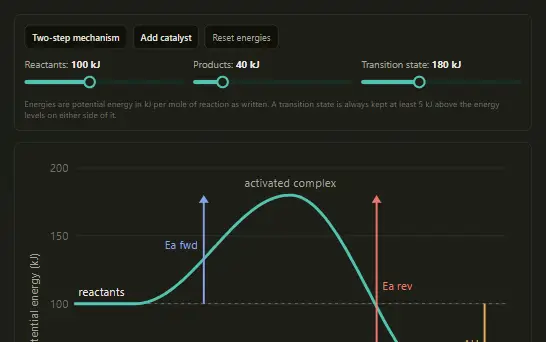
Set the energies of the reactants, products and transition state, add a catalyst, and read the enthalpy change and activation energy straight off the diagram.