Skip to content
Study Hall
Lesson 4 of 10Trigonometric Functions
Unit 4 · Lesson 4 of 10

The Sine Law

SOH CAH TOA only works in right triangles — the sine law extends triangle-solving to ANY triangle, whenever you have a matched angle/side pair.

6 min read11 practice questionsAsk AI about this →

Key things to remember

  1. 1Sine law: , or flipped for angles: .
  2. 2Each side is paired with the angle directly opposite it.
  3. 3Use the sine law when you know an angle and its opposite side (ASA, AAS, or SSA).
  4. 4Angles in any triangle always sum to .
  5. 5It comes from writing the same altitude two ways: .
  6. 63D problems: split into flat triangles that share a side; solve the one with enough information first.

Most real triangles don't have a convenient right angle. A surveyor who wants the distance across a river, a forest-fire lookout triangulating smoke from two towers, or a navigator fixing a ship's position all end up with a triangle whose angles are anything but . The sine law relates every side of a triangle to the sine of its OPPOSITE angle, and holds true in every triangle, right or not. Its message is simple: bigger angles sit across from longer sides, in a precise, proportional way.
Lower-case letters are sides; the matching upper-case letter is the angle directly OPPOSITE that side.
ABCabcsinA/a = sinB/b = sinC/cUse when you know:AAS — two angles + a non-included sideASA — two angles + the included side
Fig 1Side a is opposite angle A, side b is opposite angle B, and side c is opposite angle C.
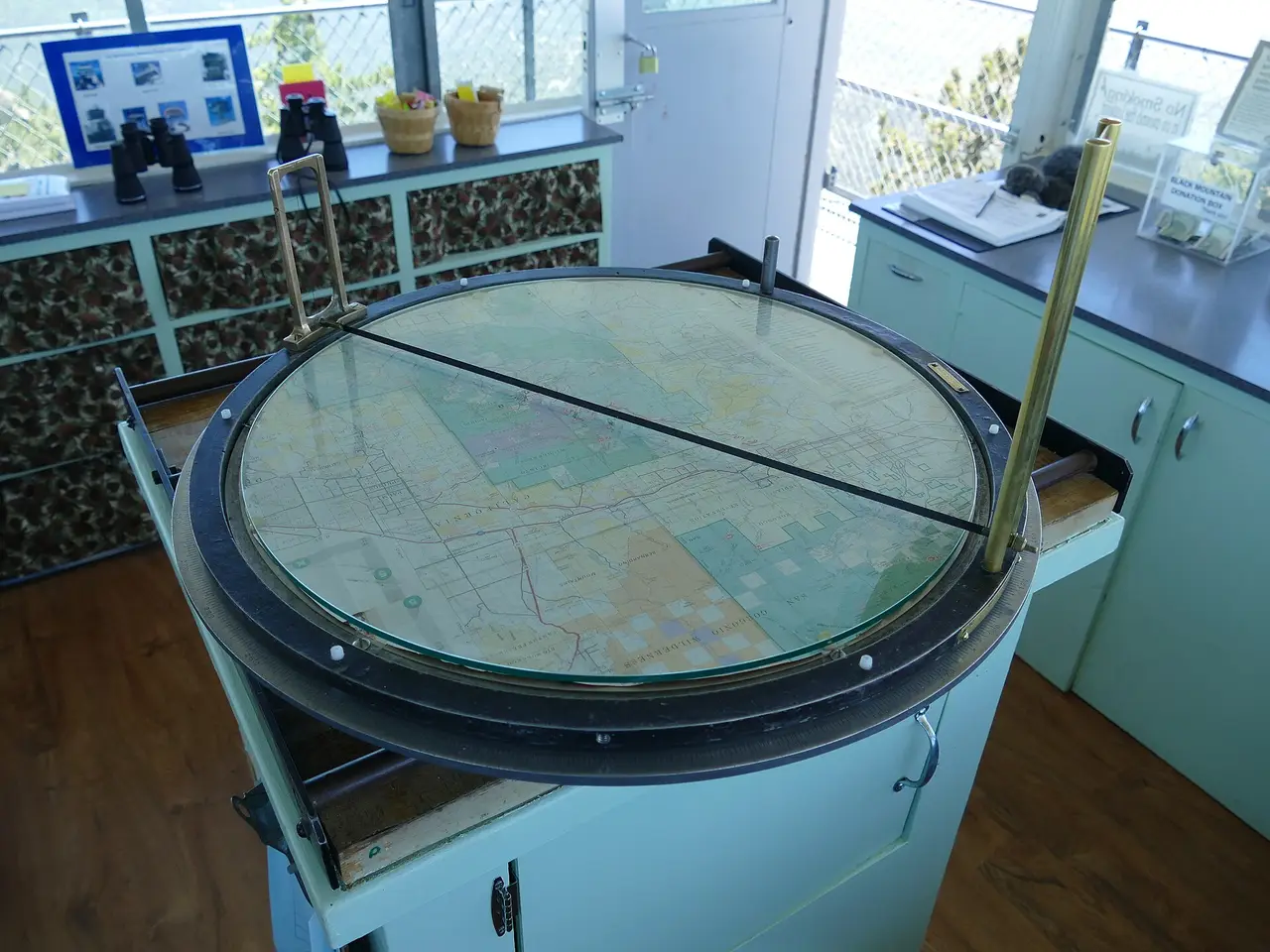
A round table-top instrument with a map under glass, a brass sighting arm across it and upright sights at each end, inside a lookout cabin with windows.
PhotoAn Osborne Fire Finder in a fire lookout, used to sight the direction of smoke. When two lookouts a known distance apart each take a direction, the two sight lines and the line between the towers form a triangle that the sine law can solve.signal mirror, CC0, via Wikimedia Commons

Why the sine law is true

Take any triangle and drop a perpendicular (the altitude ) from down to side . It splits the triangle into two right triangles, so SOH CAH TOA applies to each. In the left one, is opposite angle and is the hypotenuse, so , giving . In the right one, is opposite angle and is the hypotenuse, so . Both expressions equal the same height, so they equal each other. Dividing both sides by gives the first half of the sine law. Dropping the altitude from a different vertex brings in and the same way. If the triangle is obtuse, the altitude falls outside, but because the same equation still comes out.

VideoKhan Academy drops an altitude and writes its length two ways using sine, the same argument this section uses to show the sine law holds in every triangle. Law of sines is the American name for the sine law.Watch on YouTube

When to use the sine law

The sine law needs at least one complete angle/opposite-side PAIR that you already know. It applies to two classic situations: ASA or AAS (two angles and a side — find the third angle by subtracting from , then use the sine law for the remaining sides), and SSA (two sides and a non-included angle — the trickier 'ambiguous case,' covered in the next topic). When you are solving for an ANGLE, flip every fraction first so the unknown is on top: . This form is equally true and saves an algebra step.

What you are givenTool to start with
A right triangleSOH CAH TOA (faster than either law)
AAS or ASA (two angles, one side)Sine law, after finding the third angle
SSA (two sides, a non-included angle)Sine law, then check for a second triangle
SAS (two sides, the included angle)Cosine law
SSS (three sides)Cosine law
How to recognize which method to use.
When the sine law can't start
If you only know three sides (SSS) or two sides with the INCLUDED angle (SAS), the sine law can't get started — you don't have a full angle/side pair yet. Use the cosine law instead.

Solving with the sine law

  1. Sketch and label the triangle: lower-case letters for sides, matching upper-case letters for the OPPOSITE angles.
  2. If two angles are known, find the third by subtracting from (angles in a triangle always sum to ).
  3. Use only two of the three ratios at a time (a matched pair you know, and the unknown pair) — cross-multiply to solve.
  4. For a side, put sides on top: . For an angle, put sines on top: , then apply .
  5. Check: the longest side must be opposite the largest angle, and the shortest side opposite the smallest angle.

One trap deserves its own warning. For the positive ratios that come up in a triangle, the inverse sine key only returns an angle between and , yet a triangle can contain an obtuse angle, and has the same value for and . So when the sine law hands you an ANGLE, ask whether the obtuse partner could also fit. Two quick tests settle it: if the side opposite the unknown angle is shorter than the known side in your pair, the unknown angle must be smaller than the known angle, so it cannot be obtuse; and if adding the obtuse partner to the known angle already reaches , it is impossible. A safe habit when you have a choice is to use the sine law for the SMALLEST unknown angle (opposite the shortest side), since that angle is always acute, then finish with the angle sum. This is exactly how forest-fire lookouts triangulate smoke: two towers a known distance apart each measure an angle, the third angle comes from the angle sum, and the sine law gives the distance from each tower to the fire.

VideoTwo worked examples of setting up the sine law with a known side and its opposite angle, one to find a side and one to find an angle.Watch on YouTube

The sine law in 3D problems

A 3D problem is really two (or more) flat triangles standing in different planes that share one side. The classic setup: two observers on level ground look at the base of a tower (a horizontal, oblique triangle) and one of them measures the angle of elevation to the top (a vertical, right triangle). Redraw each triangle flat on its own, mark which angles are horizontal and which are vertical, and solve the triangle that already has enough information first. The side it produces, often the ground distance from an observer to the base, is then carried into the other triangle. The sine law usually handles the ground triangle; SOH CAH TOA finishes the vertical one. A labelled sketch of each triangle is worth more here than anywhere else in the unit, because a 3D diagram on paper distorts angles: a right angle at the base of a tower rarely LOOKS like in a perspective drawing.

Keep full precision
Store intermediate answers in your calculator's memory instead of retyping rounded values. In a two-stage problem, rounding the shared side to one decimal can shift the final height by several tenths.

Worked examples

Reveal one step at a time and try to beat it to the next line.

Example 1
In , , , and cm. Find , , and .
Example 2
In , , , and m. Find .
Example 3
In , , cm and cm. Find angle and angle to the nearest tenth of a degree.
Example 4
Two surveyors, and , stand m apart on level ground. The base of a tower makes horizontal angles and . From , the angle of elevation to the top of the tower is . Find the tower's height to the nearest tenth of a metre.

Where marks get lost

  • Pairing a side with the WRONG angle — always match each side to the angle directly opposite it, never an adjacent one.
  • Trying to apply the sine law to an SSS or SAS triangle where no full angle/side pair is known yet.
  • Forgetting that a triangle's angles must sum to when a third angle is needed.
  • Rounding intermediate angle or side values too early, which can shift later answers noticeably.
  • In 3D problems, mixing a horizontal angle and an angle of elevation in the same triangle — each flat triangle only uses angles that lie in its own plane.

Flashcards 8

Sine law
When to use sine law
Angle sum in a triangle
What sine law CANNOT start from
+ 4 more

Practice

1
In , . Find (round to 2 decimals).
2
Which set of given information lets you start directly with the sine law?
3
In , . Find angle .
°
4
Using from above, find side (round to 2 decimals).
5
In the sine law, side is paired with which angle?
6
In , . Find side (round to 2 decimals).
7
In , , and . Find angle in degrees (round to 1 decimal).
°
8
Points and are m apart on level ground. The base of a cliff makes horizontal angles and . From , the angle of elevation to the top of the cliff is . Find the cliff's height in metres (round to 1 decimal).
9
In any triangle, the longest side is always opposite which angle?
10
Match the given information to the best first step.
Two angles and any side
Two sides and the included angle
Three sides
Two sides and a non-included angle
A right triangle with a side and an acute angle
11
Put the steps for a 3D tower problem (two observers on the ground, one angle of elevation) in order.
  1. 1Check that the height is reasonable
  2. 2Use tangent in the vertical triangle to find the height
  3. 3Use the sine law for the ground distance to the tower's base
  4. 4Sketch the ground triangle and the vertical triangle separately
  5. 5Find the third angle of the ground triangle

Spot a mistake on this page? Let us know