Skip to content
Study Hall
Lesson 1 of 10Trigonometric Functions
Unit 4 · Lesson 1 of 10

Right Triangle Trigonometry

SOH CAH TOA lets you find a missing side or angle in any right triangle, and angles of elevation/depression are the most common way this shows up in word problems.

6 min read11 practice questionsAsk AI about this →

Key things to remember

  1. 1, , .
  2. 2Reciprocal ratios: , , .
  3. 3To find a missing SIDE, set up the correct ratio and isolate the unknown.
  4. 4To find a missing ANGLE, use the inverse function: , , or .
  5. 5Angle of elevation (looking up) = angle of depression (looking back down) between the same two points, since horizontal lines are parallel.
  6. 6Two-triangle problems: solve for the shared side first, then add or subtract, rounding only at the end.

How tall is a tree you can't climb? How far away is a boat seen from a cliff? How steep is a wheelchair ramp? Surveyors, carpenters, pilots and engineers answer questions like these without measuring the hard-to-reach length directly: they measure one easy distance and one angle, then let trigonometry do the rest. The whole trick rests on a single fact about right triangles, and once you see why that fact is true, SOH CAH TOA stops being a chant to memorize and becomes common sense.
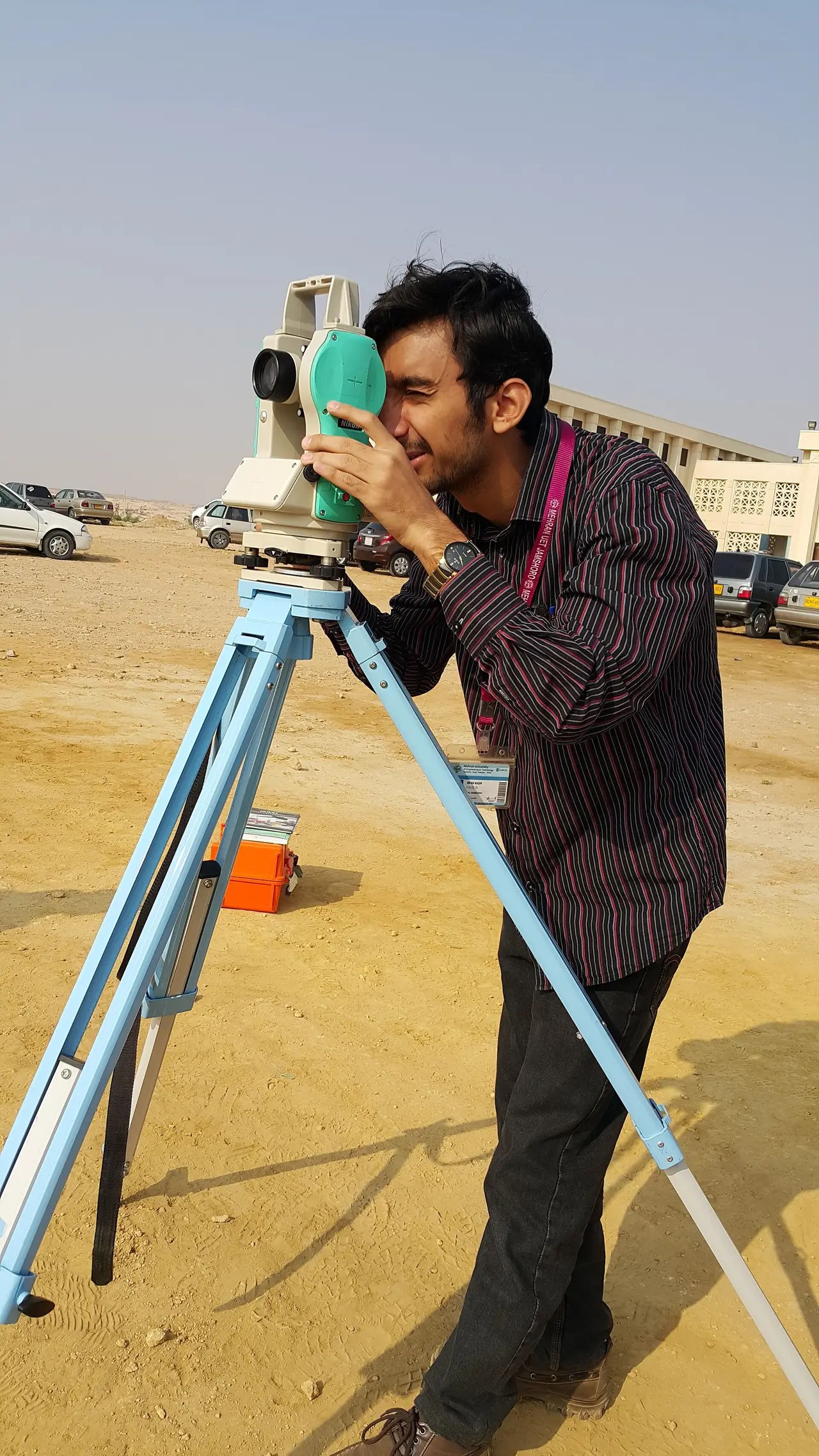
A student in a striped shirt looks through a surveying instrument mounted on a blue tripod on sandy ground, with parked cars and buildings behind.
PhotoA student sighting through a theodolite, an instrument that measures angles precisely. Combining one measured angle with one measured distance lets surveyors find heights and distances they cannot reach directly, which is the idea behind solving right triangles.Kskhh, CC BY-SA 4.0, via Wikimedia Commons

Naming the sides, and why the ratios never change

Relative to a chosen angle (not the right angle), the three sides of a right triangle are named: the hypotenuse (always opposite the right angle, the longest side), the opposite side (across from ), and the adjacent side (next to , but not the hypotenuse). Now draw two right triangles that both contain a angle, one small and one huge. Their angles match (, and ), so the triangles are similar: one is just a scaled copy of the other. Scaling multiplies every side by the same factor, so the RATIOS between sides are identical. A 3-4-5 triangle and a 6-8-10 triangle with the same angle both give . In a right triangle, once you fix one of the non-right angles, the ratios between the three sides never change, no matter how big or small the triangle is. Those fixed ratios are called sine, cosine and tangent, and they're the whole engine behind right-triangle trigonometry.

θadjacentoppositehypotenuseSOH CAH TOAsinθ = opp/hypcosθ = adj/hyptanθ = opp/adjelevationobserver looks up → angle of elevation
Fig 1Labelling opposite, adjacent and hypotenuse relative to the chosen angle theta. The labels swap if you switch to the other acute angle.
SOH – CAH – TOA

The reciprocal ratios

Each primary ratio has an upside-down partner. Cosecant is the reciprocal of sine, secant is the reciprocal of cosine, and cotangent is the reciprocal of tangent: , and . A quick way to pair them: each reciprocal pairs with the primary ratio whose name does NOT start with the same letters (cosecant with sine, secant with cosine). Most calculators have no csc, sec or cot button, so evaluate them as 1 divided by the primary ratio: Because the hypotenuse is the longest side, and are always at least for an acute angle, a handy check on your answer.

Solving a right triangle: side or angle?

AFinding a missing SIDE
  • You know an acute angle and one side.
  • Label the sides from that angle, then pick the ratio that uses the known side and the unknown side.
  • Write it as an equation, e.g. .
  • If the unknown is on top, multiply: . If it's on the bottom, swap: .
BFinding a missing ANGLE
  • You know two sides and no acute angle.
  • Label the two known sides from the unknown angle, then pick the ratio that uses exactly those two.
  • Compute the ratio as a number, e.g. .
  • Undo the trig function with its inverse: .

The inverse keys (, , ) run a ratio backwards: you feed in a ratio and get back the angle that produces it. Always confirm the calculator shows DEG, since MCR3U works entirely in degrees. Once two parts are known, you can finish the rest of the triangle the cheap way: the two acute angles add to , and the Pythagorean theorem gives a third side without any trig. Use it to check: the hypotenuse must come out longest.

Angles of elevation and depression

An angle of elevation is measured UPWARD from the horizontal (e.g. looking up at the top of a building). An angle of depression is measured DOWNWARD from the horizontal (e.g. looking down at a boat from a cliff). Crucially, the angle of elevation from the ground up to a point equals the angle of depression from that point back down to the ground: the two horizontal lines are parallel and the line of sight cuts across both, so the angles are alternate angles. In practice this means you can always move the given angle to the bottom of the triangle, where the right angle and the ground distance are easy to see.

Both angles are measured from a horizontal line, never from the vertical.The two horizontals are parallel, so the angle of depression equals the angle of elevation (alternate angles).sea levelobserverboathorizontalline of sightθangle of depressionθangle of elevationhdtan θ = h ÷ d
Fig 2The angle of depression from the observer equals the angle of elevation from the object, because the two horizontal lines are parallel (alternate angles).
VideoA set of word problems that turn an angle of elevation or depression into a right triangle, then pick sine, cosine or tangent to find the missing side or angle.Watch on YouTube

Problems with two right triangles

Exam problems often hide two right triangles in one picture: two boats seen from one lighthouse, a flagpole standing on a building, or two observers on either side of a tower. The strategy is always the same. Find the side the two triangles SHARE (usually a height or a ground distance), solve each triangle separately for the piece you need, then add or subtract. If both boats are on the same side of the lighthouse, the gap between them is a difference of two distances; if the observers stand on opposite sides of the tower, their distances add. Keep full calculator values until the final subtraction, because subtracting two rounded numbers magnifies the rounding error.

Sketch before you choose a ratio
Always sketch the triangle first. Mark the right angle, the given angle, and label which side is opposite / adjacent / hypotenuse BEFORE choosing a ratio. Most errors come from skipping this step. A quick sanity check afterwards: a bigger angle of elevation over the same ground distance must give a taller height.
VideoTwo angles of depression from one lookout create two right triangles that share a side. Mario solves each triangle and subtracts to find the gap between the ships, the same strategy as this section.Watch on YouTube

Worked examples

Reveal one step at a time and try to beat it to the next line.

Example 1
From a point 50 m from the base of a building, the angle of elevation to the top is . Find the height of the building.
Example 2
A ladder 8 m long leans against a wall, making a angle with the ground. Find how high up the wall it reaches, and how far its base is from the wall.
Example 3
A right triangle has an opposite side of 7 cm and an adjacent side of 10 cm (relative to angle ). Find , then check it using the hypotenuse.
Example 4
From the top of a 45 m lighthouse, the angles of depression to two boats directly in line on the same side are and . How far apart are the boats (to the nearest tenth of a metre)?

Where marks get lost

  • Leaving the calculator in RADIAN mode — MCR3U works entirely in degrees, so always confirm the calculator says DEG before evaluating any trig function.
  • Mislabelling opposite vs. adjacent relative to the wrong angle (they swap depending on which angle you're using).
  • Forgetting to apply the INVERSE trig function when solving for an angle — writing instead of .
  • Mixing up angle of elevation and angle of depression — both are measured from the HORIZONTAL, never from the vertical.
  • Rounding each distance in a two-triangle problem before subtracting — for example using and gives by luck here, but in general early rounding shifts the final difference. Keep full values until the last step.

Flashcards 9

SOH CAH TOA
Solving for a missing side
Solving for a missing angle
Angle of elevation
+ 5 more

Practice

1
A right triangle has hypotenuse and an angle of . Find the length of the side opposite that angle (round to 2 decimals).
2
Which ratio should you use if you know the adjacent side and the hypotenuse?
3
From a cliff 60 m high, the angle of depression to a boat is . Find the horizontal distance to the boat in metres (round to 1 decimal).
4
In a right triangle, which side is always opposite the right angle?
5
A right triangle has opposite side 9 and hypotenuse 15. Find in degrees (round to 1 decimal).
6
You know the opposite and adjacent sides. Which ratio do you use to find the angle?
7
A 6 m ladder leans against a wall at a angle with the ground. How high up the wall does it reach (round to 2 decimals)?
8
In a right triangle, the side opposite is and the hypotenuse is . Find (give a decimal).
9
Standing 25 m from a building, you measure the angle of elevation to the bottom of a flagpole on its roof as and to the top of the flagpole as . How tall is the flagpole, in metres (round to 2 decimals)?
10
Match each ratio to its definition in a right triangle.
11
Put the steps for finding a building's height from an angle of elevation in order.
  1. 1Evaluate in degree mode and round at the end
  2. 2Write the equation and isolate the unknown
  3. 3Choose the ratio linking the known side to the unknown side
  4. 4Sketch the right triangle and mark the given angle
  5. 5Label opposite, adjacent and hypotenuse from that angle

Spot a mistake on this page? Let us know