Core French
Grade 9 Academic, following the Ontario curriculum.
- 5 units
- 26 lessons
- 290 practice questions
- 231 flashcards
- 2 simulators
Units
Les bases: Sounds, Nouns and the Present Tense
Rebuild the foundations of French from scratch: how the language sounds and is spelled, how nouns and articles work, how to conjugate regular and essential irregular verbs in the present, and how to ask questions and say no.
Décrire: Describing People, Places and Things
Learn to describe the world in French: make adjectives agree and put them in the right place, say whose things are whose, compare people and things, explain where objects are, and walk through your daily routine and the time of day.
Raconter: Past, Present and Future
Tell stories across time in French: say what happened with the passé composé (with avoir and with être), describe how things used to be with the imparfait, talk about plans, hopes and part-time jobs in the future, and anchor it all with time markers, sequencing words and si clauses.
Communiquer: Pronouns, Commands and Connecting Ideas
Sound more natural in French by replacing nouns with object pronouns and y and en, giving instructions with the impératif, linking ideas with qui, que and connectors, and choosing the polite or casual way to speak.
La francophonie and Real-World Texts
Meet French-speaking communities in Africa, Asia, the Middle East and the Indian Ocean, then put your French to work on real texts: reading ads, emails and train schedules, writing a polished opinion paragraph, and cracking new words with cognates, faux amis and word families.
Simulators
Simulators for every course →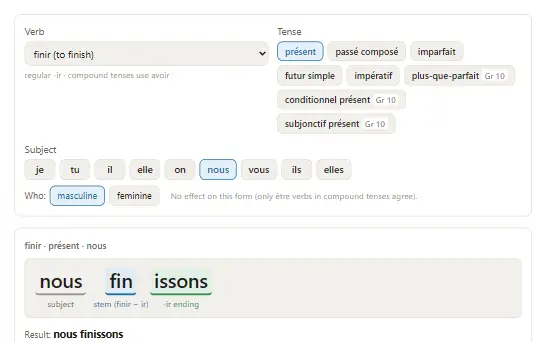
 FSF1D
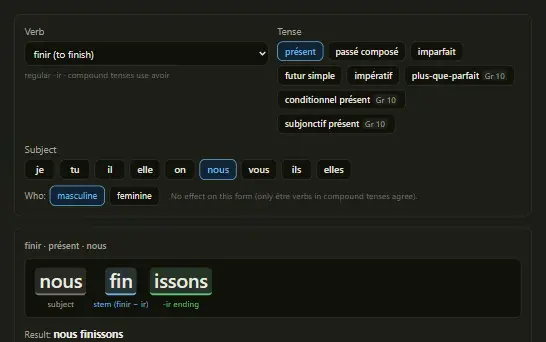
Pick a verb, a subject and a tense and watch the form get built from its stem, ending and auxiliary, then test yourself on the forms that trip people up.
 FSF1D
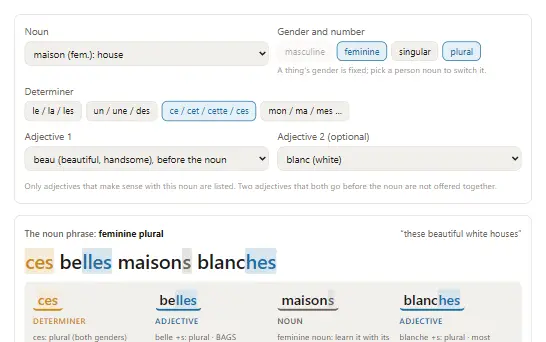
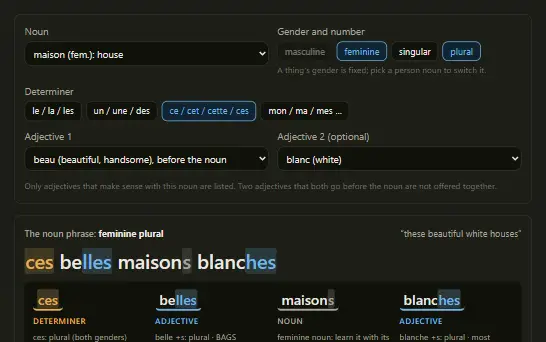
Change a noun's gender and number and watch every article, adjective and past participle around it change to agree, with the rule for each ending shown.