Skip to content
Study Hall
Lesson 1 of 4Algebraic Expressions and Equations
Unit 3 · Lesson 1 of 4

Writing Expressions from Patterns and Words

Use variables to describe a whole pattern or situation in one short expression, name the parts of an expression, translate words into algebra, and see where the idea of algebra came from.

8 min read8 quick checks11 practice questionsAsk AI about this →

Key things to remember

  1. 1A variable stands for a number that can change; a coefficient multiplies a variable; a constant is a term with no variable.
  2. 2An expression has no equals sign (); an equation says two things are equal ().
  3. 3The sign in front of a term belongs to it: in the coefficient of is . The coefficient of alone is , and of is .
  4. 4For a pattern that grows by the same amount each stage: expression = (change) + (stage 0 value), where stage 0 value = stage 1 value − change.
  5. 5"5 less than " is ; "twice " is ; "the square of " is ; "triple the sum of and 6" is .

A bike rental shop charges a flat fee of 15 dollars plus 4 dollars for every hour you ride. For 1 hour you pay 19 dollars, for 2 hours 23 dollars, for 3 hours 27 dollars. You could keep listing prices forever, or you could write one short rule that works for any number of hours: if stands for the number of hours, the cost in dollars is . That rule is an algebraic expression. It packs a whole table of values into a few symbols, and you can use it for numbers nobody wrote down, like 2.5 hours or 11 hours. This lesson is about writing rules like that: from a pattern of tiles, from a sentence of words, and from a real situation.

The parts of an expression

A variable is a letter that stands for a number that can change or that you don't know yet, like for hours or for a stage number. A term is a number, a variable, or numbers and variables multiplied together; terms are separated by and signs. The number multiplying a variable is its coefficient: in the coefficient is . A term with no variable, like , is a constant, because its value never changes. An expression is a combination of terms, such as . It has no equals sign. Once you write , you have an equation: a statement that two things are equal, which you can solve (that is the job of a later lesson). Two hidden coefficients trip people up: means , so its coefficient is , and means , so its coefficient is .

one expression, no equals sign5xterm 1: 5xcoefficient 5variable x− 3yterm 2: −3ycoefficient −3the sign travels with the term+ 7term 3: 7constant (no variable)Hidden coefficients: x means 1x, and −x means −1xAdd an equals sign and it becomes an equation: 5x − 3y + 7 = 20
Fig 1The expression 5x − 3y + 7 split into its three terms, with the coefficient of each variable term, the constant, and the minus sign kept with −3y.
Term in 5x − 3y + 7TypeCoefficient
variable term
variable term (the sign belongs to the term)
constant termno variable, so no coefficient
The expression 5x − 3y + 7 has three terms.
The sign travels with the term
Read each or as part of the term that follows it. In the terms are and , so the coefficient of is , not . Keeping the sign attached is what makes later steps (collecting like terms, solving equations) come out right.
Quick checkTry it before you read on
1
In , what is the coefficient of ?
Quick checkTry it before you read on
2
What is the coefficient of in ?

From a growing pattern to an expression

Look at the tile pattern below. Stage 1 uses 5 tiles, stage 2 uses 8 and stage 3 uses 11. Instead of drawing stage 50, look at how each stage is built. Every stage has 2 tiles that never change, plus 3 rows of tiles whose length matches the stage number. So stage has 3 rows of tiles, which is tiles, plus the 2 fixed ones: tiles in total. The coefficient is the number of tiles added each stage, and the constant is the part that stays the same.

Stage 15 tilesStage 28 tilesStage 311 tiles+3+33 rows of n tiles: grows by 3 each stage2 tiles: the same in every stageStage 10: 3(10) + 2 = 32 tiles, no drawing neededStage nTilesChange1528+3311+3n3n + 23n + 23: coefficient (3 new tiles per stage)n: variable (the stage number)2: constant (never changes)
Fig 2Stages 1 to 3 of a tile pattern, its table of values, and the expression 3n + 2 with its coefficient, variable and constant labelled.
Stage nTilesUsing 3n + 2
15
28
311
10?
50?
Testing the expression on stages you can count, then using it for stages you cannot.

When you can't see the structure in a picture, a table still works. Step 1: find how much the count changes from one stage to the next. If the change is the same every time, that change is the coefficient of . Step 2: work backward one stage to find "stage 0": subtract the change from the stage 1 value. That number is the constant. For 5, 8, 11 the change is 3, and stage 0 would be , giving . Step 3: test the expression on a stage you already know. This method works only when the change is constant (a linear pattern). The square numbers 1, 4, 9, 16 grow by 3, then 5, then 7, so no expression of the form "coefficient times plus constant" fits them; they need .

Quick checkTry it before you read on
1
A pattern has 7 tiles in stage 1, 10 in stage 2 and 13 in stage 3. Which expression gives the number of tiles in stage n?
Quick checkTry it before you read on
2
Which pattern can not be described by an expression of the form (coefficient) + constant?

Translating words into algebra

WordsExpression
5 more than a number
5 less than a number
a number decreased by 5
twice a number
the product of 4 and a number
a number divided by 3
the square of a number
3 less than twice a number
triple the sum of a number and 6
Common phrases and the expressions they become, using n for the unknown number.
Less than flips the order
"5 less than a number" means start with the number and take 5 away: . Writing is a different expression (try : but ). The same flip happens with "subtracted from": "4 subtracted from " is . Brackets matter too: "triple the sum of a number and 6" is , because the whole sum is tripled, while "6 more than triple a number" is .
“5 less than a number”n = 8− 53n − 5not 5 − n, which gives 5 − 8 = −3“triple the sum of a number and 6”n = 8+ 614× 3423(n + 6)the whole sum is tripled“6 more than triple a number”n = 8× 324+ 6303n + 6only the number is tripledSame numbers, different order: 42 and 30 are not equal, so the brackets matter.
Fig 3Three phrases tested with n = 8: "5 less than a number" gives n − 5 = 3, "triple the sum of a number and 6" adds first and gives 3(n + 6) = 42, and "6 more than triple a number" multiplies first and gives 3n + 6 = 30.
Quick checkTry it before you read on
1
Which expression means "4 subtracted from twice a number"?
Quick checkTry it before you read on
2
Evaluate "double the sum of a number and 5" when the number is 7.
VideoKhan Academy turns word phrases into algebraic expressions, paying attention to order, such as what "less than" does and when brackets are needed.Watch on YouTube

Where algebra came from

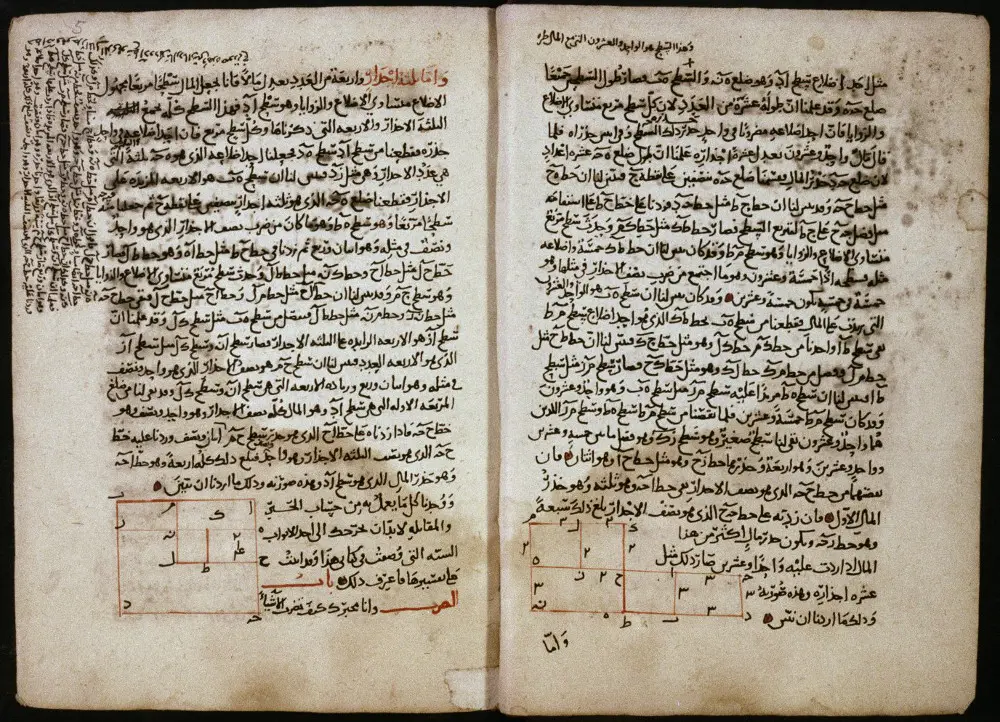
People solved problems about unknown amounts long before anyone wrote . Clay tablets from Babylon (in present-day Iraq), nearly 4000 years old, contain problems we would now solve with equations, written entirely in words. Around 820 CE (sources give dates between about 813 and 833), the Persian scholar Muhammad ibn Musa al-Khwarizmi, working at the House of Wisdom in Baghdad, wrote a book often called The Compendious Book on Calculation by Completion and Balancing. Its Arabic title contains the word al-jabr, "restoring" or "completion": moving a subtracted quantity to the other side of an equation so that it becomes added. It also contains al-muqabala, "balancing": cancelling equal amounts from both sides. When the book was translated into Latin, al-jabr became our word algebra, and his own name, written in Latin as Algoritmi, gave us the word algorithm. He still wrote everything in words. One of his best-known problems, paraphrased in modern English, says that a square together with ten of its roots (a "root" meant the unknown number itself) makes thirty-nine. Today we write it as .

  • About 1800 BCE, Babylon: word problems about unknown quantities on clay tablets, solved with step-by-step recipes.
  • Probably the 3rd century CE, Alexandria: Diophantus uses short abbreviations for an unknown in his work Arithmetica (his exact dates are uncertain).
  • Around 820 CE, Baghdad: al-Khwarizmi describes completion and balancing as general methods, the start of algebra as its own subject.
  • 1557, Wales and England: Robert Recorde introduces the equals sign, two parallel lines of the same length.
  • Late 1500s to 1637, France: François Viète uses letters for both known and unknown quantities, and René Descartes popularizes , and for unknowns.
Quick checkTry it before you read on
1
In al-Khwarizmi's book, what did al-jabr ("restoring") mean?
Quick checkTry it before you read on
2
Al-Khwarizmi's problem "a square together with ten of its roots makes thirty-nine" is written today as which equation?
Two facing pages of a handwritten Arabic manuscript, with square diagrams drawn in red ink near the bottom of each page.
PhotoTwo pages from a handwritten copy of al-Khwarizmi's book on al-jabr, kept at the Bodleian Library in Oxford. The problems are written entirely in words, and the square diagrams show his geometric way of solving them.Muḥammad ibn Musa al-Khwarizmi, Public domain, via Wikimedia Commons

Worked examples

Reveal one step at a time and try to beat it to the next line.

Example 1
A pattern of squares has 6 squares in stage 1, 10 in stage 2, 14 in stage 3 and 18 in stage 4. Write an expression for the number of squares in stage , then find the number in stage 25.
Example 2
Write an expression for each phrase, using for the number: (a) "7 less than three times a number"; (b) "three times the sum of a number and 7". Then evaluate both when .
Example 3
A gym charges a sign-up fee of 40 dollars plus 25 dollars per month. Write an expression for the total cost of months, name its coefficient and constant, and find the cost of one year.
Example 4
List the terms of and give the coefficient of each variable term and the constant.

Where marks get lost

  • Writing "5 less than a number" as . The number comes first: .
  • Using the stage 1 value as the constant. For the pattern 5, 8, 11 the expression is , not : test and , which is wrong.
  • Dropping the sign of a term: in the coefficient of is , not .
  • Saying has no coefficient. It has coefficient , and has coefficient .
  • Mixing up "twice a number" () and "the square of a number" (), or leaving out brackets: "triple the sum of and 6" is , not .

Flashcards 8

Variable
Term
Coefficient
Constant
+ 4 more

Practice

1
What is the coefficient of in ?
2
Which expression means "5 less than a number n"?
3
A tile pattern has 7 tiles in stage 1, 12 in stage 2 and 17 in stage 3. If it keeps growing the same way, how many tiles are in stage 30?
tiles
4
A pattern has 9 dots in stage 1, 11 in stage 2, 13 in stage 3 and 15 in stage 4. Write an expression for the number of dots in stage n.
5
Evaluate when .
6
Match each phrase to its expression (n is the number).
  1. A.
  2. B.
  3. C.
  4. D.
  5. E.
twice a number
the square of a number
a number divided by 4
4 more than a number
4 less than twice a number
7
Which of these is an equation rather than an expression?
8
How many terms does have?
terms
9
The word algebra comes from al-jabr, a word in the title of a book written around 820 CE by which scholar?
10
Put these steps in order for writing an expression from a pattern that grows by the same amount each stage.
  1. 1Subtract that change from the stage 1 count to get the stage 0 value
  2. 2Test the expression on a stage you already know
  3. 3Write the expression as (change)n + (stage 0 value)
  4. 4Find how much the count changes from one stage to the next
11
A phone repair shop charges a 30 dollar inspection fee plus 45 dollars per hour of work, so the cost is . What is the cost, in dollars, for 3.5 hours of work?
dollars

Spot a mistake on this page? Let us know