Skip to content
Study Hall
Lesson 2 of 5Rational Numbers and Proportional Reasoning
Unit 2 · Lesson 2 of 5

Fractions, Unit Fractions and Measuring

Build every fraction from unit fractions, find equivalent fractions, and read the fractions that real tools use: an imperial ruler marked in sixteenths of an inch and a set of measuring cups.

7 min read8 quick checks10 practice questionsAsk AI about this →

Key things to remember

  1. 1A unit fraction is ; the fraction is copies of .
  2. 2For positive unit fractions, a larger denominator means a smaller piece: .
  3. 3Equivalent fractions: for any .
  4. 4A typical imperial ruler has 16 gaps per inch; read a length by counting sixteenths past the last inch mark, then simplify.
  5. 51 in cm exactly; 1 cup is usually taken as 250 mL in Canadian recipes.

Canada measures in metric, but walk into a hardware store and you will still meet inches everywhere: a "2-by-4" board, a inch wrench, a inch drill bit. Open a family recipe and you will find cup of flour and cup of milk. These tools are built on fractions, and on one kind in particular: the unit fraction, a single equal piece of a whole. Once you can see a fraction as "so many copies of one piece", reading a ruler to the nearest sixteenth of an inch or measuring cup with only a cup scoop becomes counting.

Unit fractions

A unit fraction has a numerator of 1: . The denominator says how many equal pieces the whole is cut into, so is one piece when the whole is cut into 8. Any positive fraction with whole-number parts is a count of unit fractions: means three pieces of size . Because more cuts make smaller pieces, a larger denominator gives a smaller unit fraction: of an inch is half the size of of an inch.

1 wholethe whole1/2cut into 21/4cut into 41/8cut into 81/16cut into 163/8 is three pieces of size 1/8: 3/8 = 1/8 + 1/8 + 1/83/81/81/81/83 × 1/8
Fig 1Five bars, each one whole, cut into 1, 2, 4, 8 and 16 equal pieces with one piece of each shaded; below, a bar of eighths with three pieces shaded shows 3/8 = 1/8 + 1/8 + 1/8.
Quick checkTry it before you read on
1
Which of these unit fractions is the smallest piece?
Quick checkTry it before you read on
2
How many pieces of size make ?

Equivalent fractions

Cut each of the pieces of into two, and you have : twice as many pieces, each half as big, and exactly the same amount. That is the rule for equivalent fractions: multiply (or divide) the numerator and the denominator by the same number, as long as that number is not zero. Dividing both by a common factor is called simplifying; a fraction is in simplest form when the numerator and denominator have no common factor other than 1. To compare two fractions, rewrite them with the same denominator and compare the numerators.

same amount12/1612 of 16↓ ÷ 26/86 of 8↓ ÷ 23/43 of 4Each step: half as many pieces, each twice as big, and the same amount shaded.12/16 = (12 ÷ 2)/(16 ÷ 2) = 6/8 = (6 ÷ 2)/(8 ÷ 2) = 3/4
Fig 2Three bars of the same length: 12 of 16 pieces, 6 of 8 pieces and 3 of 4 pieces shaded. The shading ends at the same place, so 12/16 = 6/8 = 3/4.
Quick checkTry it before you read on
1
Write in simplest form (type it like 3/4).
Quick checkTry it before you read on
2
Which is greater, or ?
VideoKhan Academy shows with pictures why multiplying the top and bottom of a fraction by the same number gives an equivalent fraction, the same idea as 3/4 = 6/8 = 12/16 on a ruler.Watch on YouTube

Reading an imperial ruler

A typical imperial ruler splits each inch in half, then halves the halves, and so on, until the smallest gap is inch (some precision rulers go on to ). The tick marks show this with their lengths: the longest ticks mark whole inches, the next longest the half inch, then quarters, eighths, and the shortest ticks are the sixteenths. So there are 16 equal gaps between inch marks. The reliable way to read a length is to count sixteenths from the last whole-inch mark, then simplify the fraction. If the count is odd (like 11 sixteenths) it cannot be simplified; if it is even, divide the top and bottom by 2 until you can't.

1 and 6/16 in = 1 3/8 in0121/41/23/46 sixteenths past the 1-inch markwhole inch1/2 inch1/4 inch1/8 inch1/16 inch
Fig 3Two inches of an imperial ruler in sixteenths. Longer ticks mark larger fractions. The pointer sits 6 sixteenths past the 1-inch mark: 1 and 3/8 inches.
TickFraction of an inchIn sixteenthsTicks of this size per inch
Longestwhole inch1
Second longest1 (at the halfway point)
Middle2
Short4
Shortestthe odd sixteenths8
How tick length on an imperial ruler matches the fraction of an inch
Three-step ruler reading
1. Write down the last whole-inch mark you passed. 2. Count the sixteenth gaps from there to the end of the object. 3. Simplify: 12 sixteenths becomes , so a reading 12 gaps past the 1 is in.
Quick checkTry it before you read on
1
A pencil ends 10 sixteenth-gaps past the 4-inch mark. How long is it, in simplest form?
Quick checkTry it before you read on
2
Which of these marks has the shortest tick on an imperial ruler?
VideoA step-by-step lesson on reading a ruler or tape measure to the nearest sixteenth of an inch, using the lengths of the tick marks to tell halves, quarters, eighths and sixteenths apart.Watch on YouTube

Measuring cups and converting to metric

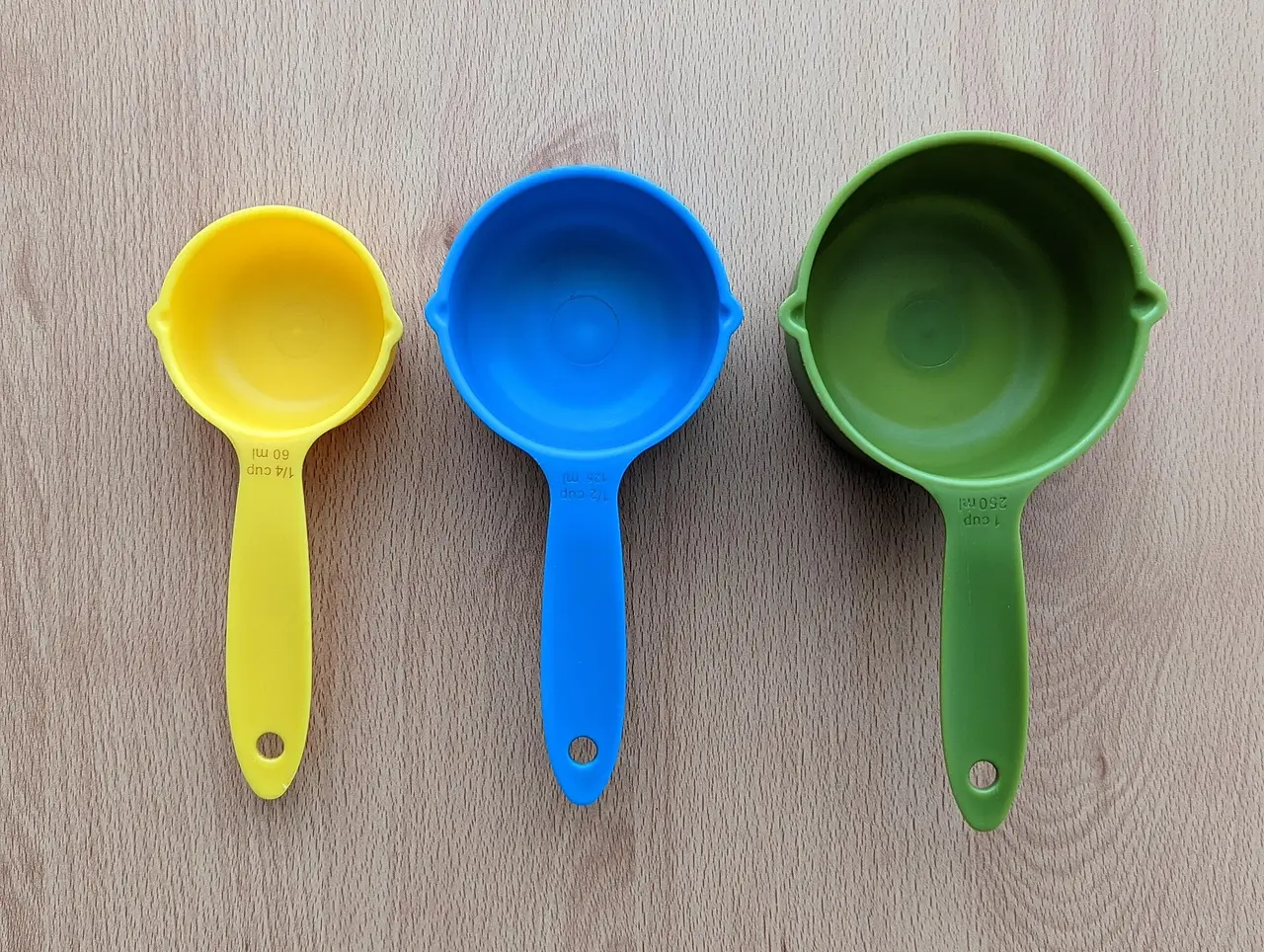
A set of measuring cups is a set of unit fractions: usually 1 cup, , and cup. To measure cup with only the cup scoop, fill it 3 times, because is three quarters. To measure cup, use the cup twice. Most Canadian recipes and measuring cups treat 1 cup as 250 mL (a US cup is a little smaller, about 237 mL). For length, the link between the two systems is exact: 1 inch is defined to be exactly 2.54 cm. To convert a fractional inch measurement, change the fraction to a decimal first, then multiply by 2.54.

AImperial ruler
  • Each inch is halved again and again
  • Smallest mark: in
  • Readings like in
  • Fractions with denominators 2, 4, 8, 16
BMetric ruler
  • Each centimetre is cut into tenths
  • Smallest mark: 1 mm = 0.1 cm
  • Readings like 6.7 cm
  • Decimals (denominators 10, 100, 1000)
The exact link
1 inch cm exactly. Example: in in, and , so about cm.
Quick checkTry it before you read on
1
You need cups of milk and only have the cup scoop. How many scoops do you need?
Quick checkTry it before you read on
2
Convert inches to centimetres, rounded to two decimal places.
cm
Three plastic measuring cups in yellow, blue and green, in increasing sizes, lying on a wooden table.
PhotoA set of measuring cups is a set of unit fractions. The handles of these are marked in both units: 1/4 cup with 60 mL, 1/2 cup with 125 mL and 1 cup with 250 mL.Vimkay, CC BY-SA 4.0, via Wikimedia Commons

Worked examples

Reveal one step at a time and try to beat it to the next line.

Example 1
A bolt's end lines up 12 sixteenth-gaps past the 1-inch mark. A second bolt ends 11 sixteenth-gaps past the 2-inch mark. Read both lengths in simplest form.
Example 2
A recipe needs cups of oats, but the only clean scoop is the cup. How many scoops do you need?
Example 3
A shelf bracket is in long. Convert this to centimetres, to two decimal places.
Example 4
Which drill bit is wider, in or in? By how much?

Where marks get lost

  • Thinking is bigger than because 16 is bigger than 8. More pieces means smaller pieces.
  • Counting tick marks instead of gaps. From the 1-inch mark to the third tick after it is 3 gaps, i.e. in; counting the starting tick as well gives 4.
  • Reading every tick as an eighth. Many rulers stop at sixteenths, so the short tick right after an inch mark is , not .
  • Changing only the numerator or only the denominator: is not equal to . Multiply both by the same number.
  • Converting in as or, worse, . Write exactly, and round only at the end.

Flashcards 8

Unit fraction
Equivalent fractions
Simplest form
Smallest gap on an imperial ruler
+ 4 more

Practice

1
Which of these is a unit fraction?
2
How many sixteenths of an inch are in inch?
3
The end of a nail is 6 sixteenth-gaps past the 0 mark on an imperial ruler. What is its length in simplest form?
4
How many cup scoops make cups?
5
Put these lengths (in inches) in order from shortest to longest.
  1. 111/16
  2. 25/8
  3. 31/2
  4. 43/8
  5. 57/16
6
Match each fraction of an inch with the same length in sixteenths.
1/2
1/4
3/8
1/8
7
Convert inches to centimetres. Round to two decimal places.
cm
8
Write 10/16 in simplest form (type it like 3/4).
9
Which fraction is NOT equivalent to 3/4?
10
A 9/16 inch wrench is how many inches wider than a 1/2 inch wrench? Give the answer as a fraction or a decimal.
in

Spot a mistake on this page? Let us know