Skip to content
Study Hall
Lesson 4 of 6Geometry and Measurement
Unit 7 · Lesson 4 of 6

The Pythagorean Theorem

Use to find a missing side of a right triangle, apply it to real and composite shapes, and use its converse to check whether a corner is square.

7 min read6 quick checks10 practice questionsAsk AI about this →

Key things to remember

  1. 1In a right triangle with legs , and hypotenuse : .
  2. 2The hypotenuse is opposite the right angle and is the longest side.
  3. 3Hypotenuse: . Leg: .
  4. 4Converse: if with the longest side, the triangle is right-angled. If it is obtuse; if it is acute.
  5. 5Common triples: 3, 4, 5; 5, 12, 13; 8, 15, 17; 7, 24, 25, and any positive whole-number multiple of them.

A rectangular park is 120 m long and 50 m wide. Walking along two edges from one corner to the opposite corner is m. Cutting straight across on the diagonal path is shorter, but by how much? You cannot measure the path with the edges alone, unless you know one of the most useful facts in all of mathematics. The same fact tells you how tall a ladder can reach, what "a 55-inch TV" really measures, and lets a builder check that the corner of a deck is perfectly square using only a tape measure. It is called the Pythagorean theorem, and it connects the three sides of every right triangle.

Legs and hypotenuse

A right triangle has one angle. The two sides that form the right angle are the legs, usually called and . The side across from the right angle is the hypotenuse, called . The hypotenuse is always the longest side of a right triangle, because it is opposite the largest angle. The theorem says: in a right triangle, the area of the square on the hypotenuse equals the sum of the areas of the squares on the two legs.

9a = 316b = 425c = 5Count the unit squaresa² = 3 × 3 = 9b² = 4 × 4 = 16c² = 5 × 5 = 259 + 16 = 25a² + b² = c²c is the hypotenuse, the sideopposite the right angle
Fig 1A right triangle with legs 3 and 4 and hypotenuse 5, drawn to scale, with a square on each side divided into 9, 16 and 25 unit squares

Why it works. Take four copies of a right triangle with legs and , and arrange them inside a big square with side , one triangle in each corner, so that their hypotenuses form a tilted square of side in the middle. The big square's area can be counted two ways: as , or as the tilted square plus the four triangles, . Expanding and setting the two equal:

Quick checkTry it before you read on
1
In right triangle , the right angle is at . Which side is the hypotenuse?
Quick checkTry it before you read on
2
The squares on the two legs of a right triangle have areas and . What is the area of the square on the hypotenuse?
cm²

Finding a missing side

You knowYou wantFormulaExample
Both legs a and bThe hypotenuse c:
The hypotenuse c and one leg bThe other leg a:
Add the squares for the hypotenuse, subtract for a leg
Two checks before you calculate
First, the theorem is only for right triangles; for any other triangle, does not equal . Second, decide which side is the hypotenuse. If you are finding the hypotenuse, add the squares. If you are finding a leg, subtract the smaller square from the hypotenuse's square. Your answer for a leg must come out shorter than the hypotenuse.
Finding the hypotenuse: add120 m50 mc = 130 mc² = 120² + 50² = 14 400 + 2500c² = 16 900c = √16 900 = 130 mThe diagonal saves 170 − 130 = 40 mFinding a leg: subtract6 ma = 8 m10 m laddera² = 10² − 6² = 100 − 36a² = 64a = √64 = 8 mCheck: the leg 8 m is shorter than 10 m
Fig 2Left: a 120 m by 50 m park drawn to scale, whose diagonal is the hypotenuse, 130 m, found by adding the squares. Right: a 10 m ladder with its foot 6 m from a wall, which reaches 8 m up the wall, a leg found by subtracting the squares

Many answers are not whole numbers. With legs 7 cm and 10 cm, . The value is the exact answer; cm is that value rounded to one decimal place. Round only at the very end, and say how you rounded. Real problems often hide a right triangle inside a bigger shape (a composite shape): the height of a triangular roof, the diagonal brace of a gate, the slanted edge of a ramp, or the straight-line distance between two points on a grid. Sketch the shape, find the right angle, and label the legs and hypotenuse before you calculate.

Quick checkTry it before you read on
1
A right triangle has a hypotenuse of 20 cm and one leg of 12 cm. How long is the other leg?
cm
Quick checkTry it before you read on
2
A right triangle has legs 4 cm and 6 cm. How long is the hypotenuse, to the nearest tenth of a centimetre?
cm
VideoAn Ontario teacher uses the Pythagorean theorem to find a missing side of a right triangle.Watch on YouTube

The converse: checking for a right angle

The theorem also works backwards. If the sides of a triangle satisfy , where is the longest side, then the triangle is a right triangle. Builders use this to check corners: measure 3 units along one wall and 4 units along the other; if the diagonal between those marks is exactly 5 units, the corner is . (Bigger multiples like 6, 8, 10 feet or 0.9, 1.2, 1.5 m give a more precise check.) If is less than , the longest side is too long for a right angle, so the angle opposite it is obtuse. If is greater than , that angle is acute, and since it is the largest angle, the whole triangle is acute.

c = 4.579°C344.53² + 4² = 25c² = 4.5² = 20.2525 > 20.25: acutec = 590°C3453² + 4² = 25c² = 5² = 2525 = 25: right anglec = 6117°C3463² + 4² = 25c² = 6² = 3625 < 36: obtuse
Fig 3Three triangles drawn to scale with sides 3 and 4 and a third side of 4.5, 5 or 6: since 25 is more than, equal to or less than the third side squared, the angle opposite it is acute (about 79 degrees), right (90 degrees) or obtuse (about 117 degrees)
Pythagorean tripleCheckA multiple of it
3, 4, 59 + 16 = 256, 8, 10
5, 12, 1325 + 144 = 16910, 24, 26
8, 15, 1764 + 225 = 28916, 30, 34
7, 24, 2549 + 576 = 62514, 48, 50
Whole-number right triangles worth recognizing
An old idea from many places
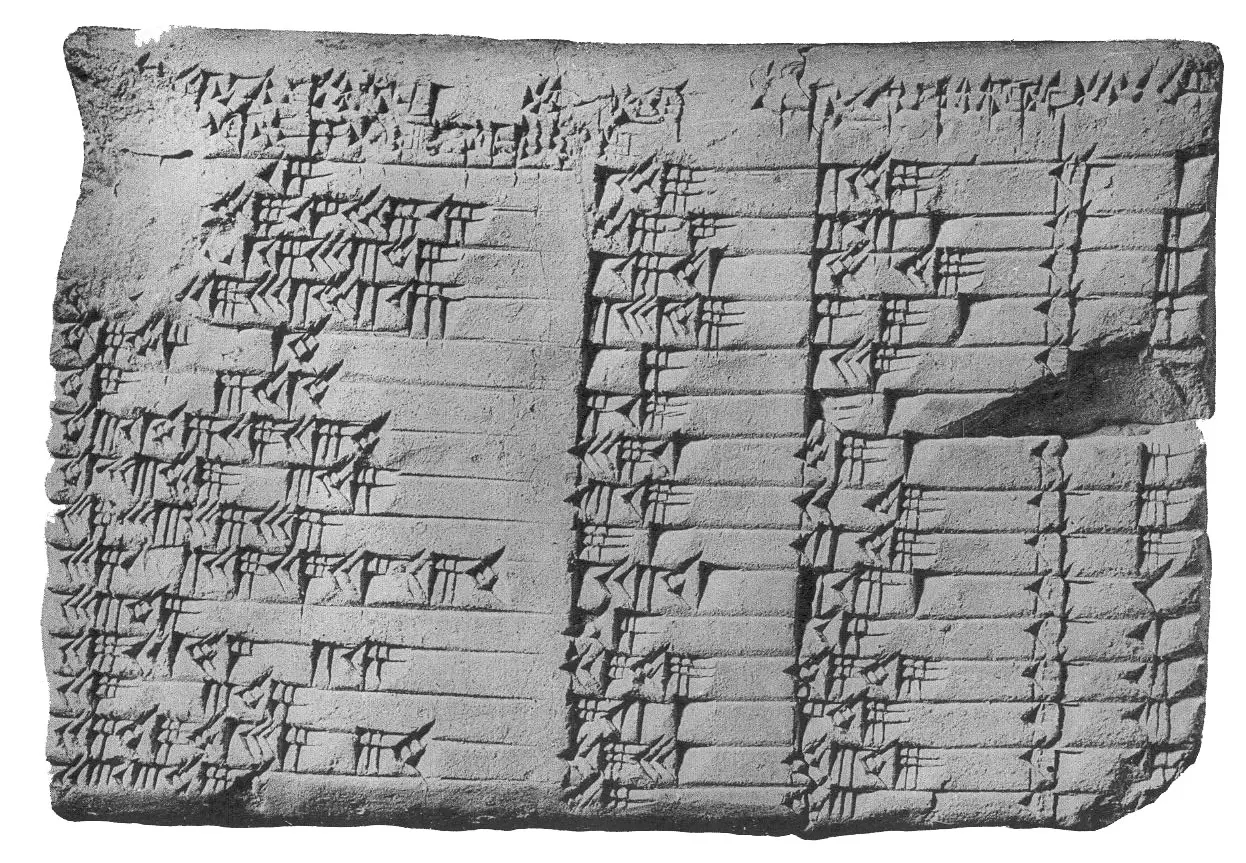
The theorem is named after Pythagoras, a Greek thinker of the 500s BCE, but the relationship was known long before him and in many places. A Babylonian clay tablet known as Plimpton 322, about 3800 years old (dates vary), lists sets of numbers that fit right triangles. Early texts from India (the Sulba Sutras) and China (where it is known as the gougu rule) also describe it; their exact dates are uncertain. Historians are not sure whether Pythagoras himself proved it.
Quick checkTry it before you read on
1
A triangle has sides 6, 7 and 9. What kind of triangle is it?
Quick checkTry it before you read on
2
A builder marks 0.9 m along one wall and 1.2 m along the other. For a square corner, how long should the diagonal between the marks be?
m
A broken clay tablet covered in rows and columns of small wedge-shaped marks.
PhotoPlimpton 322 is a Babylonian clay tablet about 3800 years old. Scholars link its columns of numbers to the sides of right triangles, recorded long before Pythagoras.photo author unknown, Public domain, via Wikimedia Commons
VideoEddie Woo explains what a converse is and how the side lengths alone can tell you whether a triangle has a right angle.Watch on YouTube

Worked examples

Reveal one step at a time and try to beat it to the next line.

Example 1
A rectangular park is 120 m long and 50 m wide. How long is the diagonal path from one corner to the opposite corner, and how much shorter is it than walking along two edges?
Example 2
A 6.5 m ladder leans against a wall. Its foot is 2.5 m from the base of the wall. How high up the wall does the ladder reach?
Example 3
Is a triangle with sides 9 cm, 12 cm and 15 cm a right triangle? What about 8 cm, 11 cm and 14 cm?
Example 4
The front of a shed roof is an isosceles triangle with a base of 8 m and two equal sloping sides of 5 m. Find the height of the roof and the area of the triangular front.

Where marks get lost

  • Adding the squares when finding a leg. With hypotenuse 13 and leg 5, the other leg is , not .
  • Stopping at . If , the side is , not 169.
  • Thinking . With legs 3 and 4, , not 7.
  • Using the theorem on a triangle with no right angle, or using a leg as c. The hypotenuse is the side across from the right angle.
  • Testing the converse with the wrong side as . Always square the longest side by itself and compare it with the sum of the other two squares.

Flashcards 8

Pythagorean theorem
Hypotenuse
Legs
Finding the hypotenuse
+ 4 more

Practice

1
A right triangle has legs 9 cm and 12 cm. How long is the hypotenuse?
cm
2
A right triangle has a hypotenuse of 13 m and one leg of 5 m. How long is the other leg?
m
3
A right triangle has legs 6 cm and 9 cm. Find the hypotenuse, rounded to one decimal place.
cm
4
Which set of side lengths makes a right triangle?
5
A TV screen is 120 cm wide and 68 cm tall. TV sizes are measured along the diagonal. What is the diagonal, to the nearest centimetre?
cm
6
A gate is a rectangle 2.4 m wide and 1.0 m tall. How long is a diagonal brace from one corner to the opposite corner?
m
7
A square tile has sides of 10 cm. How long is its diagonal, to one decimal place?
cm
8
On a grid where each square is 1 km, a park is at (1, 2) and a school is at (7, 10). What is the straight-line distance between them in kilometres?
km
9
Put the steps in order to find a missing leg of a right triangle.
  1. 1Check that the answer is shorter than the hypotenuse
  2. 2Take the square root of the result
  3. 3Subtract the leg's square from the hypotenuse's square
  4. 4Identify the hypotenuse, the side across from the right angle
  5. 5Square the hypotenuse and square the known leg
10
Match each set of side lengths with what kind of triangle it makes.
6, 8, 10
5, 6, 9
5, 6, 7
3, 4, 8

Spot a mistake on this page? Let us know