Skip to content
Study Hall
Lesson 5 of 5Trigonometric Identities & Equations
Unit 5 · Lesson 5 of 5

Trig Equations with Multiple Angles and Applications

Equations such as , and : widen (or shrink) the interval, solve for the whole angle, then divide back. Plus equations that need a compound- or double-angle identity first, and equations that come from sinusoidal models.

6 min read11 practice questionsInteractiveAsk AI about this →

Key things to remember

  1. 1For on , solve on , then divide every angle by .
  2. 2For , transform the interval the same way: multiply by , then add ; undo in reverse order at the end.
  3. 3A whole-number normally gives solutions for sine or cosine with ; a fraction such as shrinks the interval and can leave one solution or none.
  4. 4If an equation mixes and , expand the double angle first: ; pick or to match the other ratio.
  5. 5Recognize compound forms: and
  6. 6In applied problems the interval comes from the context (one day, one revolution); state it first and interpret every answer with units.

Real periodic things rarely complete exactly one cycle every units. A tide model has , a voltage oscillates sixty times a second, and squeezes two whole cycles into the interval where fits one. So the equations you meet in applications almost always look like rather than . The good news is that you already know how to solve . Everything in this lesson is about one idea: treat the whole argument as a single angle, solve for it over the right interval, then convert back to . The one thing that can go wrong is the interval, and getting it right is what decides whether you find two solutions, four, or six.

Why a multiple angle multiplies the solutions

Let . As runs from to , the angle runs from to — two full trips around the unit circle. Each trip hits a value such as twice, so has four solutions in , not two. The method is therefore: substitute ; multiply the interval by ; find every in that widened interval (reference angle, CAST, then add until you leave the interval); finally divide every by . A fraction such as works the same way in reverse. Now runs only over , half a trip, so some angles you would normally list are simply not available, and the equation may have just one solution — or none.

y = 1/2π2π3π4ππ/65π/6π/6 + 2π5π/6 + 2πSolve sin x = 1/2— one equation, but the line meets the curve again in every period.1. Reference angle: sin⁻¹(1/2) = π/6 — that is the only value your calculator returns.2. Sine is also positive in quadrant 2: x = π − π/6 = 5π/6. 3. Add 2πn for every extra turn: x = π/6 + 2πn or 5π/6 + 2πn.
Fig 1The sine curve over two full cycles cut by the line y = 1/2: one reference angle produces four solutions.
Equation on Interval for the angleAngles foundSolutions for
(six angles)
only ( is out of range)
none ( itself is excluded)No solution
Multiply the interval by k, solve for the whole angle, then divide every angle by k. Tangent repeats every π, so after its first angle you keep adding π, not 2π.
VideoSolves an equation in sin 2x by substituting for the double angle, finding the angles on the unit circle, then dividing back to get x.Watch on YouTube

Shifted angles such as 2x − π/3

The same substitution handles a phase shift. For , let and transform the interval exactly as you would transform : multiply by 2, then subtract . So becomes . Solve on that interval — — then undo the operations in reverse order: add , then divide by 2. Notice that the shifted interval starts at a negative angle, so it is worth checking whether a negative coterminal angle such as sneaks in. Here it does not, because .

Aall positiveSsine +Ttan +Ccos +θ = 145°ref = 35°Reading C-A-S-T counter-clockwise from QIV:QIV: Cosine positiveQI: All positiveQII: Sine positiveQIII: Tangent positivereference angle = acute angle to the nearest x-axis
Fig 2CAST decides which quadrants hold the angles; with a multiple angle you apply it on every trip around the circle.

When an identity has to come first

Substitution only works when ONE angle appears. If an equation mixes and , as in or , use a double-angle identity to rewrite everything in terms of , then factor exactly as in single-angle equations. Choose the version of that matches the other ratio present: next to , next to . Compound-angle formulas work in the other direction. An expression such as is the expanded form of ; recognizing it collapses two terms into a single sine of a shifted angle, which you then solve with the substitution method above. Whichever way you go, never divide both sides by a trig ratio, because the values that make it zero vanish from your answer.

Loading interactive…
Drag the angle through two full turns and count how often sine reaches the same value — that is what doubling the angle does.
VideoShows how to use a double angle identity to rewrite an equation before solving it.Watch on YouTube

Applied equations from sinusoidal models

A model such as for water depth, hours after midnight, turns every "when" question into a multiple-angle equation. Setting gives . Over one day, , the angle runs over , so expect four answers: , giving hours. The interval in an applied problem comes from the context — one day, one revolution, one year — so state it before solving, and interpret each answer with units: here the water is exactly m deep at 1 a.m., 5 a.m., 1 p.m. and 5 p.m.
Widen first, divide last
The most common error is solving over and then halving, which gives only and — half the answers. Multiply the interval by BEFORE finding angles, and divide by only at the very end. Then count: a equation with normally has solutions in when is a whole number.
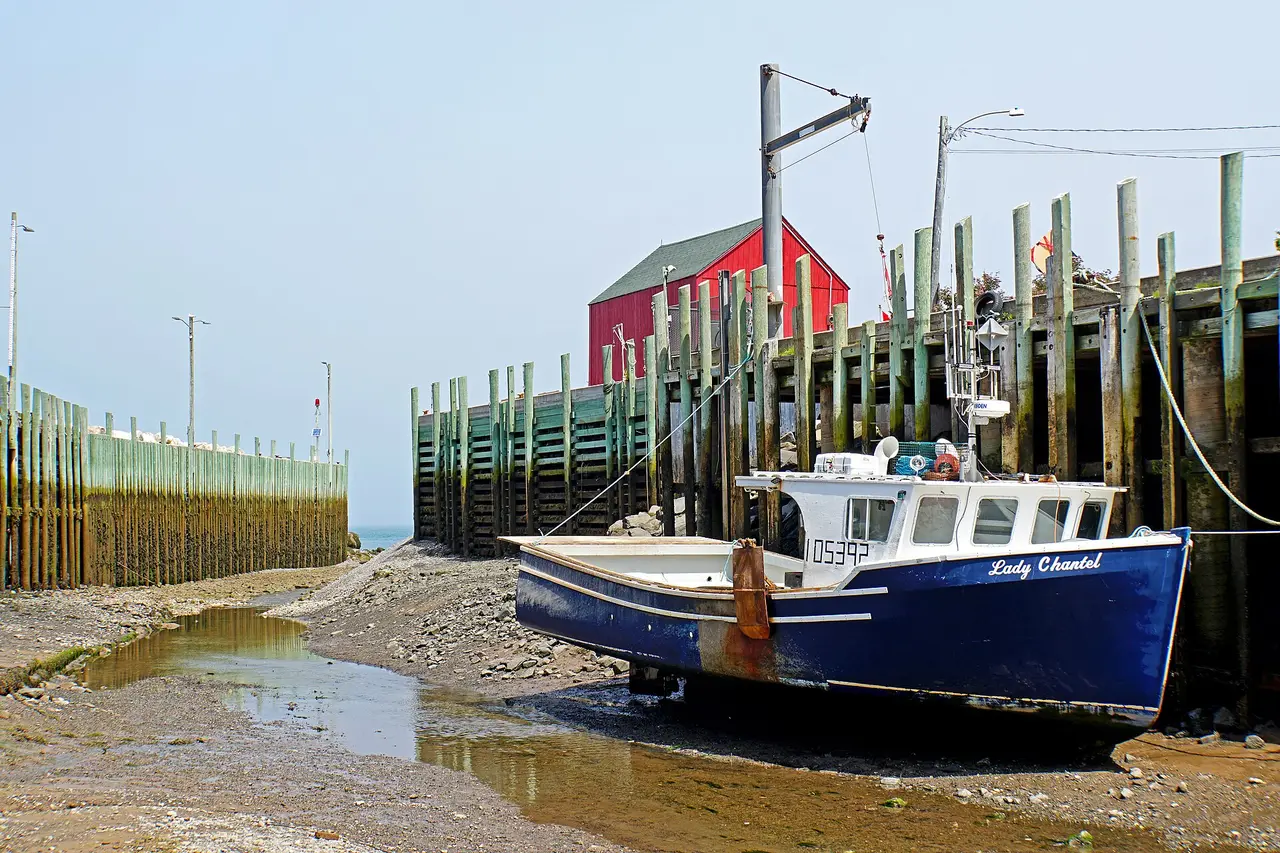
A blue and white fishing boat resting on the mud of an emptied harbour beside tall wooden wharf pilings, with a red building behind.
PhotoLow tide at Hall's Harbour, Nova Scotia, on the Bay of Fundy, where boats sit on the harbour floor until the water comes back. Asking when the water will reach a certain depth is the kind of question that turns into a multiple-angle equation.Dennis G. Jarvis, CC BY-SA 2.0, via Wikimedia Commons

Worked examples

Reveal one step at a time and try to beat it to the next line.

Example 1
Solve for .
Example 2
Solve for .
Example 3
Solve for .
Example 4
Solve for .

Where marks get lost

  • Solving over and then halving, which loses half of the solutions.
  • Forgetting to divide by at the end and reporting values of as if they were .
  • Keeping the angle for , even though only runs over ; it gives , outside the interval.
  • Shifting the interval in the wrong order for : multiply by 2 first, then subtract .
  • Dividing by instead of factoring , which deletes and .

Flashcards 9

Interval for when
Interval for when
How many solutions does have on ?
Interval for when
+ 5 more

Practice

1
How many solutions does have on ?
2
How many solutions does have on ?
3
Which list gives all solutions of on ?
4
Solve on . Type the single solution, e.g. pi/4.
5
Find the smallest positive solution of , in radians to 3 decimal places.
6
Find the largest solution of on , in radians to 3 decimal places.
7
Put the steps for solving on in order.
  1. 1Divide each result by 2
  2. 2Add to each angle
  3. 3Find every in the new interval
  4. 4Isolate the sine
  5. 5Let and transform the interval
8
Match each equation to its number of solutions on .
9
What is the best first step for ?
10
Water depth is m, hours after midnight. How many times between and (not including 24) is the depth exactly m?
11
simplifies to which equation?

Spot a mistake on this page? Let us know