Skip to content
Study Hall
Lesson 1 of 7Rates of Change & Combining Functions
Unit 6 · Lesson 1 of 7

Average Rate of Change

The average rate of change is the slope of the secant line joining two points on a graph — it measures how much the output changed per unit of input across a whole interval.

4 min read11 practice questionsAsk AI about this →

Key things to remember

  1. 1Average rate of change on is — the slope of the secant through and .
  2. 2It equals : change in output divided by change in input.
  3. 3Units of the rate are (output units) per (input unit), e.g. m/s, dollars per item, people per year.
  4. 4A positive rate means the output rose overall; negative means it fell; zero means it ended where it began.
  5. 5The order of subtraction must match in numerator and denominator — both "later minus earlier" or both "earlier minus later".

Suppose you drive from Toronto to Ottawa — about km — and the trip takes hours. Your average speed was km/h. That does not mean the speedometer read the whole way: you sat in traffic on the 401, you stopped in Kingston for coffee, and at one point you were doing on an open stretch. The number summarizes the entire trip with a single rate. That is exactly what an average rate of change does for any function: it compresses everything that happened between two inputs into one "per unit" number.
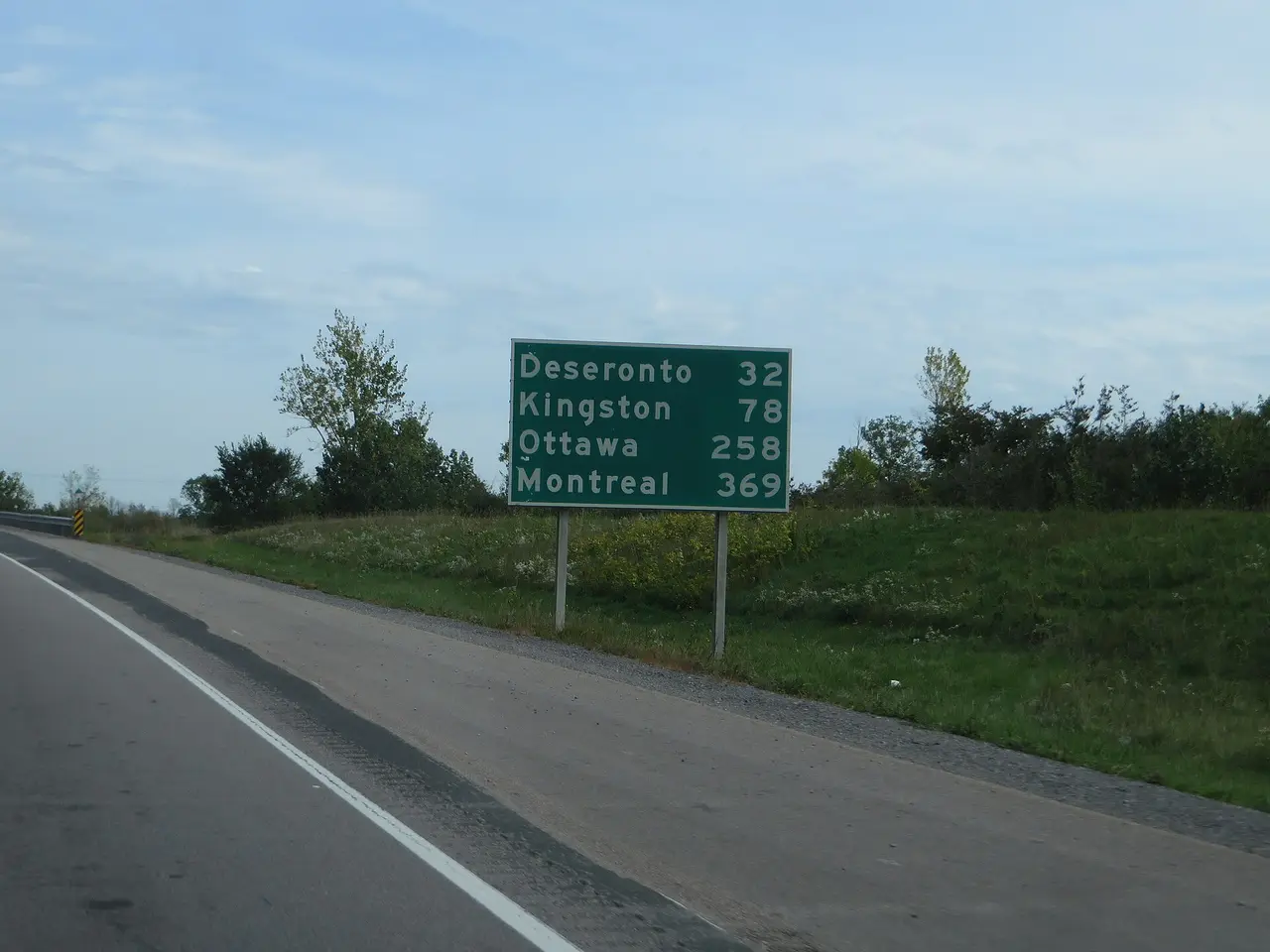
A green distance sign beside a highway lists Deseronto 32, Kingston 78, Ottawa 258 and Montreal 369, under a cloudy sky.
PhotoA distance sign on Highway 401 in eastern Ontario. Divide a distance like these by the time the drive takes and you get an average speed, one rate that sums up the whole trip.Ken Lund from Reno, Nevada, USA, CC BY-SA 2.0, via Wikimedia Commons

The slope of a secant line

Pick two points on the graph of : the point at , which is , and the point at , which is . The straight line drawn through those two points is called a secant line (from the Latin for "cutting" — it cuts across the curve). The average rate of change of on the interval from to is precisely the slope of that secant line: rise over run, output change over input change.

12345(1, 1.5)(4, 9)f(x) = 0.5x² + 1Average rate over [1, 4] — SECANTΔy/Δx = (f(4) − f(1))/(4 − 1)= (9 − 1.5)/3 = 2.5Instantaneous rate at x = 1 — TANGENTslope of the line touching at one point= 1 (estimate it with a tiny interval)Average = how fast on the whole trip (two points). Instantaneous = how fast right now (one point).On a curve they differ; they agree only for a straight line, whose slope never changes.
Fig 1A secant line across an interval gives the average rate; a tangent line at one point gives the rate at that instant.
Rise over run, with meaning attached
The formula is just the slope formula you learned in Grade 9, , written in function notation. Everything you know about slope still applies — the only new thing is that we now insist on saying what the number means in context, with units.
VideoAn Ontario Grade 12 lesson on finding the average rate of change of a function over an interval.Watch on YouTube

Reading it from a table

You do not need an equation. If you are handed a table, find the two rows that bracket the interval you want, subtract the outputs, subtract the inputs, and divide. The rows do not need to be adjacent, and the input values do not need to be evenly spaced.

YearPopulation of a town (thousands)
201542
201851
202166
202490
Population recorded every three years.

From 2018 to 2024 the population changed by thousand over years, so the average rate of change is thousand people per year. Notice that this single number hides the fact that growth was slower in the first half ( thousand per year) and faster in the second half ( thousand per year).

VideoA quick MHF4U example of finding an average rate of change from a table of values.Watch on YouTube

Units always come along for the ride

  • The units of a rate of change are always output units per input unit. Height in metres against time in seconds gives m/s.
  • Money against quantity gives dollars per item; volume in litres against depth in centimetres gives L/cm.
  • An answer with no units is an incomplete answer. "The rate is " says nothing; " thousand people per year" says everything.
  • Keep exact values where you can. If the arithmetic gives , write rather than rounding to unless the question asks for a decimal.
Average means average
An average rate of change describes an entire interval, not a moment inside it. A function can wander far above and far below its average and still produce that average. Never say "the value at that point" when you computed an average rate over an interval.

Positive, negative and zero rates

APositive average rate
  • Output ends higher than it started
  • Secant line slopes upward left to right
  • Example: a savings balance growing over a year
BNegative average rate
  • Output ends lower than it started
  • Secant line slopes downward left to right
  • Example: a hot drink cooling toward room temperature

A rate of change of exactly zero means the output finished where it started — the secant line is horizontal. It does not mean nothing happened. A ball thrown straight up and caught at the same height has an average velocity of m/s over the whole flight, even though it was moving the entire time. This is the clearest possible warning that an average rate is a summary, not a description.

Worked examples

Reveal one step at a time and try to beat it to the next line.

Example 1
A ball is thrown upward and its height in metres after seconds is . Find the average rate of change of height from to , and interpret it.
Example 2
Using the population table above, find the average rate of change from 2015 to 2021 and from 2021 to 2024. What does the comparison tell you?
Example 3
For , find the average rate of change on the interval from to .

Where marks get lost

  • Subtracting in opposite orders — computing on top but on the bottom — which flips the sign of the whole answer.
  • Reporting a bare number with no units, so "the rate is " could mean anything.
  • Treating the average rate as the value of the function, e.g. saying "the population was thousand" instead of "it grew by thousand per year".
  • Claiming an average rate of change describes every moment in the interval — a zero average rate does not mean the function stood still.
  • Dividing by the number of table rows instead of by the actual change in the input values, especially when the inputs are not spaced one unit apart.

Flashcards 6

Average rate of change
Secant line
Units of a rate of change
+ 2 more

Practice

1
Which expression gives the average rate of change of from to ?
2
For , find the average rate of change from to .
3
A car's distance travelled is recorded as: h, km; h, km; h, km; h, km; h, km. Find the average rate of change of distance from to , in km/h.
km/h
4
A tank's volume is measured in litres and time in minutes. State the units of the average rate of change of volume with respect to time.
5
A hiker's elevation has an average rate of change of m/min over the first minutes of a hike. Which statement must be true?
6
For , find the average rate of change from to .
7
Find the average rate of change of from to . Give your answer as a decimal rounded to two places.
8
Order the steps for finding the average rate of change of f on the interval from x = a to x = b:
  1. 1Evaluate f(b), the output at the right endpoint
  2. 2State the result with its units and interpret it in context
  3. 3Divide the change in output by the change in input
  4. 4Evaluate f(a), the output at the left endpoint
9
Match each rate of change to its correct units.
Height (m) with respect to time (s)
Cost (dollars) with respect to number of items
Population (people) with respect to time (years)
Volume (L) with respect to depth (cm)
10
On the graph of , the average rate of change from to is the slope of which line?
11
A function has an average rate of change of on the interval from to . Does that mean the function is constant on that interval? Answer yes or no.

Spot a mistake on this page? Let us know