Skip to content
Study Hall
Lesson 4 of 5Economic Foundations
Unit 1 · Lesson 4 of 5

Trade and Government in the Market

Canada trades heavily with the world, especially the United States, under agreements such as CUSMA, CETA and CPTPP, and governments and non-governmental bodies step in when markets fail to protect people, competition and the environment.

6 min read1 quick check9 practice questionsAsk AI about this →

Key things to remember

  1. 1Export = sold to another country. Import = bought from another country.
  2. 2The United States is Canada's largest trading partner. Major agreements: CUSMA (U.S. and Mexico), CETA (European Union), CPTPP (Asia-Pacific).
  3. 3A tariff is a tax on imports. Cost with tariff .
  4. 4A market failure is when a free market produces a result that is bad for society, such as monopoly power, price-fixing, pollution, unsafe products or very low pay.
  5. 5The Competition Bureau enforces the Competition Act (no price-fixing, no misleading ads); minimum wage, consumer protection, environmental rules, taxes and subsidies also correct failures.
  6. 6The Better Business Bureau is a non-governmental, non-profit organization, not a government agency.

Check the labels on your clothes, your phone and the fruit in your fridge, and you will find places all over the world. Canada also sends its products everywhere: wheat, lumber, cars and car parts, energy, seafood, maple syrup and much more. Trade gives Canadians more choice and gives Canadian businesses more customers. But markets do not always work fairly on their own, so governments and other organizations set rules to protect buyers, workers and the environment.

Imports, exports and why countries trade

An export is a good or service sold to buyers in another country. An import is a good or service bought from another country. Countries trade because no country can make everything well or cheaply. Canada cannot grow bananas or coffee, so it imports them. Canada has huge forests, farmland and energy resources, so it exports lumber, grain and energy. When each country focuses on what it does best and trades for the rest, both sides usually end up with more and cheaper goods than if they tried to make everything themselves.

Exports (Canada sells abroad), e.g. energy, cars and parts, lumber, wheat, seafoodImports (Canada buys abroad), e.g. machinery, electronics, winter fruit, clothingUnited States andMexicoCUSMA (Canada–UnitedStates–Mexico Agreement)The U.S. is by far Canada’sbiggest trading partner.European UnionCETARemoves most tariffs ongoods traded with EUcountries.Asia-Pacific partnersCPTPPe.g. Japan, Australia,VietnamOther partnersother free trade agreementse.g. United Kingdom, SouthKorea, ChileCanadasells exports andbuys importsWhat trade agreements mean for Canadian businessesBigger marketsFewer tariffs(taxes on imports)let Canadian firmssell to millionsmore customers.More competitionForeign firms sellhere too, soCanadian firms mustimprove quality andprice.Cheaper inputsBusinesses can buyparts and materialsfrom abroad forless.Rules to meetProducts must meeteach market’sstandards, labelsand paperwork.
Fig 1Exports flow out and imports flow in between Canada and its trading partners under several trade agreements.
VideoThis American explainer covers why countries trade, plus tariffs and trade deals; think about how the same ideas apply to Canada and its partners.Watch on YouTube

Canada's trade relationships

The United States is by far Canada's largest trading partner: most of what Canada exports goes there. A free trade agreement is a deal between countries to cut or remove tariffs and other barriers to trade. A tariff is a tax on imported goods. Canada belongs to several major agreements:

AgreementPartnersWhat it does
CUSMA (Canada–United States–Mexico Agreement)The United States and MexicoReplaced NAFTA in July 2020; sets the rules for trade among the three countries. Goods that meet its rules were traditionally tariff-free, but since 2025 the U.S. has placed tariffs on many Canadian goods, such as steel, aluminum, autos and lumber, even when they meet CUSMA rules.
CETA (Comprehensive Economic and Trade Agreement)The European UnionRemoved tariffs on most goods traded between Canada and the EU
CPTPP (Comprehensive and Progressive Agreement for Trans-Pacific Partnership)A group of mostly Asia-Pacific countries (including Japan, Australia and Vietnam; the U.K. joined in 2024)Cuts tariffs and opens markets in the Asia-Pacific region
Canada also has other trade agreements with individual countries.
  • Bigger markets: a small Canadian maple-syrup producer can sell to millions of customers in Europe or Japan without paying high tariffs.
  • More competition: Canadian businesses face foreign rivals selling into Canada, which pushes them to cut costs and improve quality, and gives consumers lower prices.
  • Cheaper inputs: a Canadian furniture maker can import parts or materials at lower cost.
  • Tariffs and trade disputes: when a trading partner puts tariffs on Canadian goods, those goods cost more for foreign buyers, so Canadian exporters can lose sales and jobs.

Here is how a tariff changes a price. Suppose an imported pair of sneakers costs a store $80 and a 25% tariff applies. The tariff is , so the store's cost rises to $100. That makes locally made sneakers more competitive, but it also means shoppers pay more.
Quick checkTry it before you read on
1
An imported bicycle costs $400. A 10% tariff is charged on it. What is the cost of the bicycle including the tariff, in dollars? Give your answer to the nearest dollar.
$
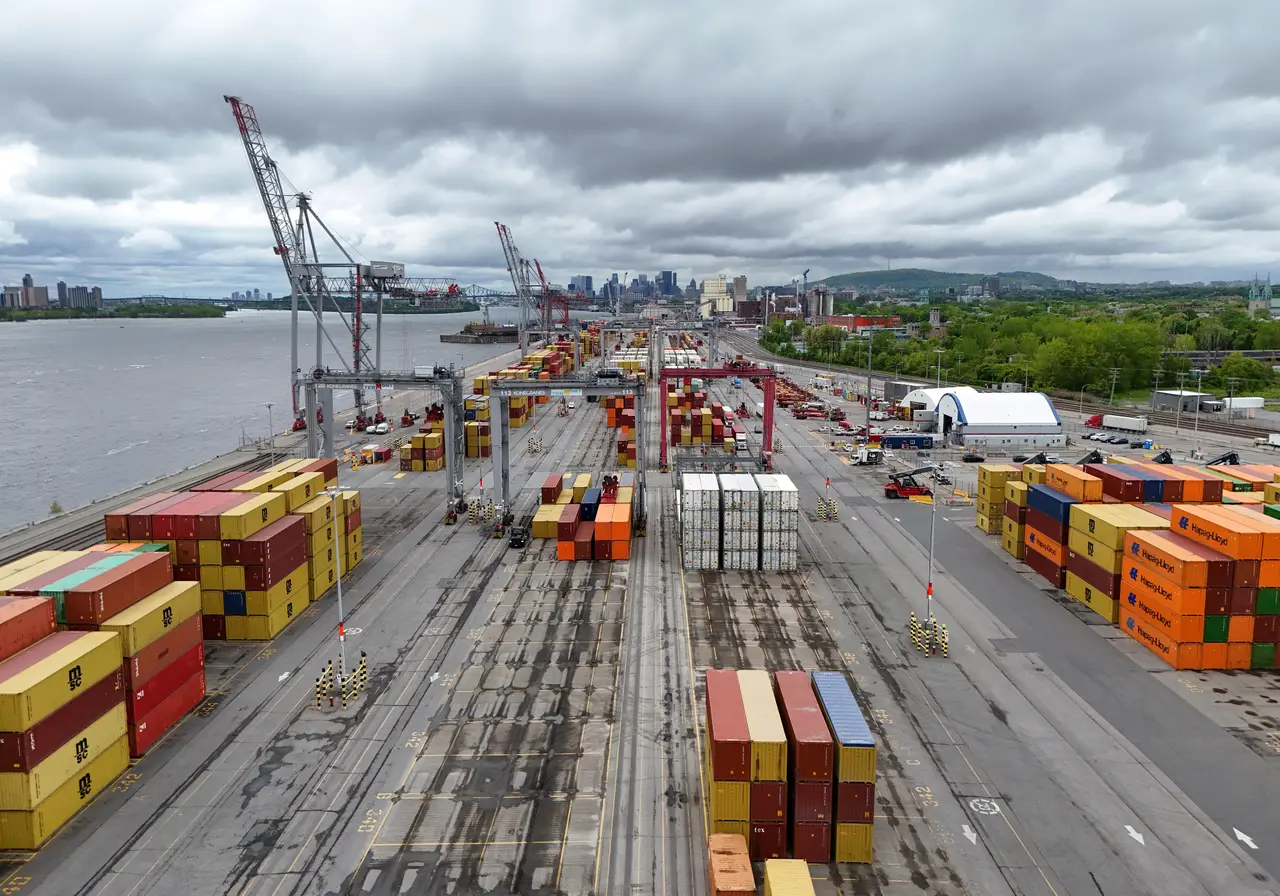
Rows of stacked shipping containers, cranes and rail tracks at the Port of Montreal beside the St. Lawrence River, with the city skyline behind.
PhotoShipping containers at the Port of Montreal. Containers like these carry many of the goods Canada imports and exports by sea.Quintin Soloviev, CC BY 4.0, via Wikimedia Commons

Market failures and why government steps in

A market failure happens when a free market, left alone, produces a result that is bad for society. Common examples: one company becomes so powerful that it can charge whatever it likes (a monopoly); businesses agree secretly to keep prices high (price-fixing); a factory pollutes a river and nobody pays for the damage; products are unsafe or ads are misleading; or workers are paid too little to live on. Governments, and some non-governmental organizations, intervene to correct these problems.

Why intervene? Markets sometimes failMonopoly powerOne firm, or a few workingtogether, can overchargeand shut out rivals.PollutionA firm can push the cost ofits waste onto neighboursand the planet.Unsafe productsBuyers can’t always tell ifa product is safe orhonest.How governments step inLaws and regulationThe Competition Act,enforced by the CompetitionBureau, bans price-fixing,misleading ads and mergersthat kill competition.Taxes and subsidiesTaxes on harmful products(e.g. tobacco) cut theiruse; subsidies and grantssupport things like cleantechnology and start-ups.Consumer protectionProduct safety rules,recalls, honest labels, andrights about contracts andrefunds protect buyers.Environmental rulesLimits on pollution, wasteand emissions make firmspay for the harm theycause.Minimum wageProvinces set the minimumwage and employmentstandards: hours, breaks,vacation.Health and safetyInspections of restaurants,food and workplaces keepcustomers and workers safe.Non-governmental bodies help tooStandards bodiesGroups such as CSA Group test products andcertify that they meet safety standards.Industry associationsMembers agree to codes of conduct; e.g. AdStandards reviews complaints aboutmisleading ads.
Fig 2Markets can fail through monopoly power, pollution and unsafe products; governments and non-governmental bodies respond.
Level or bodyExamples of how it intervenes
Federal governmentThe Competition Act, enforced by the Competition Bureau, bans price-fixing and misleading advertising and reviews big mergers; federal product-safety rules and recalls; the federal minimum wage for federally regulated workplaces such as banks and airlines
Provincial government (Ontario)Ontario's general minimum wage and employment standards; consumer protection laws on contracts, refunds and unfair practices; workplace health and safety rules; environmental rules
Municipal governmentBusiness licences, zoning bylaws that say where a business can operate, local property taxes, and public health inspections of restaurants
Non-governmental bodiesThe Better Business Bureau, a non-profit that rates businesses and handles complaints; standards bodies such as CSA Group that test and certify product safety; industry associations with codes of conduct, such as Ad Standards for advertising
Each level of government has different powers, and non-governmental groups fill gaps.

Governments also use money to steer markets. A tax on something society wants less of, such as tobacco, raises its price so people buy less. A subsidy is money a government gives to a business or a person to make something cheaper or more attractive, such as a grant for a company that hires students for the summer or a rebate for making a home more energy efficient. Regulators are government agencies that set and enforce rules for a specific industry; for example, the CRTC regulates broadcasting and telecommunications, including the companies that sell phone and internet service. Notice the difference: the Competition Bureau and the CRTC are government agencies with legal powers, while the Better Business Bureau and Ad Standards are independent non-profit organizations that rely on businesses agreeing to follow their codes.

Who sets the rules for marketing in CanadaFederal lawCompetition Actmisleading advertisingEnforced by the Competition BureauBans false or misleading claims used topromote a product or a business.e.g. a “was $80, now $40” sale when the itemnever really sold for $80.Industry self-regulationAd StandardsCanadian Code of Advertising StandardsIndependent, not-for-profit advertisingself-regulatory bodyAdministers the Code, which sets thestandards for acceptable ads, andreviews complaints from the public.e.g. someone complains an ad is inaccurate,and it is judged against the Code.Federal lawCASLCanada's Anti-Spam LegislationEnforced mainly by the CRTCGet consent before sending commercialelectronic messages such as emails andtexts.Each message must identify the sender andinclude a way to unsubscribe.Federal privacy lawPIPEDAPersonal Information Protection andElectronic Documents ActOverseen by the Office of the PrivacyCommissioner of CanadaBusinesses need consent to collect, use,or share customers' personalinformation, and must protect it.e.g. a store cannot hand its customer emaillist to another company without consent.Laws are enforced by government; Ad Standards is the advertising industry regulating itself.
Fig 3Who sets the rules for advertising and customer data in Canada.
VideoWatch for pollution as a cost the market ignores and how taxes, subsidies and rules can push markets toward a better result.Watch on YouTube

Worked examples

Reveal one step at a time and try to beat it to the next line.

Example 1
A Canadian store imports winter jackets that cost $120 each. A new 15% tariff is applied. Find the new cost, and explain one effect on a Canadian jacket maker and one on shoppers.
Example 2
For each problem, name the market failure and the most likely body to deal with it: (a) three bakeries secretly agree to all charge $6 for a loaf; (b) a company's ad claims a phone case is "drop-proof from any height" when it is not; (c) a restaurant's kitchen is unsanitary; (d) a customer wants help with a complaint about a contractor before hiring another one.
Example 3
A small Ontario maple-syrup producer is deciding whether to start exporting. Using what trade agreements do, list two opportunities and two risks.

Where marks get lost

  • Mixing up imports and exports. Exports go out of Canada (we sell); imports come in (we buy).
  • Thinking tariffs are paid by the foreign country. The importer pays the tariff, and that cost is usually passed on to shoppers.
  • Calling the Better Business Bureau a government agency. It is an independent non-profit with no power to fine businesses.
  • Thinking free trade only helps. It also brings more foreign competition, which can hurt some Canadian businesses and workers.
  • Mixing up which level of government does what. Business licences and zoning are municipal; minimum wage for most workers in Ontario is provincial; the Competition Act is federal.

Flashcards 10

Export
Import
Tariff
Free trade agreement
+ 6 more

Practice

1
Which country is Canada's largest trading partner?
2
Match each trade agreement to Canada's partners in it.
CUSMA
CETA
CPTPP
3
An imported game console costs a store $500. A 20% tariff is added. What is the store's cost including the tariff, in dollars? Give your answer to the nearest dollar.
$
4
Two gas stations on the same corner secretly agree to always charge the same high price. Which law does this break?
5
Match each action to who usually does it.
Issues a local business licence
Sets Ontario's general minimum wage
Enforces the Competition Act
Rates businesses and handles customer complaints
6
A factory dumps waste into a river, and people downstream pay the cost through dirty water. What kind of problem is this?
7
What is the term for a tax placed on imported goods?
8
Which is an example of a subsidy?
9
How can free trade agreements hurt some Canadian businesses?

Spot a mistake on this page? Let us know