Skip to content
Study Hall
Lesson 5 of 9Accounting for Assets
Unit 2 · Lesson 5 of 9

Inventory Errors, Technology and Internal Control

An ending-inventory error misstates cost of goods sold, profit, assets and equity this year and reverses itself next year, which is why businesses use technology for accurate tracking and internal controls to protect inventory and its records.

6 min read1 quick check10 practice questionsAsk AI about this →

Key things to remember

  1. 1COGS = Beginning inventory + Purchases − Ending inventory, so an ending inventory error moves COGS the opposite way.
  2. 2Ending inventory overstated: COGS understated, net income overstated, assets and equity overstated this year.
  3. 3Next year the error reverses through beginning inventory; two-year total net income and the year-2 balance sheet are correct (self-correcting).
  4. 4Reorder point = daily usage × lead time + safety stock. Shrinkage = perpetual record − physical count.
  5. 5Key internal controls: separation of duties, authorization, prenumbered documents and a paper trail, physical counts, physical safeguards.

Inventory is often the biggest current asset a retailer owns, and it is counted by people walking aisles with scanners. Miss one pallet in the back room, or count a shelf twice, and the error does not stay in the inventory account. Ending inventory is subtracted to find cost of goods sold, so a counting mistake flows straight into gross profit, net income and owner's equity. And because this year's ending inventory becomes next year's beginning inventory, the same mistake shows up again a year later, in the opposite direction. This lesson traces that chain, then looks at the tools businesses use to stop it from happening: technology that tracks every unit, and internal controls that keep inventory and its records honest.

How an ending inventory error flows through two years

Ending inventory has a minus sign in front of it. So if ending inventory is overstated by $3,000, cost of goods sold is understated by $3,000, and gross profit and net income are overstated by $3,000. On the balance sheet, assets (inventory) are overstated by $3,000 and so is equity, because the extra net income was closed into Capital (or Retained Earnings for a corporation). Next year, that same inflated figure is beginning inventory, which has a plus sign: cost of goods sold is overstated by $3,000 and net income understated by $3,000. By the end of the second year the two errors cancel, so the error is called self-correcting. It still matters: both years' statements were wrong, and anyone comparing the two years sees a false drop in profit.

2026 correct2026 reported2027 correct2027 reported
Sales$100,000$100,000$110,000$110,000
Beginning inventory$12,000$12,000$15,000$18,000
Purchases$60,000$60,000$65,000$65,000
Cost of goods available$72,000$72,000$80,000$83,000
Ending inventory$15,000$18,000$14,000$14,000
Cost of goods sold$57,000$54,000$66,000$69,000
Gross profit$43,000$46,000$44,000$41,000
Operating expenses$25,000$25,000$27,000$27,000
Net income$18,000$21,000$17,000$14,000
Ending inventory for 2026 was overstated by $3,000. 2026 net income is $3,000 too high and 2027 is $3,000 too low; two-year total net income is $35,000 either way.
Year 1Year 2CorrectReportedReportedCorrectSales80 00080 00085 00085 000Beginning inventory10 00010 000↑ 15 00012 000+ Purchases50 00050 00055 00055 000= Goods available60 00060 000↑ 70 00067 000− Ending inventory12 000↑ 15 00014 00014 000= Cost of goods sold48 000↓ 45 000↑ 56 00053 000Gross profit32 000↑ 35 000↓ 29 00032 000− Expenses20 00020 00020 00020 000Net income12 000↑ 15 000↓ 9 00012 000↑ overstated, ↓ understated. Arrow: Year 1's ending inventory becomes Year 2's beginning inventory.Year 1Ending inventoryoverstated by 3 000 → COGSunderstated by 3 000 → netincome overstated by3 000.Year 2Beginning inventoryoverstated by 3 000 → COGSoverstated → net incomeunderstated by 3 000.Self-correctingTwo-year net income:15 000 + 9 000 = 24 000,same as 12 000 + 12 000.Equity is right by the endof Year 2.
Fig 1An overstated ending inventory understates cost of goods sold and overstates profit this year, then reverses next year as beginning inventory.
Ending inventory OVERSTATED in Year 1Year 1Year 2
Cost of goods soldUnderstatedOverstated
Gross profit and net incomeOverstatedUnderstated
Assets (inventory) at year endOverstatedCorrect
Owner's equity at year endOverstatedCorrect
For an understated ending inventory, reverse every word in the table.
A quick rule
Ending inventory and net income move in the SAME direction in the year of the error. Beginning inventory and net income move in OPPOSITE directions in the next year.
Quick checkTry it before you read on
1
A count misses $2,000 of goods in a back room, so ending inventory is understated. What happens to that year's net income?
VideoTraces overstated and understated inventory through cost of goods sold and net income, including how the error reverses in the following year.Watch on YouTube

Technology in inventory management

  • Barcodes: every product carries a code (such as a UPC) that is scanned on receiving and at the till, so the system knows exactly which item moved, without anyone typing it.
  • RFID (radio-frequency identification) tags: small chips read by radio, without a line of sight. A handheld or doorway reader can count a whole rack or carton in seconds, which makes frequent counts practical.
  • Point-of-sale (POS) systems: each sale updates the perpetual records immediately, recording revenue, HST, cost of goods sold and the reduction in inventory at once.
  • Perpetual tracking across locations: managers see stock in every store and warehouse, so goods can be moved to where they will sell instead of being marked down.
  • Reorder alerts: when units on hand fall to the reorder point, the system flags or automatically creates a purchase order.
  • Cycle counts and exception reports: software schedules small counts through the year and highlights items whose records and counts disagree.

For example, if Northshore sells 12 water bottles a day, the supplier takes 5 days to deliver, and the store wants a cushion of 20, the system reorders when stock falls to bottles. Good tracking also lets managers watch inventory turnover, : how many times a year the average stock is sold and replaced. Higher turnover means less cash tied up in goods sitting on shelves. Technology does not remove the need for a physical count, though. A perpetual record only shows what SHOULD be there; the count shows what IS there, and the difference is shrinkage (theft, damage, spoilage or recording errors), recorded as debit Cost of Goods Sold, credit Merchandise Inventory.
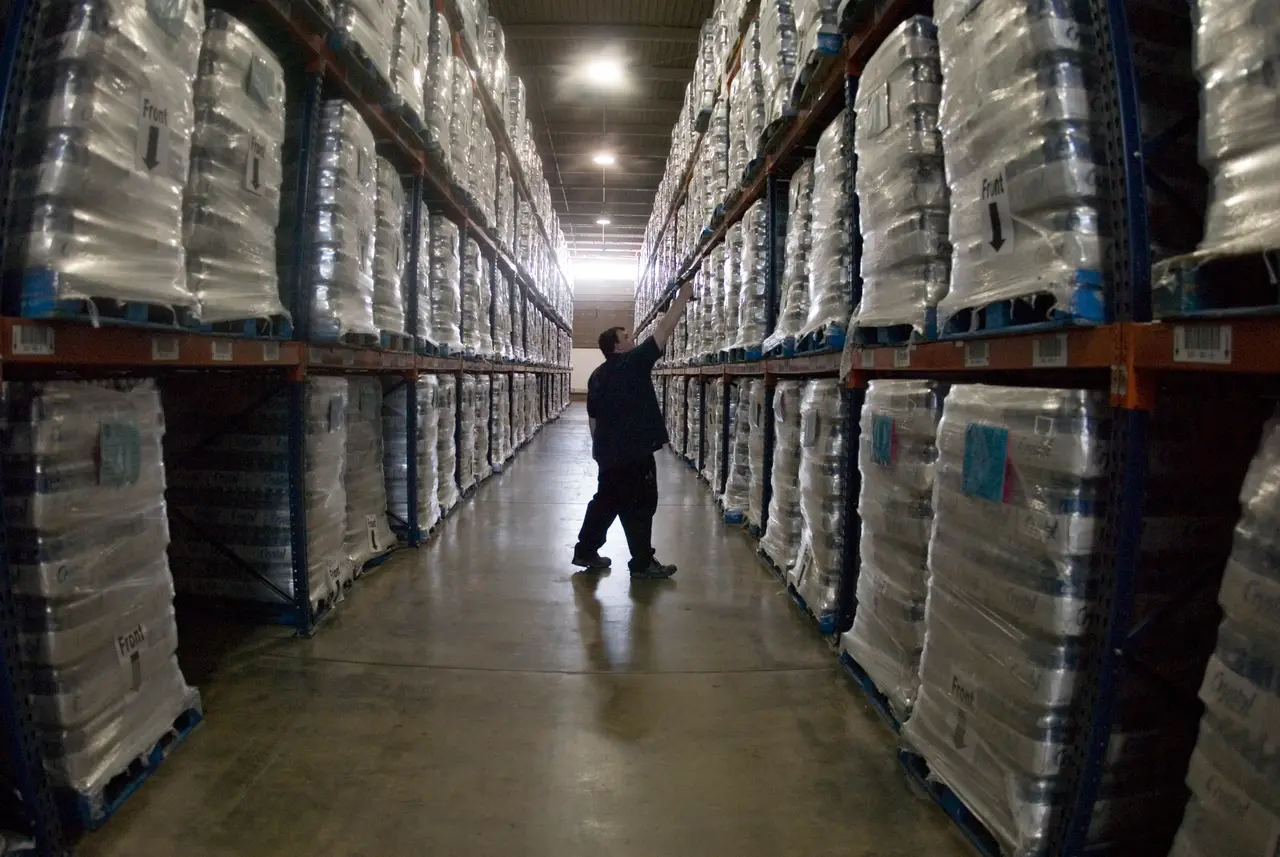
A worker in a long warehouse aisle reaches up toward shrink-wrapped pallets stacked on tall racks with barcode labels.
PhotoAn employee takes inventory in a large warehouse in Texas, 2006. Every pallet carries a barcode label, and scanning those labels instead of writing counts by hand is one way to avoid the counting errors this lesson traces.Liz Roll/FEMA, Public domain, via Wikimedia Commons

Internal control over inventory

Internal control is the set of policies and procedures a business uses to safeguard its assets, make its records reliable, and ensure that rules are followed. Inventory needs strong control because it is valuable, portable, and easy to resell. The controls below work together; none is enough on its own.

Separation of dutiesthe person who handlescash does not record it ordo the bank reconciliationAuthorizationpurchases and paymentsover a set limit need amanager's approvalPrenumbered documentscheques, invoices andreceipts numbered inorder, so a missing onestands out: a paper trailPhysical safeguardssafes, locked storerooms,passwords, securitycameras, cash registersIndependent checksbank reconciliations,surprise cash andinventory counts, internaland external auditsRotation of dutiesstaff swap jobs and musttake vacations, so ahidden scheme comes tolightAssets & recordscash, inventory,equipment and theaccounting records
Fig 2Separation of duties, authorization, prenumbered documents, physical safeguards and independent counts each block a different way that inventory or its records can go wrong.
ControlWhat it means for inventoryWhat it prevents
Separation of dutiesDifferent people order goods, receive goods, record them, and approve paymentOne person stealing goods and hiding it in the records
AuthorizationPurchases need an approved purchase order; write-offs and price changes need a manager's approvalUnneeded or fictitious purchases
Prenumbered documentsPurchase orders, receiving reports and invoices are numbered in sequence and every number is accounted forMissing or duplicate documents going unnoticed
Paper (audit) trailEvery unit can be traced from purchase order to receiving report to supplier invoice to paymentPaying for goods never ordered or never received
Physical countsRegular full counts or cycle counts, compared with the perpetual records by someone who does not handle the stockShrinkage hiding behind the records
Physical safeguardsLocked storerooms, limited access, cameras, security tagsTheft and damage
Six common internal controls over inventory.
The three-way match
Before a supplier is paid, the accounts payable clerk compares three documents: the purchase order (what was ordered, at what price), the receiving report (what actually arrived) and the supplier's invoice (what is being billed). Payment is made only when all three agree. Because the documents come from three different people, fraud would require several people to cooperate.

Worked examples

Reveal one step at a time and try to beat it to the next line.

Example 1
At December 31, 2026, staff counted one shelf of goods twice, overstating ending inventory by $3,000. Reported net income was $21,000 in 2026 and $14,000 in 2027. Find the correct net income for each year and the effect on the balance sheets.
Example 2
At December 31, 2026, $2,500 of goods in an off-site storage unit were left out of the count. State the effect on each item for 2026 and 2027.
Example 3
Northshore's perpetual records show 1,240 water bottles at a cost of $15 each. The year-end count finds 1,212. Calculate the shrinkage, journalize it, and express it as a percentage of the recorded units.
Example 4
At a small sporting-goods store, one employee orders stock from suppliers, receives the deliveries, updates the inventory records and approves the supplier invoices for payment. Purchase orders are written on blank sheets. Identify the weaknesses and recommend controls.

Where marks get lost

  • Saying an overstated ending inventory overstates COGS. Ending inventory is subtracted, so COGS moves the OPPOSITE way and net income moves the SAME way.
  • Concluding that a self-correcting error does not matter. Each year's statements are wrong, and the trend between years is distorted.
  • Forgetting the balance sheet: in the year of the error, assets AND equity are misstated by the same amount.
  • Believing a perpetual system makes physical counts unnecessary. The records show what should be on hand; only a count reveals shrinkage.
  • Describing separation of duties as "two people doing the same job". It means different people handle custody of the goods, recording, and authorization.

Flashcards 8

Effect of overstated ending inventory (year 1)
Effect of overstated ending inventory (year 2)
Self-correcting error
Shrinkage
+ 4 more

Practice

1
A company reported 2026 net income of $50,000. Later it finds 2026 ending inventory was understated by $4,000. What was the correct 2026 net income? Answer in whole dollars.
$
2
2026 ending inventory was overstated by $6,000 and never corrected. What is the effect on 2027 net income?
3
In the situation above (2026 ending inventory overstated by $6,000), by how much is the combined net income of 2026 and 2027 misstated? Answer in whole dollars.
$
4
Ending inventory is overstated by $5,000 at year end. Which is true of that year's balance sheet?
5
A store sells 15 units a day. Delivery takes 6 days and it keeps 25 units of safety stock. What is the reorder point, in units?
units
6
Perpetual records show 860 units at $12 each; the physical count finds 835. What is the shrinkage in dollars? Answer in whole dollars.
$
7
Cost of goods sold is $360,000. Inventory was $40,000 at the start of the year and $50,000 at the end. What is the inventory turnover? Answer to one decimal place.
times
8
Match each control to an example.
Separation of duties
Authorization
Prenumbered documents
Physical safeguards
9
Put the purchasing paper trail in order, from first to last.
  1. 1Three-way match, then payment
  2. 2Supplier invoice received
  3. 3Receiving report prepared when the goods arrive
  4. 4Purchase requisition from the department that needs the goods
  5. 5Approved, prenumbered purchase order sent to the supplier
10
What technology uses tags that can be read by radio waves without a direct line of sight?

Spot a mistake on this page? Let us know