Skip to content
Study Hall
Lesson 4 of 4Exponential & Logarithmic Functions
Unit 3 · Lesson 4 of 4

Solving Exponential and Logarithmic Equations

Take the logarithm of both sides to free a variable from an exponent, condense to solve logarithmic equations — and always test every candidate root against the domain before accepting it.

5 min read12 practice questionsAsk AI about this →

Key things to remember

  1. 1To free a variable from an exponent, take of both sides and apply the power law: .
  2. 2If both sides can be written with a common base, match bases instead — it is faster and gives an exact answer.
  3. 3; and .
  4. 4State the domain before solving: every argument must be positive. Every candidate root must then be tested against it, and extraneous roots rejected explicitly.
  5. 5Log scales: , with W/m², and .
  6. 6A difference of units on a Richter or pH scale means a factor of ; a difference of decibels means a factor of .

Matching bases only works when both sides of an equation happen to be powers of the same number. Most real equations are not that polite: a population reaching 8500, an investment reaching a target balance, a sample decaying to a particular mass. Logarithms remove that restriction completely, because the power law can pull any exponent down where you can reach it.

Exponential equations: take the logarithm of both sides

If two quantities are equal then their logarithms are equal, so you may take the log of both whole sides. The power law then drags the variable down out of the exponent, leaving an ordinary linear equation.
When matching bases is still faster
If both sides can be written as powers of the same base, matching bases is quicker and gives an exact answer instead of a decimal. For , write and read off in one line. Reach for logarithms only when no common base exists, as in .
VideoJensenMath, an Ontario teacher, solves exponential equations both ways: by matching bases when that is possible, and by taking the logarithm of both sides when it is not.Watch on YouTube

Logarithmic equations

A logarithmic equation has the variable inside a logarithm. The strategy is always the same: condense both sides down to a single logarithm, then convert to exponential form and solve whatever algebra is left — usually a linear or quadratic equation.

  1. State the domain first: every argument must be positive, so write down each inequality before you do any algebra.
  2. Use the logarithm laws to condense each side into a single logarithm.
  3. If the equation has the form , then . If it has the form , convert to .
  4. Solve the resulting equation for all candidate values of the variable.
  5. Test every candidate against the domain from step 1, and reject any that fail. State clearly which roots are extraneous.
  6. Substitute the surviving roots back into the original equation to confirm.
Always check for extraneous roots
Condensing two logarithms into one quietly widens the domain. The original requires , but the condensed is happy with any that makes the product positive — including negative values of . So the algebra that follows can hand you answers the original equation never allowed. Those answers are called extraneous roots, and rejecting them explicitly is part of the solution, not an optional check. One subtlety: a negative candidate is not automatically extraneous. What has to come out positive is each argument, not itself — in a negative root would be perfectly acceptable as long as it kept above zero. Always test the arguments, never just the sign of .

Logarithmic scales in the real world

Some quantities vary over such huge ranges that a linear scale is useless. The intensity of a barely audible sound and that of a jet engine differ by a factor of more than a trillion. A logarithmic scale compresses that range into manageable numbers by reporting the exponent instead of the quantity — which is why every one of these scales is defined with a logarithm.

A log scale spaces equal MULTIPLIES equally — each step to the right is ×10.That is why adding a few units to pH, dB or Richter multiplies the real quantity enormously.1010110²210³310⁴410⁵510⁶610⁷710⁸810⁹9sizelog×10×10×10×10×10×10×10×10×10pHpure water, pH 7lemon juice, pH 25 pH units = 10⁵ = 100 000× the H⁺ concentrationdecibelswhisper, 30 dBjet engine, 120 dB90 dB = 10⁹ times the sound intensityRichtermagnitude 4 quakemagnitude 7 quake3 magnitudes = 10³ = 1000× the ground motionEach scale is really a logarithm: pH = −log[H⁺], β = 10 log(I / I₀), and a Richter magnitude is log(amplitude ratio).So a difference of scale readings becomes a ratio of the underlying quantities — that is the quotient law at work.
Fig 1pH, decibels and the Richter magnitude scale all compress enormous ranges by reporting an exponent instead of a raw value.
ScaleDefinitionWhat one unit means
pH (acidity), concentration in mol/LOne pH unit is a 10-fold change in hydrogen ion concentration; lower pH means more acidic.
Sound level, W/m²10 dB is a 10-fold change in intensity; 20 dB is 100-fold.
Richter magnitudeOne magnitude unit is a 10-fold change in wave amplitude.
Working with the pH scale
Orange juice has a hydrogen ion concentration of about mol/L, so its pH is . Split it with the product law: Going the other way is even easier — a solution of pH 8 has mol/L exactly, because the definition just undoes itself.
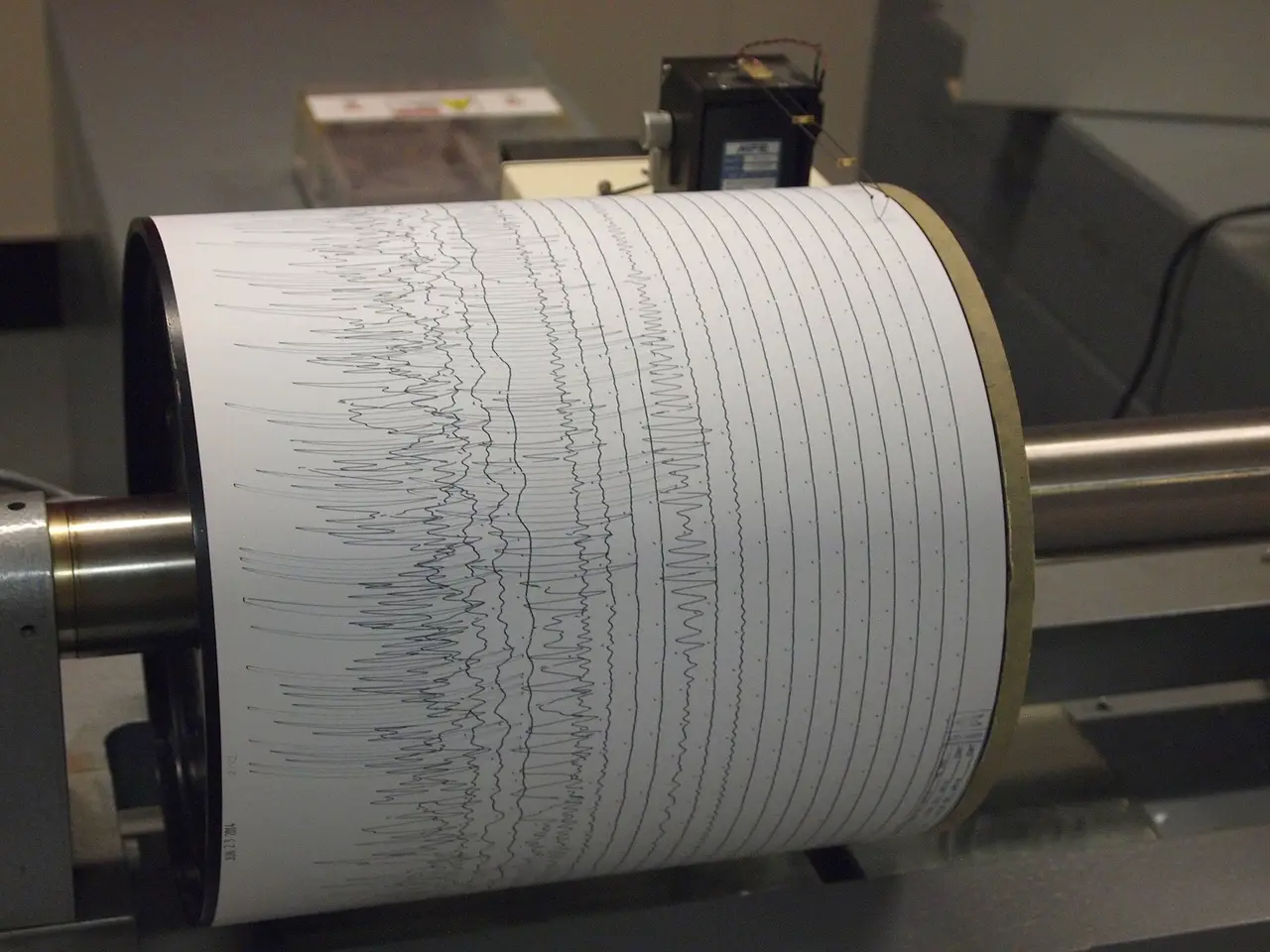
A paper-covered drum on a seismograph with rows of wavy ink traces, some rows swinging much wider than others.
PhotoA seismograph at Weston Observatory in Massachusetts records ground shaking on a rotating paper drum. Magnitude scales are built from the logarithm of wave amplitudes like these, which is why one step up in magnitude means a tenfold change in amplitude.Z22, CC BY-SA 3.0, via Wikimedia Commons
VideoA full JensenMath lesson for this course applying the logarithm laws to pH, sound intensity in decibels and earthquake magnitudes.Watch on YouTube

Growth, decay and half-life

Growth or decay at rate r, half-life h, and doubling time D. These models become solvable for time once you have logarithms: before, you could only ask how much is left after 20 hours; now you can ask how long until only 10 mg is left, and answer it exactly.
y = 0 (asymptote)y = 2ˣ growthy = (½)ˣ decayHalf-life staircase100502512.5
Fig 2Growth and decay curves: logarithms let you read the horizontal axis, answering how long rather than how much.

Worked examples

Reveal one step at a time and try to beat it to the next line.

Example 1
Solve , correct to three decimal places.
Example 2
Solve .
Example 3
Solve .
Example 4
An investment of 2500 dollars earns 4.5% per year, compounded annually. How long will it take to grow to 4000 dollars?

Where marks get lost

  • Skipping the domain check on a logarithmic equation and reporting an extraneous root as a solution. Every candidate must be tested against the original arguments, and rejected roots must be named.
  • Automatically rejecting any negative candidate. What has to be positive is the argument, not — in the root works, and a negative root would too if it kept positive.
  • Taking the logarithm of individual terms in a sum. From you cannot write ; first isolate the power as , then take logarithms of both whole sides.
  • "Cancelling" a logarithm instead of converting: from , writing rather than .
  • Using instead of as the base in a growth model, or mismatching the time units of and the rate (a monthly with an annual rate).

Flashcards 10

Solving an exponential equation with no common base
When to match bases instead
First step in any logarithmic equation
Extraneous root
+ 6 more

Practice

1
Solve , correct to three decimal places.
2
Solve .
3
Solve by matching bases. Give as a fraction.
4
Find the pH of a solution with mol/L, to two decimal places.
5
A sound has intensity W/m². Find its sound level in decibels, to one decimal place. Use W/m².
dB
6
An earthquake of magnitude 8.1 compares to one of magnitude 6.1 how?
7
A 160 g sample has a half-life of 8 days. How many days until only 10 g remains?
days
8
Solve , correct to three decimal places.
9
How many years does it take for an investment earning 6% per year, compounded annually, to double? Give your answer to two decimal places.
10
When solving , the algebra produces and . Which roots are acceptable?
11
Order the steps for solving .
  1. 1Reject x = 1 as extraneous (it fails x > 4) and accept x = 5
  2. 2Solve the quadratic x² − 6x + 5 = 0 to get x = 1 and x = 5
  3. 3Verify in the original: log₃ 3 + log₃ 1 = 1 + 0 = 1
  4. 4State the domain: x − 2 > 0 and x − 4 > 0, so x > 4
  5. 5Condense with the product law: log₃((x−2)(x−4)) = 1
  6. 6Convert to exponential form: (x−2)(x−4) = 3
12
Solve .

Spot a mistake on this page? Let us know